


A Belarusian woman suffered terrible abdominal pain attacks for two years. The cause turned out to be quite rare
Yulia Semchanka, a fitness trainer, author of ethnic tours to Podlachia, and wife of former political prisoner Dzmitry Semchanka, who now works as a presenter at Belsat, revealed that she was admitted to a Polish hospital. But she hopes that she has finally resolved the problem that was hindering her life.

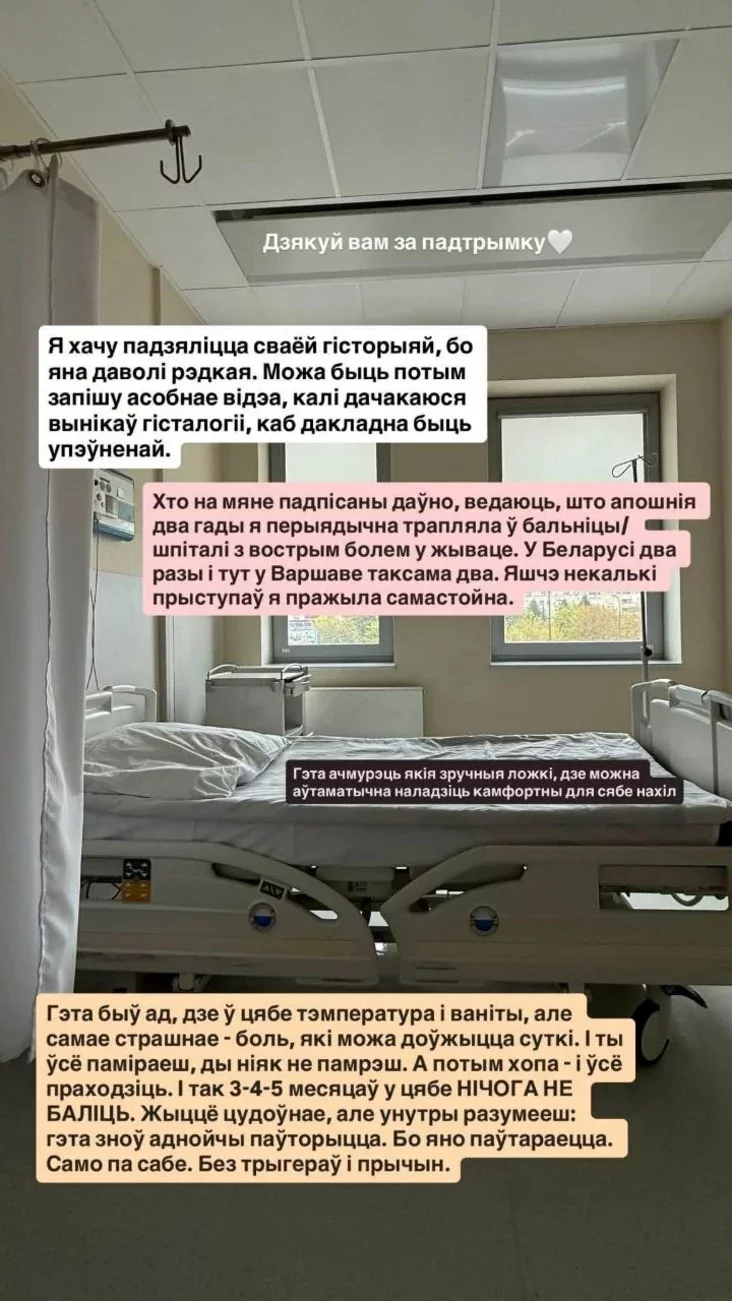
Yulia shared the story of her troubles on social media. She said that for the past two years, she had periodically suffered from terrible abdominal pain attacks.
Because of this, the woman was hospitalized twice in Belarus and twice in Poland. She endured several other attacks on her own.
"It was hell, where you have fever and vomiting, but the worst is the pain, which can last for a day. And you keep dying, dying, but never quite die. And then suddenly — hop! — and everything passes. And so for 3-4 months nothing hurts. Life is wonderful, but you understand: it will happen again someday. Because it repeats itself. On its own. Without triggers or reasons."
Of course, Yulia tried to find out what was happening to her: she underwent MRI, CT, ultrasound, FGDS, enterography, genetic tests... She even turned to a psychiatrist, thinking she was going crazy.
While still in Belarus, one of the doctors in a private medical center suggested that it might be recurrent appendicitis.
But this seemed unbelievable to Yulia: "I didn't even consider it then, because we're all used to thinking that it can only happen once — and there are two scenarios. Damn, appendicitis! And so it happens: it can become inflamed and then subside, but only for a certain time. I was just lucky that when I felt better, it wasn't because it had burst."
The Belarusian woman compared her hospitalizations in her homeland and in emigration. She says that in Belarus, the ambulance came to her without problems and took her to the hospital just as easily. In Warsaw, the ambulance came twice, once refused, so she had to go to the emergency hospital herself — there they prescribed some medication for irritable bowel syndrome and sent her home.
The last time the ambulance arrived, the medic asked why Yulia hadn't gone to the emergency hospital herself. That time Yulia rated her pain at 9 out of 10, but heard: "The lady doesn't even look like a 7." The Belarusian woman says she no longer even had the strength to cry out in agony.
As a result, she was still taken to the hospital, and the staff there were truly caring.
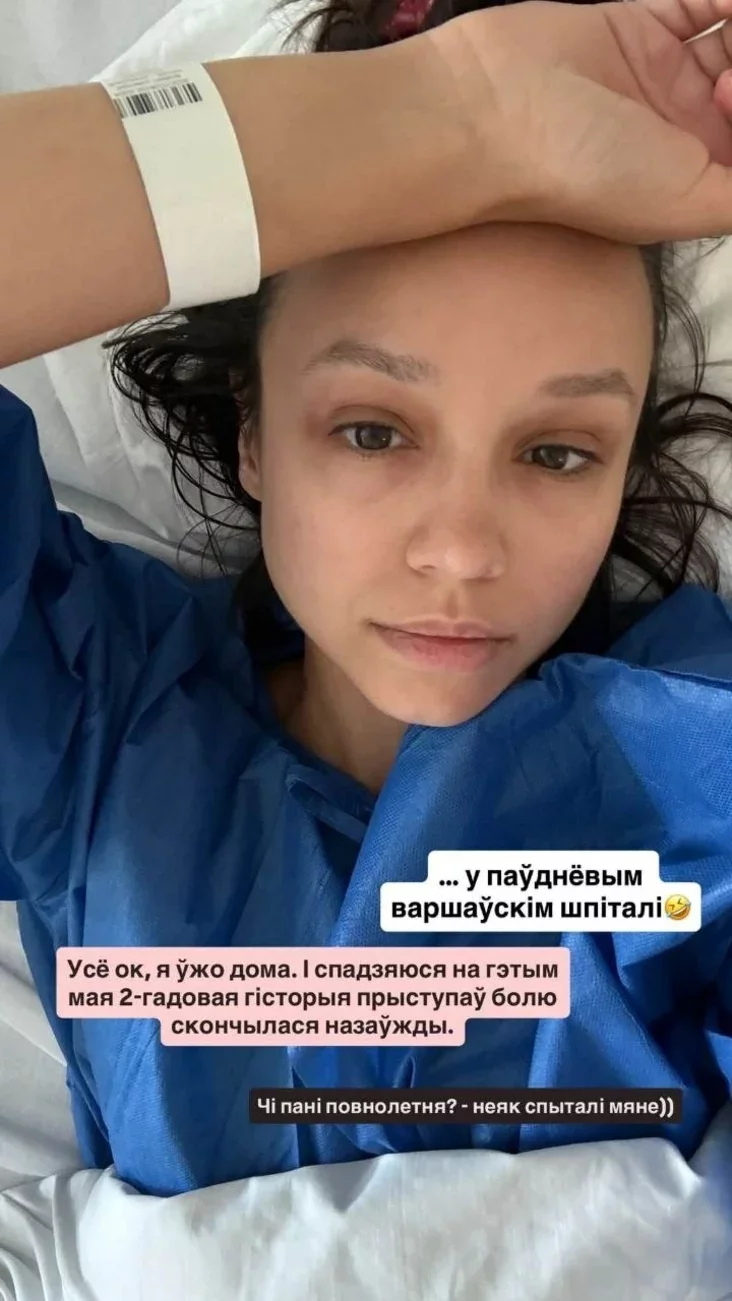
"Not for a minute did I feel abandoned, they often approached me and asked if everything was alright. They take blood — they say thank you (to me!), they do an examination — again thank you (to me!)."
Yulia notes that she felt very comfortable in the hospital. Not once did she hear a raised voice, no quarrels, nor did she see sour faces. She admits that she thought a lot about Belarusian medicine and doctors, about the conditions in which they work. She says she would really like it if it were the same in her homeland, where all employees have decent salaries and good conditions.
"In Belarus, I encountered good doctors in the hospital, very gentle gynecologists. I am grateful to them that despite everything, they maintained humanity and empathy. But the rest of the medical staff varied greatly; I saw how nurses shouted at the elderly for their groans. How one was simply torn apart because she was asked to close the window in the ward."
Yulia admits that when she was asked if she would agree to surgery and appendectomy, she smiled — because she very much wanted the suffering to end.
After the anesthesia, she was woken up with the phrase: "Pani Yulia, how do you say 'good morning' in Belarusian?" She notes that it was very sweet: "I had to speak Polish in that state, to not fall asleep, with Dr. Janrzek, and I even received a compliment that I have good articulation."
Now Yulia is awaiting the histology results, but hopes that the two-year history of suffering has finally come to an end.


Comments