


Deputy Klishchevich became a Candidate of Historical Sciences with a dissertation on the disintegration of the Belarusian Komsomol during "Perestroika"
Sergei Klishchevich received a scientific degree for his research on the processes of commercialization and political decline of the Soviet youth organization during the Perestroika period. In it, the deputy writes how the nomenclature exchanged ideology for commercial profit and completely lost the struggle for the minds of the youth.
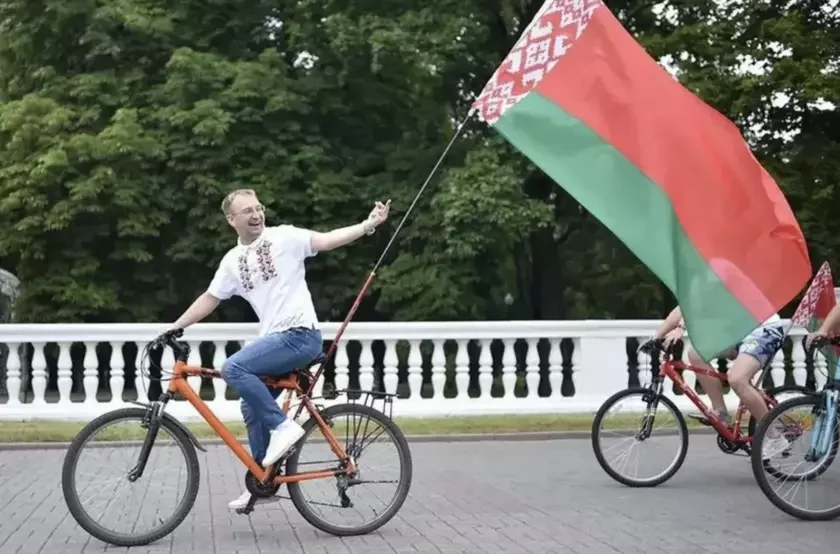
The defense of the deputy's scientific work titled "Komsomol of Belarus in the conditions of transformation of Soviet society (1985—1991)" took place on May 28 in the building of the Faculty of Law of BSU, and now Sergei Klishchevich has been officially awarded the scientific degree of Candidate of Historical Sciences.
The scientific supervisor of the newly minted candidate was the Dean of the Faculty of History, Alexander Kahanouski, known for his participation in political expulsions of students.
In his dissertation, Klishchevich actually tells how the Soviet system completely lost the struggle for national history.
The collapse of ideology before the thirst for history
In a separate chapter of his dissertation, Sergei Klishchevich thoroughly analyzes the process of the Komsomol losing its monopoly on working with youth in the late 1980s.
According to the text of the abstract, the democratization of socio-political life in the Soviet state provoked active self-organization among citizens. Numerous informal associations based on interests emerged, whose activities were no longer controlled by party-Komsomol bodies.
To maintain its influence, the LKSM of Belarus began to take measures to build interaction with representatives of these youth movements. As Klishchevich writes, official structures achieved the greatest success only in working with sports and musical formations.
However, independent associations with a historical and cultural focus became an insoluble problem for communist functionaries. These groups, as Klishchevich writes, evaded constructive dialogue with the LKSM of Belarus. The author of the dissertation attributes the main reason for such a boycott to a fundamental divergence of political views.
The desire to study national history quickly politicized the activities of historical and cultural associations. This radicalization, according to the researcher's conclusions, directly contributed to the formation of new youth structures that moved into harsh opposition to both the Komsomol itself and communist party bodies in general.
This process unfolded against the backdrop of decentralization of the state apparatus and a general weakening of the influence of the Communist Party of Belarus. The introduction of alternative elections in 1989-1990 showed the complete unpreparedness of Komsomol proteges for independent political activity in conditions of real competition with opposition national forces. As a result, the representation of Komsomol members in Councils of various levels sharply decreased, and the organization finally lost the ability to influence state decision-making.
Creation of the "Komsomol economy" and financial irregularities
The second stage of Komsomol activity during the Perestroika period, which began in the second half of 1988, was characterized by a complete rejection of traditional ideological and moral methods of youth stimulation.
Sergei Klishchevich notes in his work that with the introduction of self-financing principles into the economy, socialist competitions and ideological slogans finally ceased to work. Instead of striving for diplomas and plan fulfillment, the main direction of the LKSM of Belarus's work became total commercialization.
The main tool for the Komsomol's transition to self-financing and self-sufficiency was centers for scientific and technical creativity of youth. Their rapid development was facilitated by unprecedented support from party-Soviet bodies. Komsomol commercial enterprises received significant benefits, the main ones being complete exemption from income tax, as well as from customs duties and fees.
These preferences led to a rapid growth of business structures under the aegis of the LKSM of Belarus. Self-financing youth cafes, cooperatives, and joint ventures began to be massively created in the republic.
The deputy cites specific figures: by 1991, about 25,000 people worked in Komsomol commercial organizations. The total earnings of these structures exceeded 103 million rubles, which allowed for officially stating the formation of an entire sector of the "Komsomol economy" within the national economy of the BSSR.
Initially, the leadership of Komsomol bodies viewed commercialization as a source of funding for the organization's statutory activities in conditions of deteriorating financial situation. However, in practice, this plan failed. The dissertation notes that the LKSM of Belarus lacked effective tools to control its own self-financing enterprises. This led to systematic financial irregularities in their functioning.
As a result, commercial structures completely separated from their founders and disengaged from providing financial assistance to the Komsomol in organizing work with youth.
What Sergei Klishchevich is known for
Before beginning his scientific career, Klishchevich worked as the first secretary of the Minsk City Committee of the BRSM and an ideologue of the Minsk City Executive Committee. As his former university colleagues recalled, his managerial experience was largely based on virtual indicators and inflating the number of organization members through document manipulation.
In 2019, Klishchevich became a deputy of the House of Representatives from the Communist Party, and in 2024 he went for a second parliamentary term.
In the public space, the parliamentarian was noted for a physical altercation with activist Zmitser Dashkevich near the Lenin monument in 2016 and for showing an indecent gesture to motorists on Independence Avenue during the protests in August 2020. He formulated his approach to historical memory in a proposal to send IT sector employees with shovels to the Khatyn memorial complex for forced labor and spiritual education.
Having built his career on an aggressive state monopoly on the minds of Belarusian youth, Klishchevich himself, in his dissertation, showed its unviability in the face of real economic crises and national awakening.
«Nasha Niva» — the bastion of Belarus
SUPPORT USNow reading


RIA Novosti published a column stating that Russia is facing another 'SMO' — with Lithuania. It was later deleted with the note 'Does not comply with state policy'

RIA Novosti published a column stating that Russia is facing another 'SMO' — with Lithuania. It was later deleted with the note 'Does not comply with state policy'

Unfortunate Man from Lyakhavichy Disappeared "in the SMO" on the Third Day, While Sister, Cohabitant, and Wife — with Four Children, but Not His Own — Clashed over Funeral Payments

Unfortunate Man from Lyakhavichy Disappeared "in the SMO" on the Third Day, While Sister, Cohabitant, and Wife — with Four Children, but Not His Own — Clashed over Funeral Payments
A Belarusian woman translated for the President of Ecuador, worked as a flight attendant, and now opened her own language school "Russian with a Russian Woman" in Mexico

A Belarusian woman translated for the President of Ecuador, worked as a flight attendant, and now opened her own language school "Russian with a Russian Woman" in Mexico


Deputy Klishchevich became a Candidate of Historical Sciences with a dissertation on the disintegration of the Belarusian Komsomol during "Perestroika"


Comments