


A Mathematician in Love with the Belarusian Language and a Priest Who Learned English from Agatha Christie's Detective Novels. 100th Birthday of Alyaksandr Nadsan
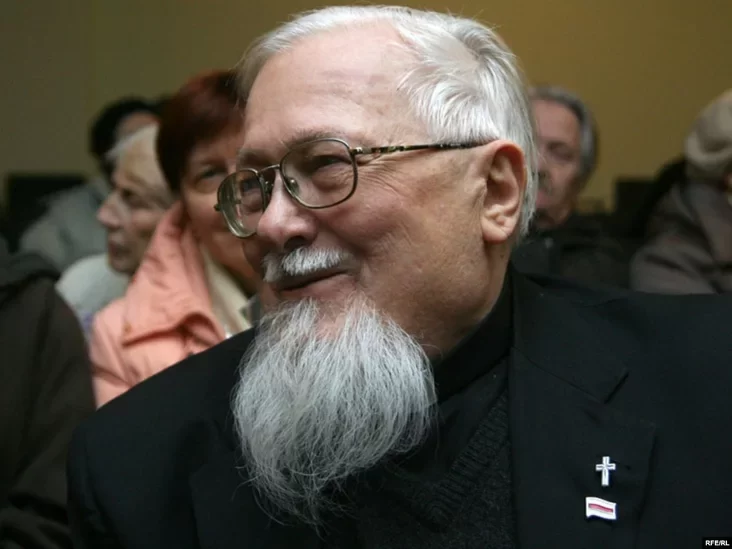
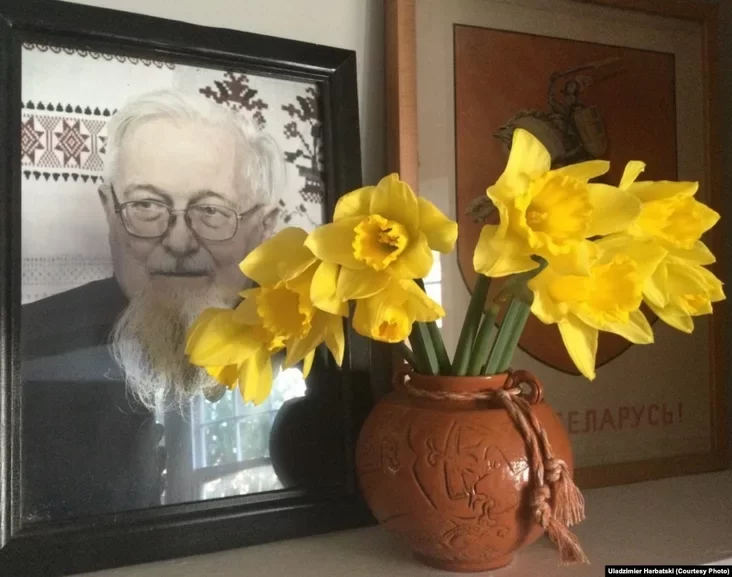
August 8 would have marked the 100th birthday of Alyaksandr Nadsan — an outstanding Belarusian enlightener, a Greek-Catholic priest, and the founder of the Francis Skaryna Belarusian Library and Museum in London. The London-based 'Skaryna' publishing house is releasing a book by Uladzislau Harbatski about the renowned Belarusian. Radio Svaboda spoke with the author of the book and learned previously unknown facts
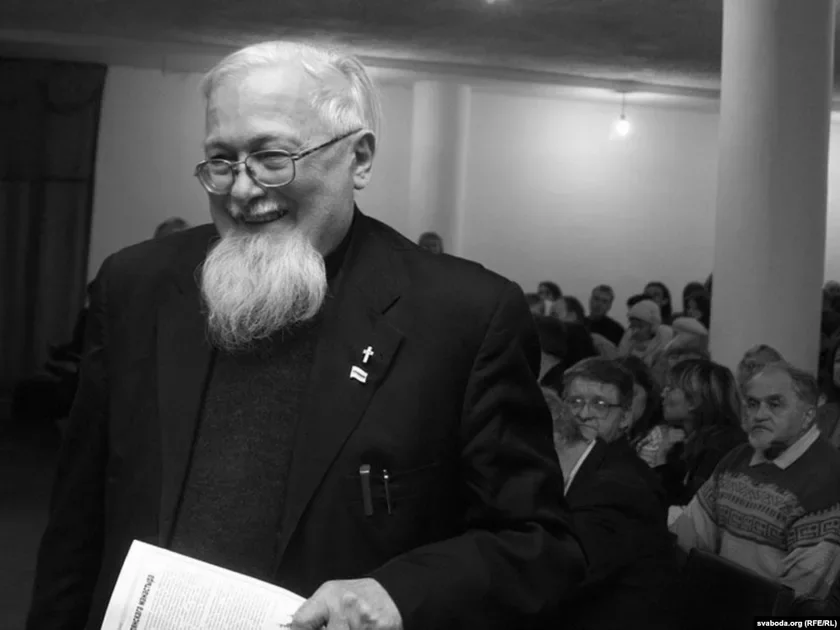
Writer and historian Uladzimir Arlou, in his 'Names of Freedom,' called Father Alyaksandr Nadsan (real surname — Bochka) an exemplary priest and patriot. A man who 'dreamed of Belarus' his entire life and left an enduring testament: 'At all costs, we must remain Belarusians.'
Uladzislau Harbatski's new book, dedicated to Alyaksandr Nadsan's intellectual legacy, is, as the author himself describes it, 'an intellectual portrait of a London Belarusian.' The author and publisher tried to release it precisely for Father Alyaksandr's centenary, but did not manage to. For now, the working title of the publication is 'Portrait of a London Belarusian. Meanings of Exile of Father Alyaksandr Nadsan' — this is how writer and EHU Associate Professor Uladzislau Harbatski presents his research.
Language as a Second Religion
In 2019, Karalina Matskevich, a member of the Skaryna Library's Board of Trustees, approached Uladzislau Harbatski. She proposed writing a book for Father Alyaksandr Nadsan's jubilee, the researcher recalls.
'I was surprised at first, thinking that people who knew Nadsan better should write the book: Karalina Matskevich, Iryna Dubianetskaya, Ihar Ivanoŭ, Natallia Hardziyenka themselves. But they decided that the book should be written by someone less emotionally connected to Father Alyaksandr.
Karalina knew of my fascination with Father Alyaksandr. As an EHU student in Minsk in the late 1990s, I read many of Father Nadsan's articles; I was very sympathetic to his critical approach in reviews, his strong interviews, and his arguments for the Belarusian language. He was a priest, but it wasn't this aspect that captivated me, rather the linguistic aspect, I would say, his sociolinguistic explanations of the marginality of the Belarusian language. I agreed, but immediately understood that it was both an honor and a responsibility,' says Harbatski.
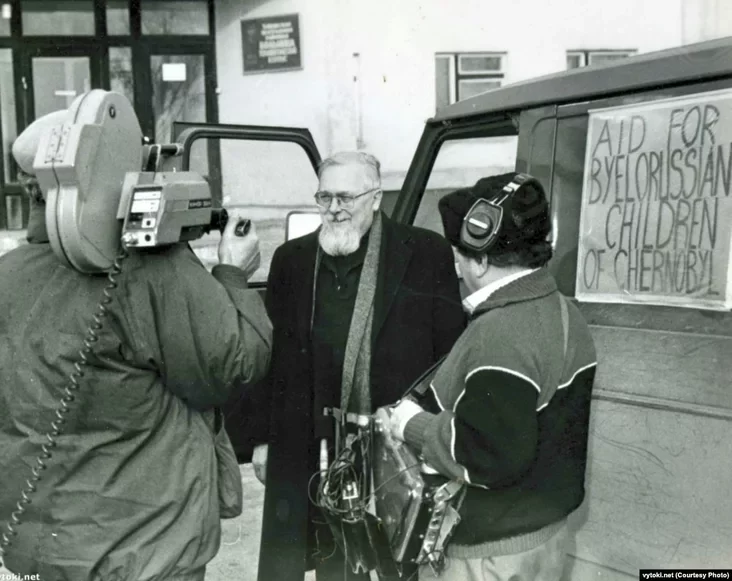
He collected materials for the book since 2019, and for the last year and a half, he wrote intensively to complete the work by the 100th anniversary. He consulted, clarified many points and topics in which he was not a specialist.
'For instance, about Nadsan's priesthood, as he was first and foremost a priest. He himself wrote that 'this is my primary hypostasis, identity, I chose this.' And for many, Father Nadsan was primarily a priest.
But for many, he was primarily a Belarusian studies scholar. London Professor Arnold McMillin said of Nadsan that 'he was the greatest Belarusian studies scholar of the century.'
It was important to combine these two hypostases.
I met Father Alyaksandr already towards the end of his life, meeting him three times before his death. We connected specifically on the language issue; for Father Alyaksandr, it was very important: for him, a person who speaks Belarusian was his friend. For Father Alyaksandr, language was a second religion,' the author of the book recalls.
Two Television Boxes
For 6 years, Uladzislau Harbatski studied Nadsan's legacy, collected interviews, and worked in archives. In the Skaryna Library in London alone, the subject of his book had several thousand letters — two large boxes from under televisions.
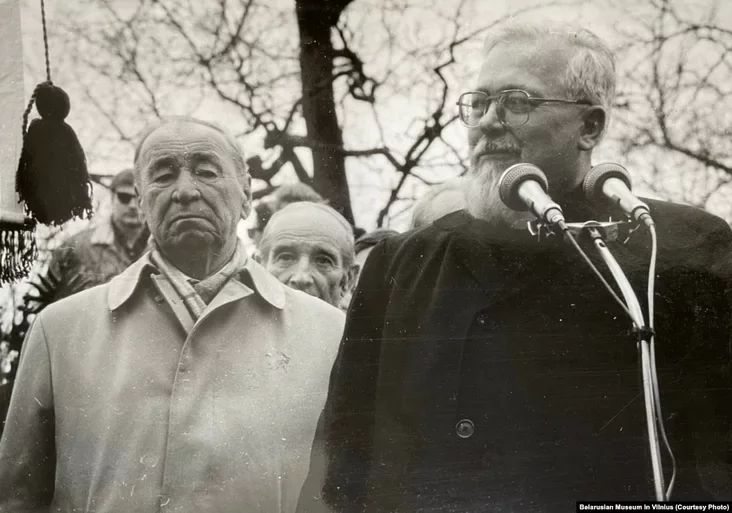
'This was an era before the internet, and people corresponded on paper. I call Nadsan in the book the last Belarusian epistolary writer. He corresponded with Belarusians all over the world, with Belarusian studies scholars in New Zealand, Australia, Israel, France. All this correspondence is stored at Skaryna Library, but it was not systematized. I came to London twice to organize it and, of course, to use this valuable material. I collected 116 folders, each folder representing one person,' Harbatski recounts.
The researcher was particularly struck by Nadsan's correspondence from 'Soviet times,' in the 1960s-70s, with the Academy of Sciences of the BSSR.
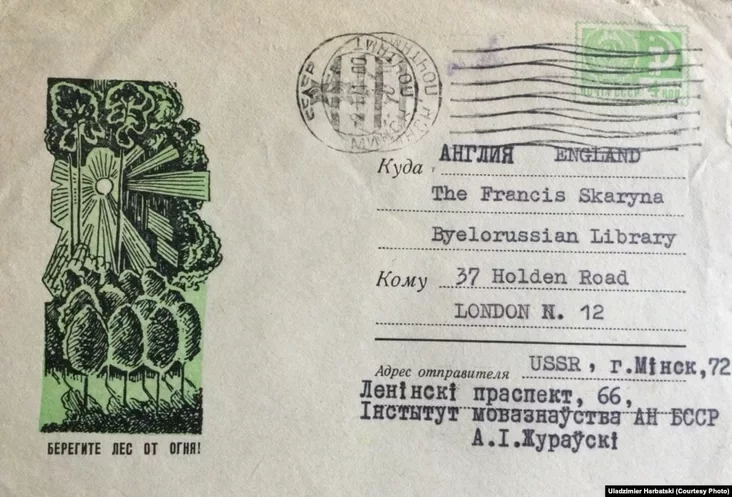
'Alyaksandr Nadsan wrote letters to Belarusian Professor Arkadz Zhurauksi (who worked at the Institute of Linguistics of the Academy of Sciences of the BSSR), stating that books were being published in English in Belarus and the USSR, but 'you are transliterating surnames and geographical names incorrectly,' sending the rules of the International Linguistic Association and showing how it should be done. This problem is relevant even today — we see what the authorities are doing. Nadsan did not remain silent even then. And he highly praised the then very young scholar Valiantsina Lemtsiuhova, who took on this task. Nadsan wrote very delicately but persistently — he always sought dialogue,' Mr. Harbatski emphasizes.
Valiantsina Lemtsiuhova became a professor, an outstanding linguist, and with her direct participation, the Law on Geographical Object Names was adopted, which legally established the practice of primarily assigning names to geographical objects in the Belarusian language, their transliteration into Latin script, and also into other languages.
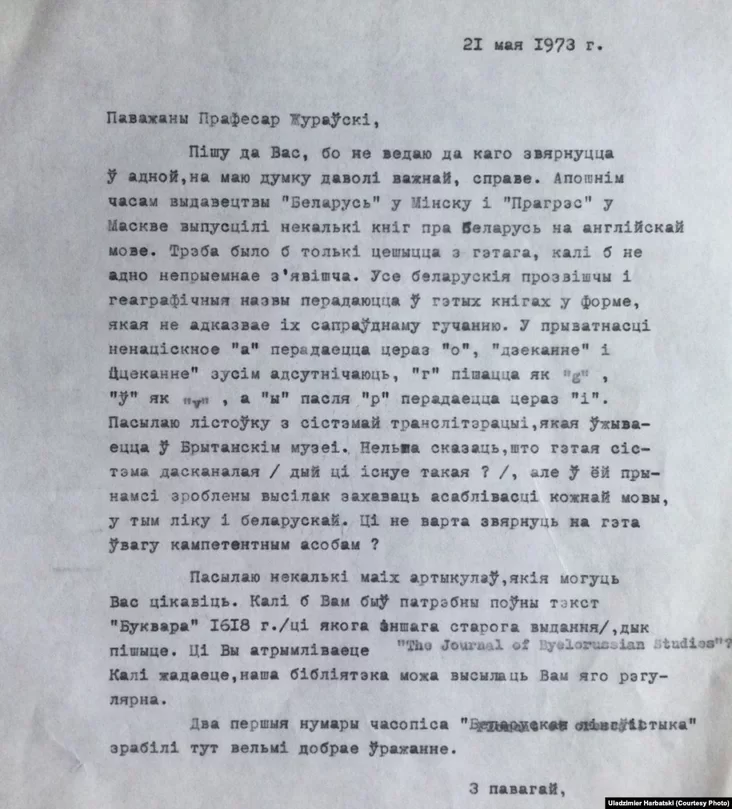
Alyaksandr Nadsan wrote to Professor Zhurauksi: 'All Belarusian surnames and geographical names in these books are rendered in a form that does not correspond to their true pronunciation. Specifically, unstressed 'а' is rendered as 'о', the 'dz' and 'ts' sounds are entirely absent, 'г' is written as 'g', 'ў' as 'у', and 'ы' after 'р' is rendered as 'і'. I am sending a leaflet with the transliteration system used at the British Museum. It cannot be said that this system is perfect (and does such a thing even exist?), but it at least makes an effort to preserve the peculiarities of each language, including Belarusian. Isn't it worth drawing the attention of competent persons to this?'
'Interviews Had to Be Done Quickly, as People Were Passing Away'
Another significant part of Harbatski's work was in the archives — with newspapers, magazines, and numerous texts by Father Alyaksandr, written in various languages: English, Italian, French, German.
According to the researcher, Nadsan was a person of 'Renaissance culture, a true enlightener, one of a kind.' There were also many interviews with people who knew Father Nadsan.
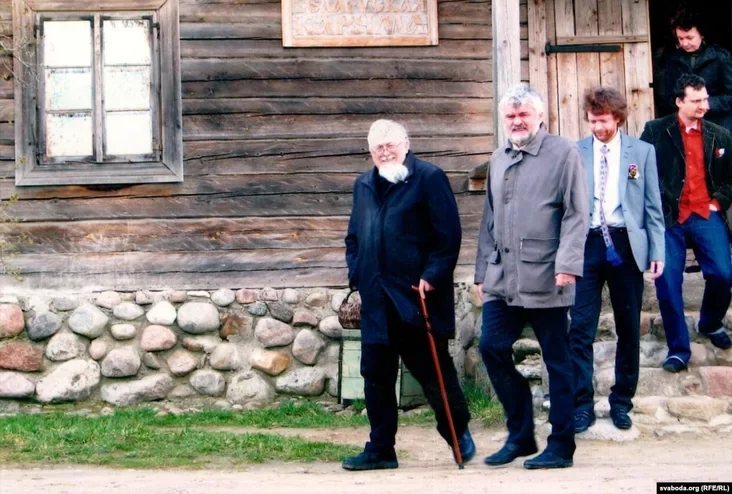
'I understood that interviews had to be conducted quickly, as people were passing away. I conducted over 40 in-depth interviews with people who knew him. Some refused, some promised me and, unfortunately, passed away. This happened with Adam Maldzis, who died in 2022. It also happened with Alyaksei Kaŭka, who lived in Moscow (first COVID interfered, then he fell ill and died in 2024). But many texts by these people, published memoirs, and correspondence with them have been preserved.
Unfortunately, the correspondence is included in the book only through quotes, as there are thousands and thousands of letters. We decided that after this biographical book, we would prepare separate books of Father Alyaksandr's correspondence with Belarusians, as well as with foreign researchers: Britons Jim Dingley, Arnold McMillin, the prominent American-Ukrainian linguist Yuriy Sherykh, and others,' the author of the book explains.
9 Languages
Uladzislau Harbatski emphasizes that despite all this, Father Nadsan was not a professional linguist. By his first higher education, he was a mathematician — he graduated from the Faculty of Mathematics at the University of London in 1953. But then he chose the priesthood. In Rome, at the Greek College, he received a thorough humanitarian education, becoming a Master of Theology. In 1958, he received priestly ordination.
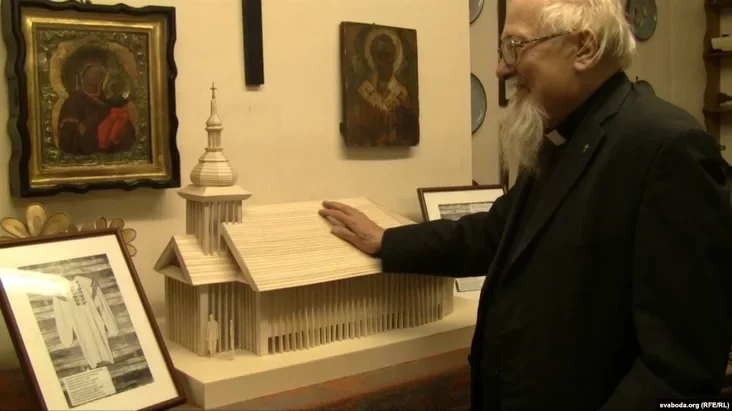
'Father Alyaksandr knew 9 languages. He was a historian, a literary critic, a translator, and a Kitabist — standing at the origins of Kitabistics (the study of texts by Tatars of the Grand Duchy of Lithuania. — RS). He found texts written by Belarusian Tatars in the Tatar language; this is valuable material. Nadsan learned Tatar and Turkish languages — he was forced to become a Kitabist. 'If it's necessary, I'll learn these languages too,' he decided. This was impressive.
He was an excellent historian (and not just a historian of religion). Hienadz Sahanovich, Natallia Hardziyenka, Dorota Michaluk, and Yauhen Mironovich all draw attention to this. He was a critical historian who could switch off his priestly function and activate rational approaches and the function of a researcher.
Nadsan was also an excellent literary critic. By the way, he improved his English thanks to Agatha Christie's detective novels when he moved to the West,' says Mr. Harbatski.
He adds that Father Nadsan very often demonstrated himself as a literary detective — he also writes about this in the book.
'He conducted his research and criticized many Soviet and Belarusian literary critics for presenting information 'ideologically incorrectly.' For example, when Maksim Bahdanovich's works were re-published in the BSSR, he pointed out the errors made as soon as the books were released.
'BSSR researchers concealed information about Maksim Bahdanovich's correspondence with certain figures considered 'bourgeois.' And instead of the surname, they often put the letter 'X' or some abbreviations. But Nadsan exposed this and said that this and that surname should be here (Ales Harun, Maksim Horecki, Mikhas Zaretski, etc.),' Uladzislau Harbatski ironizes.
'Machinations' for Transferring Texts from Soviet Belarus
During Soviet times, Father Alyaksandr contributed to samizdat, to the creation of clandestine channels through which manuscripts from the Soviet Union, from the BSSR, were transmitted to the West and then printed there.
For example, in this way, Alyaksei Kaŭka's famous text 'Letter to a Russian Friend' was published. This is a well-known polemical essay by the Belarusian historian, literary critic, and public figure Alyaksei Kaŭka, written in 1976-1977. The text is dedicated to the acute problem of the status of the Belarusian language, Russification, and the violation of linguistic rights in Soviet Belarus, as well as the delineation of Belarusian and Russian cultural and national identities.
'Father Alyaksandr Nadsan and Yuriy Turonak created entire 'machinations,' schemes on how to transfer texts from Belarus, from the USSR, to the West — via diplomatic mail, sending them to third parties in Switzerland, and then collecting these documents from there. This is an interesting topic that is often ignored. They say, what is Belarusian dissidence? It cannot be compared to Polish, Lithuanian, or Ukrainian. Indeed, it cannot be compared. But it existed. And Father Alyaksandr Nadsan, who helped publish those texts, was involved in this story. Tatsiana Astrouskaya, a contemporary historian, wrote about this in her recent publication,' Uladzislau Harbatski relates.
He adds that these are such droplets, pearls, of which there are many in the new book. And it promises many revelations for the general public.
The book 'Portrait of a London Belarusian. Meanings of Exile of Father Alyaksandr Nadsan' is expected to be released in early autumn in London. It will be available for purchase online.
Now reading


Unique photos of the construction of the Old Bridge in Grodno. Who photographed the dangerous caissons in which people risked their lives at the bottom of the Neman to place the supports? MANY PHOTOS


Comments