


"I can't convey how much everyone here loves children." A Belarusian woman shared her experience of giving birth in Argentina
Ksenia shared with Radio Svaboda what makes pregnancy care and childbirth in this country unique.

Argentina has become a popular destination where couples come to give birth and then can stay to live. In Ksenia's story, everything happened in reverse. She came to Argentina convinced that she would never give birth again. But she met a man, fell in love, got married, and recently the couple had a baby girl.
Ksenia* (name changed), a Belarusian woman, moved to Argentina a year and a half ago. She moved for her daughter's education, as her daughter chose a university there.
Her friends then asked her if Ksenia was pregnant or if she was crossing the ocean to give birth. Because Argentina is a popular destination for coming and giving birth there (birth tourism). The baby immediately receives Argentine citizenship by birth. This also gives grounds for parents to legalize their stay in South America over time. However, Ksenia was convinced that she had already closed the chapter on having children. She has older children whom she gave birth to in Belarus. Moreover, giving birth to another child would have been dangerous for her health.
However, after moving, the Belarusian woman started dating an Argentine man. The man said he dreamed of a family and children. Ksenia initially told him that she no longer planned to have children and that perhaps it would be better for them to go their separate ways. But the couple decided that staying together was more important to them. Love is the reason Ksenia gives for changing her mind.
"It's just so great there, it feels like a completely different vibe. When I saw him (my husband) and heard him talk about it (children), I wanted it more and more. We decided: 'Let's try, maybe it won't work out'," the interviewee recalls.
Soon, the couple became pregnant. Recently, Ksenia and her Argentine husband had a daughter.
Fewer tests and examinations
She notes that there is no obligation to register for pregnancy care in Argentina. "It's all up to your conscience," she says.
Overall, in the interviewee's opinion, the attitude towards pregnancy in Argentina is more relaxed than in Belarus.
"Everything here is very friendly, gentle, with smiles, with support. Women are never frightened here. Unlike before: if you didn't do some test, you'd be lectured like a first-grader," she compares the approaches in Argentina and Belarus.
Ksenia recalls talking to an Argentine woman who was pregnant for the third time. And she couldn't answer the question of how far along she was because she simply wasn't keeping track.

"Most likely, she went to the doctor once or twice, or maybe not at all," the interviewee speculates.
Ksenia herself, she says, visited gynecologists about once a month, and closer to childbirth, once a week. The woman notes that she was never examined on a gynecological chair throughout her entire pregnancy.
"Here, no one will examine you unnecessarily. Once, when I found myself on the chair, they took a swab from me, closer to childbirth. I didn't climb onto that chair with my legs up, but just lay on the edge. The swab was taken without me removing my underwear. She carefully moved (the clothing) with the words 'Allow me,' wiped with a stick, and that was it," the interviewee describes the procedure.

She notes that in Argentine hospitals, fewer tests are required during pregnancy than in Belarus. They are prescribed only when there is a reason, some complications.
"There's no such thing as having to see all specialists, a full check-up twice during pregnancy. It seems that this is not bad. But for us, it's mostly a formality. It just takes time. I remember there was just a stack of papers for blood tests," the Belarusian woman compares.
The interviewee notes that the Argentine approach is closer to her. When she needed it and consulted a doctor, they prescribed additional examinations for her. For example, for toxoplasmosis (an infectious disease of humans and animals), because they have cats at home.
Ksenia says that she was monitored in a polyclinic and then gave birth with medical insurance she has thanks to her husband's job. Almost all medical services in this case were free for her. Some women in Argentina choose to give birth not in private but in public hospitals, because medical care there is also of good quality. Moreover, it is free.
If there is no insurance, then for pregnancy and childbirth, medical services in private hospitals can cost about five thousand dollars.

"There (in public hospitals), maybe the food isn't as good, no desserts or simpler desserts. But in terms of medicine, everything is at the same level," the interviewee compares private and public healthcare.
Ksenia only paid for choosing a specific doctor and midwife who attended the birth: about $200 and $100 respectively. She says it's a tradition to tip medical professionals certain amounts, according to their rates. The maximum fees she heard of were $500-600. According to her, hospitals don't hide this and don't make it a secret.
Ksenia gave birth at the age of 39. She says no one told her that this was a late age to give birth.
At the same time, she saw more pregnant women her age than younger ones. And such an age is considered normal in the country to become a mother.
Husband at birth — the norm
The role of the husband or partner in Argentina is important, Ksenia continues her story. Usually, couples give birth together. If a woman gives birth alone, it's more of an exception. You can also bring not only your husband but also other close people, a friend, to the birth. Several of them can be present at the same time. But this is usually allowed only in private hospitals. In any hospitals, not just maternity wards, there are usually sofas or chairs for those accompanying the patient.
"There are no restrictions on people visiting you. For us (in Belarus, the maternity ward) it's a closed space, here it's open," says the Belarusian woman.
Ksenia explains that in Argentina, it is not customary to go to the maternity hospital in advance. In prenatal classes, they were taught to wait out the first contractions at home. To go only when they occur every five minutes. Ksenia needed a planned C-section, but she still went to the hospital directly before the birth.
"I arrived at the hospital doors. They saw I was pregnant. They immediately put me in a chair and wheeled me away. They asked for my documents and went to the delivery room," the interviewee recalls.
Her husband was with her almost the entire time, Ksenia says, sitting in a chair by her head. He was only asked to leave the room for 15 minutes while they prepared for the operation. The interviewee says that the woman's body is almost completely covered during a C-section. Only the area where the incision will be made is left open. The operating area is also shielded by a curtain.
In her case, the operation took about two hours because she experienced severe bleeding, and an additional surgeon was called. In the end, everything went well. During the birth, the medical staff themselves took photos and videos of the process on their phones for the family to remember.
"They try their best to give parents magical moments," the mother shares.
Children's names on the ward doors
After birth, the baby was with the parents the entire time. The husband stayed with his family in the room all the days until discharge.
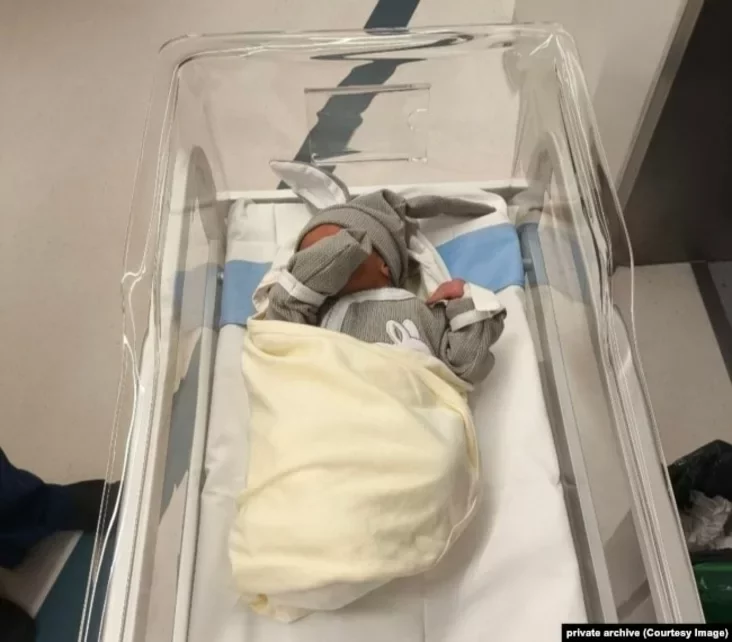
"They started preparing the child's birth certificate when I came to the operating room. I'm sitting on the operating table, and they're asking me what the name will be, and for my fingerprint. Here, on the birth certificate, parents put their fingerprints and the baby's footprint," the young mother says.
She notes that in the maternity documents, her name was always written first, and the child's father's name second.

The interviewee points out that in Argentine hospitals, a child is given more subjectivity from birth. This is also manifested in the immediate issuance of a birth certificate with a name. On the door of the ward, at the parents' request, the child's name is also written.
"They (the medics), when they go into the ward, look at the child's name and address them by name: 'How's Catalina?'"
After giving birth, mothers stay in the hospital for several days. Ksenia noticed that Argentine medical staff have well-developed skills in caring for women who cannot yet walk.
"They moved me from the couch to the bed, turned me, washed me. It feels very practiced, efficient, organic, with minimal effort, with care for the person being moved and for the specialists doing it," says the interviewee.
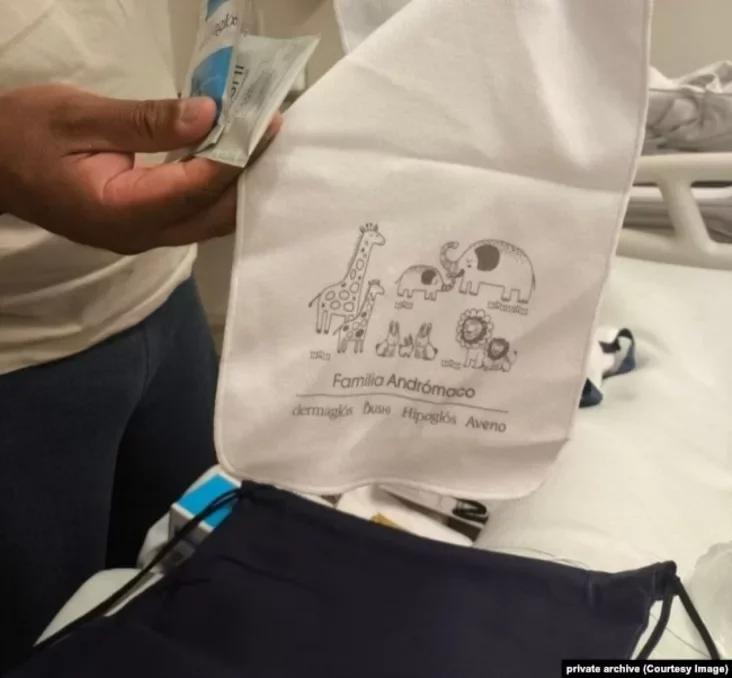
Ksenia says that in Argentina, babies are treated very kindly. Young mothers are congratulated by strangers on the street. She noticed this even when she was working as a nanny in Argentina.
"I can't convey how much everyone here loves children, how sincerely they express it, sparing no words or facial expressions," says the Belarusian woman.
She recalls that only once did she feel that those around them did not have such admiration for the child she was caring for. Instead, there was just a calm attitude. This was in a Russian-speaking cafe in Buenos Aires.
"I feel like something's off. And I can't understand what's different. And then I realize — no one there is admiring, no one is paying attention: they came and they came. In any other Argentine place, wherever you go with a child, everyone breaks into smiles. They'll definitely rock the stroller, ask a couple of questions. I really feel this contrast now. I told them about our traditions, that it's customary to say ugly words to a baby (to ward off evil eye. — RS). They were shocked. I don't think they believed me," the Belarusian woman recalls.
Now reading


A Young Belarusian Didn't Want to Serve Time in Russia for Drugs, So He Figured Out How to Quickly Get Out of the Colony — And Ended Up on Ukrainian Positions Near Pokrovsk


Comments