


Will Latvia allow Belarusian potash? We found out what Cole heard in Riga
Latvia welcomes US efforts to free Belarusian political prisoners, but sees no reason to ease pressure on Lukashenka's regime.
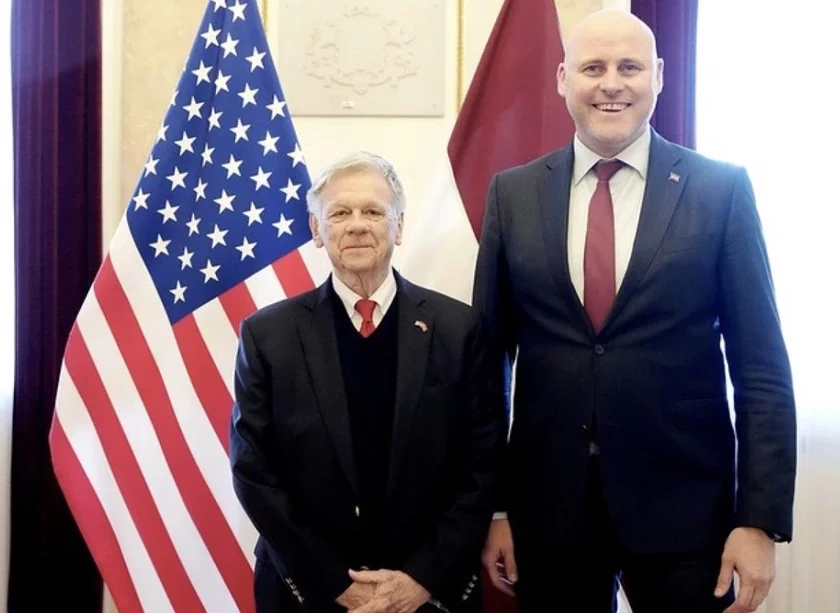
On September 17, Riga was visited by John Cole, the US President's Special Envoy for Belarus. He met with Latvian Prime Minister Andris Kulbergs, Foreign Minister Baiba Braže, and the leadership of the State Border Guard. During the negotiations, significant attention was paid to the security of Latvia's eastern border, illegal migration, which Latvian authorities consider an instrument of hybrid pressure from Minsk, and US efforts to free Belarusian political prisoners.
The day before, John Cole met with the leadership of Lithuania and announced a trip to Latvia so that, according to him, all parties could coordinate further actions. One of the possible topics of discussion was the transit of Belarusian potash.
"The potash fertilizer deal is in very good shape to get potash from Belarus to the US — that's what President Trump wants," The New York Times quoted the American diplomat.
"Riga's position remains unchanged"
Dzianis Kuchynski, Sviatlana Tsikhanouskaya's advisor on diplomacy, told Nasha Niva that he was in contact with Latvian colleagues on the day of Cole's visit.
Shortly before, he himself visited Riga and held consultations with the Chief Advisor to the Latvian Prime Minister on International Policy and representatives of the Ministry of Foreign Affairs. During those meetings, they discussed regional security, provocations by the Lukashenka regime, and support for Belarusians in Latvia and the European Union.

"Today, Latvian partners once again confirmed to me that Latvia's position remains consistent and unchanged. Riga welcomes the release of Belarusian political prisoners and highly appreciates the efforts of the United States and Special Envoy John Cole. We are interested in this diplomatic track continuing and leading to the release of all political prisoners," noted Dzianis Kuchynski.
At the same time, the Latvian side sees no reason to speak of significant changes in the policy of the Belarusian regime:
"Repressions continue, as does support for Russian aggression against Ukraine and hybrid pressure on EU countries. Therefore, Latvia's position regarding maintaining political and sanctions pressure remains unchanged. This also applies to economic pressure, including the potash issue."
Focus on the border situation
Regarding the content of the negotiations in Riga, Dzianis Kuchynski specifically noted that the Latvian side paid the most attention to illegal migration and the situation on the eastern border of the European Union:
"At the same time, it is important to emphasize: the central issue in the Latvian side's conversations with American partners was illegal migration and the migratory pressure that the Lukashenka regime continues to exert on Latvia and the eastern border of the European Union, not the issue of potash fertilizers."
The positions of Washington and Riga converge on the need to continue working for the release of Belarusian political prisoners. At the same time, Latvia considers it important to maintain leverage over the regime as long as repressions continue in Belarus, and Minsk supports Russian aggression and exerts hybrid pressure on neighboring countries.
Latvian Prime Minister Andris Kulbergs stated the necessity of maintaining sanctions pressure after his meeting with Cole. As reported by his office, Riga supports the preservation, expansion, and strengthening of EU sanctions against the Lukashenka regime.
Latvian Foreign Minister Baiba Braže announced after the meeting that the parties had agreed on practical steps to strengthen NATO's eastern border.
"For us, Latvia's position is an important signal: the release of people and dialogue for their release must continue, but this cannot automatically mean normalization of relations or easing of pressure. We must seek the release of all political prisoners and at the same time maintain leverage over the regime," summarized Dzianis Kuchynski.
People are being released, repressions continue
A new round of diplomacy is taking place immediately after John Cole's negotiations with Lukashenka. On September 16, 25 people were released from Belarusian prisons. In response, Washington agreed to lift US sanctions on "Bellesbumprom" and the "Lakokraska" enterprise. Cole also stated that another hundred or more people could be released within a month.
Meanwhile, according to human rights activists, almost 900 political prisoners remain in Belarusian prisons. Sviatlana Tsikhanouskaya, meeting the released in Vilnius, noted that individual releases cannot be perceived as a sign of political change: repressions in Belarus continue, and Lukashenka uses people as a commodity for negotiations.
Negotiations around potash remain more complex than a bilateral agreement between Washington and Minsk. Even after the easing of American restrictions, transit depends on the position of neighboring states and EU sanctions. In May, Lithuanian Foreign Minister Kęstutis Budrys stated that Vilnius would not discuss resuming Belarusian potash exports through Lithuania, including through the Klaipėda port, as long as EU sanctions are in effect.


A resident of Donetsk entered Ukraine via Belarus to change her passport and go to live in Europe. It turned out that before that, she fought for Russia

A resident of Donetsk entered Ukraine via Belarus to change her passport and go to live in Europe. It turned out that before that, she fought for Russia


"About 70% of Russian visitors turned out to be vatniks." An ex-guide from the WWII museum, detained by his own tour group, is now popular in Warsaw — we spoke with him


Comments