


Mіkola Statkevich: A political forecast is not a verdict. But it allows one to prepare to take advantage of a given chance
Accurate political forecasts are a very important thing. Not only because they satisfy our curiosity about the future. An accurate forecast also allows one to prepare to take advantage of the opportunities that future changes provide, or to neutralize possible threats. This is now extremely important for Belarus and the entire European region, writes former political prisoner Mіkola Statkevich on Telegram.
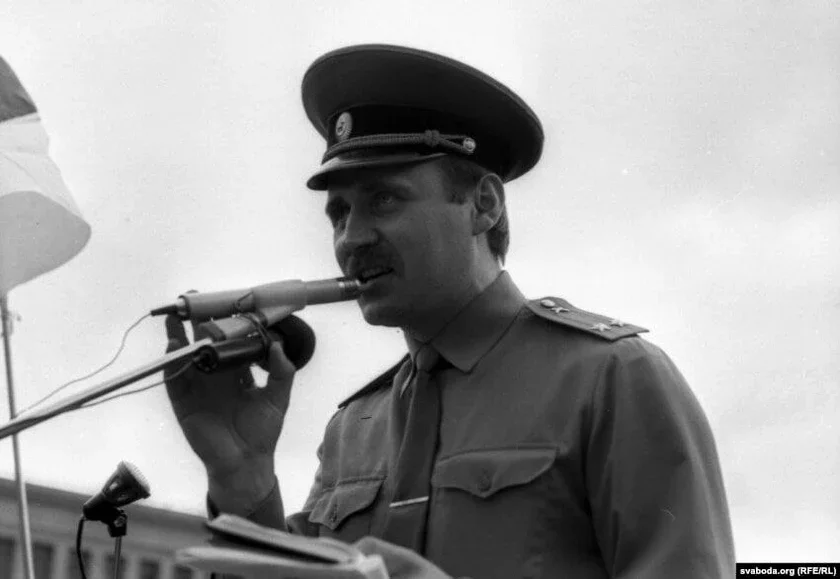
For example, 35 years ago, the GKChP (State Committee on the State of Emergency) putsch began in Moscow, the aim of which was to save the USSR. But which, as a result, led to its collapse. Therefore, today is a convenient occasion to reflect on the forecasts of that time, as history itself has already shown their correctness or incorrectness. Back then, some not only predicted the collapse of the Soviet empire itself but even tried to foresee the future of its constituent parts.
At that time, I was working on my doctoral dissertation, dedicated to human-machine control systems, and had to deal, in addition to technical issues, with human motivation in these systems for effective control and for teaching such control, which required the study of humanitarian sciences as well.
From social psychology, I knew that a state not united by common values inevitably disintegrates. The Soviet Union was united by communist ideology, which was completely discredited as a result of Gorbachev's "glasnost" and the truth about the true cost of the communist experiment for the peoples of the USSR. The only other unifying ideology at that time could be nationalistic, which became a death sentence for the multinational empire.
Then, predicting its collapse, I saw the greatest risk in the Soviet army unleashing civil war in the national republics. Because when an empire disintegrates under the imperial army, the almost reflexive reaction of this army is to prevent the collapse by force of arms. This became clearly evident a few years later with the breakup of Yugoslavia.
Therefore, the question of dividing the Soviet army among the republics and creating their own armies became crucial. Especially since the experience of the collapse of the Russian Empire in 1917 showed that only those "outskirts" that managed to create and preserve national military units by the time of the collapse were able to achieve independence. Belarusians did not succeed in this.
Independence is not gained or defended by declarations and charters alone. I have the impression that this commonplace truth is still not understood by those who aspire to alternative state leadership.
Therefore, through my initially anonymous publications in the Belarusian press of 1990-1991, public opinion was prepared in favor of creating our own army. It must be said that this proposal appealed to Belarusians, because for them it meant that their children would serve in the army near home, and not in Siberia or Central Asia. According to a sociological survey in mid-1991, 60% of Belarusian residents supported it.
Also, thanks to these publications and the postal contacts listed within them, a network of Belarusian officers who wanted to serve Belarus was created throughout the entire territory of the Soviet Union (including in Belarus).
The GKChP forced us to accelerate. On August 20, 1991, during a broadcast on the radio station "Belarusian Youth," thanks to its host Vital Syamashka, I announced the creation of the Belarusian Association of Servicemen (BAS) and the BAS's appeal to all military personnel not to obey the orders of the GKChP. On the same day, this announcement and appeal were voiced at a BPF rally on Independence Square.
After the defeat of the GKChP, we immediately submitted a draft law on the creation of a Belarusian army to the Supreme Soviet, through the BPF faction within it. However, this draft law was thwarted by the overly active opposition of one deputy from the Shklov district, who had influence over numerous deputies — collective farm chairmen — and did everything to prevent the Belarusian army from being created. As a result, the law was adopted only on the fourth attempt, at the beginning of 1992. All this time, the region was on the brink of civil war. Ukraine demanded that Moscow transfer all Soviet military units on its territory to its subordination.
A conspiracy was brewing in the General Staff of the Soviet Army, and an armed rebellion was being prepared in the Baltic Military District, where local authorities demanded the immediate withdrawal of Soviet troops. After Belarus finally joined Ukraine's demands, Moscow conceded, and the threat of civil war was averted.
This story is an important testament to the importance of accurate political forecasting. On this channel, I have already written about the forecast made in 2018 by the People's Hramada and the Belarusian National Congress regarding the ripening of a revolutionary situation in Belarus, which allowed us to prepare for future events.
Now I will give a few more examples of political forecasts made by other people on the eve of the collapse of the USSR regarding the future of its republics, which still impress me with their accuracy.
It seems to me that at turning points in history, some people's sense of its course and direction becomes sharper.
At one of the scientific conferences in the late 1980s, I met a scientist from Moscow who belonged to a very old, educated family that had lived for centuries in various Islamic countries, and who had a good knowledge of the southern Soviet regions. We discussed the future of these regions after the collapse of the Soviet empire.
According to him, the Central Asian Soviet republics were destined for "either a khan or Sharia law." Now we see that there, after the war with Islamists in Tajikistan and the suppression of their uprisings in Uzbekistan, they have so far settled on "khanate" forms of rule.
My interlocutor believed that Azerbaijan had prospects for the existence of its own state, thanks to oil revenues, and predicted problems for Georgia, which, according to him, would find it difficult to offer anything liquid for international markets. He was also very skeptical about the prospects for Armenia's independent existence, as it was then already engaged in an armed conflict with Azerbaijan over Nagorno-Karabakh and was in a cold conflict with Azerbaijan's ally, Turkey. Trapped between enemies, Armenia, in his opinion, would have no other option but to "return" to Russia.
But a forecast is not a verdict. And now we see how Armenia is escaping from a geopolitical trap, albeit forced to sacrifice Nagorno-Karabakh. This somehow reminds me of a story I once heard, about a wolf biting off its own trapped paw to escape a snare.
Another forecast from that time particularly stuck with me, which, more precisely, should be called a warning or even a threat.
One cadet from the Minsk Higher Engineering Anti-Aircraft Missile School, for whom I was a diploma project supervisor, after vacations spent in Moscow, told me about a conversation at a party with a representative of some Russian chauvinistic organization. That person, according to my diploma student, briefly formulated his vision of the empire's future. It sounded like this:
“The Baltic states will leave. They are strangers to us there, they will never be ours. So let them go. Let the Asian republics also leave — how long can they sit on our necks? We will fight for Ukraine. But it is too big, I don't know if we can overcome it. And you, Belarusians, just sit still and don't even stir.”
I don't know if this warning was addressed to me personally, as rumors of my "nationalist" views were already circulating at the school, or if it was a threat to all Belarusians. But I took it seriously, because the views of that "forecaster" were, as I have been convinced many times, dominant among Russian society. However, at that moment, this threat even somewhat reassured me, because if they themselves are not sure if they can "overcome" Ukraine, then their defeat there would give us a chance for independence too.
Therefore, we had to "stir": create our own army, conduct historical and patriotic education of society. But, knowing the sentiments in Russia, constantly wait for Moscow to begin its revanche.
Frankly, in December 2021, 30 years after the Belovezha Accords, which "canceled" the USSR, I had already begun to hope that everything would end with Crimea and Donbas, until Moscow's impossible ultimatum to NATO appeared, which was a classic casus belli (a reason for war), and until Russian troops were deployed in the Mozyr region, ostensibly for exercises.
And now Ukraine is fighting not only for its own independence. It is also fighting for the independence of Belarus and the Baltic states, at a minimum.
I think that Belarusians who went to Ukraine after the Russian invasion there understand this perfectly well. Another paradox of history — once Ukraine, thanks to Bohdan Khmelnytsky, made Muscovy an empire due to its accession to it, which, after a long and bloody resistance and the greatest human losses in our history, "entangled" Belarus in this empire too. And now Ukraine is waging war to defend its independence and thereby "undo" the empire.
It resembles the correction of historical errors.
-
"If there were no BPF, there would be no session. The communists wouldn't have gathered for it." Navumchyk sharply responded to Tsygankov, the "denier."
-
“The narrative that on August 25, 1991, someone made a beautiful speech and everyone changed their views — that's for a feature film”
-
Tatyana Zamirovskaya wrote why she comments on posts written by AI that people share on their social media
Now reading


Tragedy in Borisov Hospital: patient's granddaughter says he received attention after six hours, when foam was already coming from his mouth — he died


Comments
Другі бок беларускай арміі таго часу - не расійскі, а польскі. Ну тут наша незалежная ад залежнай эканомікі, ні разу не ваяваўшая ніколі і ні з кім армія, як мінімум магла вярнуць Польшчы заходнюю палову БССР - тое, што забраў у палякаў у 1939 таварыш Сталін.
Такім чынам, існаванне Беларусі немагчыма без існавання Расіі.
Вось і ўся беларуская ваенная, грамадская, эканамічная і дзяржаўная палітыка. І гэткая яе ўся гісторыя - тады жылі Беларусь і яе народ, калі жылі разам з Расіяй. Іншых варыянтаў быць не можа. Бо ў РФ болей аўтаматчыкаў і іншых рэсурсаў. З павагай да таварыша афіцэра Міколы Статкевіча, малодшы сержант запасу Савецкай арміі Анатоль Старкоў.