


Scientists Propose Restoring the Aral Sea and Profiting from it
Restoring the dried-up Aral Sea doesn't necessarily have to mean only colossal costs. A new study shows that refilling the body of water could prevent significant greenhouse gas emissions and create opportunities to attract multi-billion dollar funding from the carbon credit market.
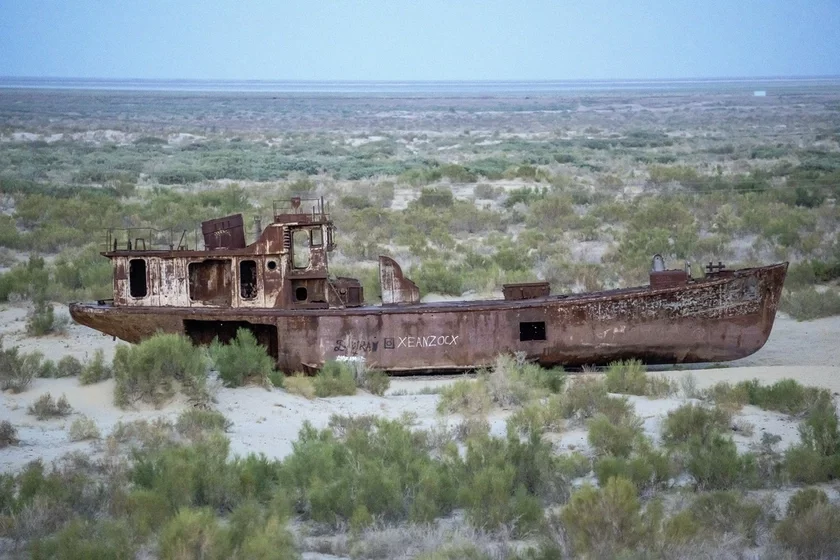
The desiccation of the Aral Sea is considered one of the biggest environmental catastrophes on the planet. This lake, once the fourth largest in the world, began to disappear in the 1960s after the waters of the Amu Darya and Syr Darya rivers, which fed it, were diverted for large-scale irrigation projects.
By the late 1980s, the water level had dropped so much that the once single Aral Sea divided into the North and South Aral. Later, the South Aral, which continued to shrink rapidly due to the lack of water inflow from the Amu Darya, split into eastern and western parts.
The North Aral, fed by the waters of the Syr Darya, was partially stabilized, thanks in part to the Kokaral Dam built in 2005.
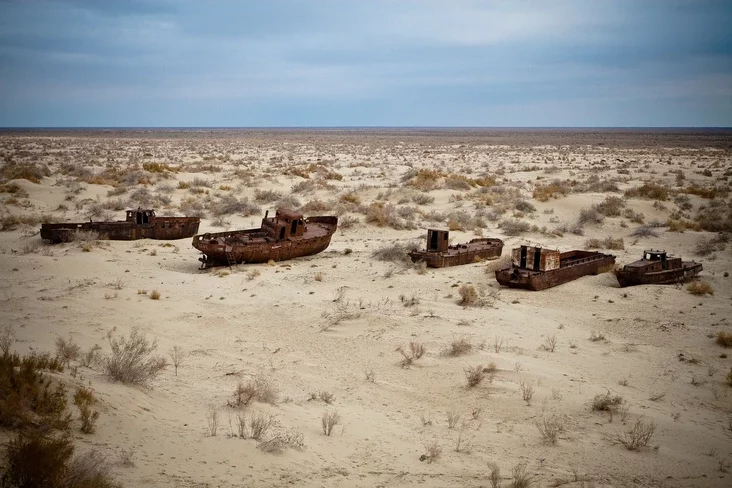
The situation in the southern part is much worse: most of the former seabed there has been exposed and turned into a salt desert. Overall, as a result of many years of desiccation, only a small part of the once vast Aral Sea water area remains. However, the consequences of this process are not limited to the loss of water and the transformation of the seabed into a desert. The exposed seabed has become a source of carbon dioxide.
Lakes and inland seas play an important role in the global carbon cycle, as they accumulate organic matter in their sediments over long periods, storing carbon that was originally absorbed from the atmosphere by plants and algae.
However, when such bodies of water dry up, their carbon storage function reverses: sediments are exposed to the atmosphere, organic matter decomposes, and carbon returns to the air as CO₂.
How to Profit from Aral Sea Restoration
A new study, the results of which were published in the journal Science, shows that sediments exposed by the receding sea have released 748 megatons of carbon dioxide into the atmosphere since 1960. At the same time, scientists found that a significant amount of carbon is still buried beneath the former lakebed. Reflooding could prevent the emission of another 605 megatons of CO₂.
Researcher at the Centre for Advanced Studies of Blanes (CEAB-CSIC, Spain) and lead author of the study, Rafael Marcé, explains in a press release published on the scientific institution's website:
"A carbon treasure is hidden beneath the Aral Sea. If these sediments remain exposed, carbon will continue to be released into the atmosphere. But if the sea is refilled with water, this very carbon could turn from a source of emissions into part of a climate solution."
According to the authors, carbon preservation can have significant economic value on voluntary carbon markets and potentially generate between $3.6 billion and $18 billion in tradable carbon credits. Monetizing preserved carbon through such credits could help attract international funding and make reflooding more financially realistic.
The authors estimate that an investment of about $9.7 billion in improving water resource management — increasing irrigation efficiency and optimizing infrastructure — could increase water inflow enough to restore about 50% of the lake's surface area compared to 1960 levels. This would simultaneously allow for the generation of about 323 megatons of CO₂ equivalent carbon credits.
While the full restoration of the Aral Sea remains an enormous technical, social, and political challenge, climate finance could be a catalyst for this process.
Scientists emphasize that the Aral Sea is not the only body of water whose desiccation can affect the carbon cycle. Similar processes can occur in the Great Salt Lake in Utah and Salton Sea in California (USA), Lake Urmia in northwestern Iran, and Lake Chad, located on the border of Chad, Cameroon, Niger, and Nigeria. The Caspian Sea causes particular concern. According to forecasts, its level may also significantly decrease in the coming decades.


Comments