


Interrogations and Threats. What's Happening to EHU Students After the University Was Declared "Extremist"
The European Humanities University in Vilnius was, until recently, one of the few universities where Belarusians could get an independent education according to Western standards. However, the future of this education is now in question. In April 2026, Belarusian authorities recognized the university as an "extremist organization," and now hundreds of students and faculty members face lengthy prison sentences.
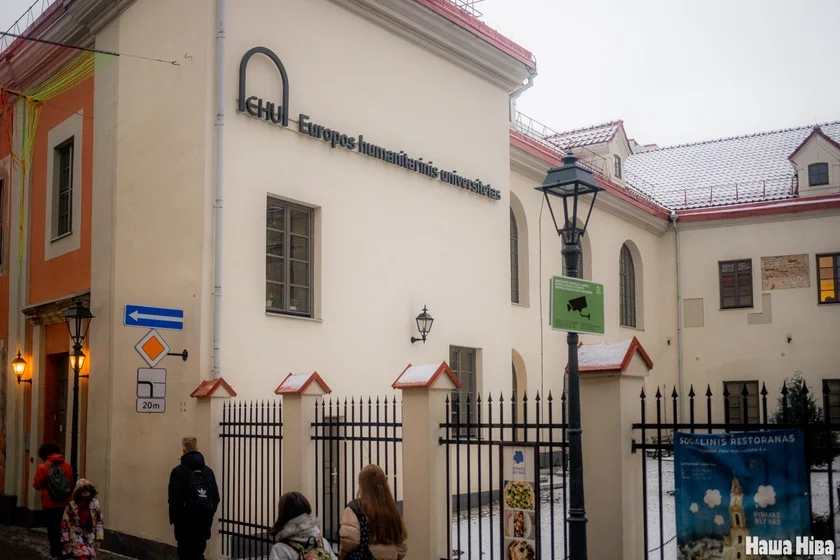
BBC writes how the lives of EHU students and faculty have been divided into "before" and "after," and what future awaits the university if Belarusians can no longer study there.
"No understanding of the future"
"First, they took me into an office and confiscated my passport. They [the KGB] threatened that if I didn't cooperate, they would imprison me and all my relatives," says Kira.
Kira (name changed) is a student at the European Humanities University (EHU). In 2004, the Ministry of Education of Belarus revoked the university's license, and since then, it has been located in Lithuania.
Until recently, over 70% of the university's students were Belarusians, and EHU was considered one of the few universities where young people from that country could receive an independent European education.
However, in April 2026, the Supreme Court of Belarus recognized the university as an "extremist organization"—now Kira, like hundreds of other students, faces imprisonment for studying at EHU.
The recognition of EHU as an "extremist organization" comes amid ongoing repression in Belarus. Despite the periodic release of groups of political prisoners, sentences continue to be handed down in the country that human rights defenders call politically motivated.
Currently, more than 870 people have the status of political prisoners in Belarus, but human rights defenders claim that the actual number of people held in prisons for political reasons is significantly higher.
In recent years, almost all independent media and non-governmental organizations have been liquidated or forced to leave Belarus. Many of them, like EHU, have been declared "extremist formations."
Human rights defenders call the campaign against EHU unprecedented. Searches and interrogations are taking place across Belarus as part of the "EHU case." According to the Viasna Human Rights Center, more than 180 cases of persecution have been recorded. Security forces are threatening criminal liability even to students' relatives.

"Many students are afraid for their families. I know at least ten people who have either dropped out or falsified documents to send to the KGB so they would just leave them alone," says Kira.
Over the years of its existence, EHU has faced many challenges.
However, students and faculty interviewed believe that the current ordeal could be one of the most serious in its history and call into question the very existence of the university.
"There is no understanding of its future today, neither within the academic community nor, I think, among the students," one EHU lecturer told the BBC.
Interrogations in a cell and death penalty threats
"They put me in a cell," Kira recalls. "I still don't understand why they had to do it so harshly. I had no contact with my parents; I sat there for several days. They told me what an unpleasant prison awaited me, that I would, figuratively speaking, rot in that cell."
Journalists met Kira in a quiet courtyard of a Vilnius cafe. She was noticeably nervous and wanted to cancel the interview the day before the meeting. Fearing for the safety of her family in Belarus, she agreed to speak with us only on condition of anonymity.
Kira claims that over the past year, KGB officers tried to recruit her several times when she visited relatives in Belarus during holidays.
The conversations were accompanied by threats.
"They demanded that I give them access to all possible and impossible resources at EHU," Kira says, adding that in return, the security forces guaranteed her freedom and safety.
A similar story happened to EHU graduate Lena—her name is also changed for security reasons. Like Kira, she is very frightened and cannot hold back tears during the conversation. Lena says that after returning to Belarus in May this year, unknown people knocked on her apartment door.

"I woke up and heard knocking on the door. Well, I'm a timid person. I didn't open it until the phone started ringing too. About five people came in. One immediately started filling out documents. The second conducted a search wearing gloves, and there were three witnesses. They introduced themselves as KGB officers. And you, they said, are a witness in the case that EHU is an extremist organization. A search will now be conducted," Lena recalls.
According to the girl, after that, they gave her time to change, take warm clothes, and drove her to the department. There, Lena was interrogated, and then forced to sign a confession of repentance, which contained a request to release her from criminal liability under Articles 361.2 and 361.4 of the Criminal Code of Belarus—financing and facilitating extremist activities—and also obliged her to bring her EHU diploma within 10 days.
Lena says she signed the document because she "simply had no choice."
"After that, they gave me a printout about what extremism is. They also told me to sign that I had familiarized myself with what it is, that I know that in case of anything, the death penalty can be a measure of punishment for it," Lena recalls, her voice trembling.
Belarusian university in exile
EHU was founded in Minsk as a private university in 1992, but 12 years later, the university was closed. The official reason was non-compliance with the requirements of the Ministry of Education.
Commenting on the university's closure in 2004, Alexander Lukashenka stated that "we will train our elite, the future leadership of the country, ourselves, in Belarusian universities."
Critics of the Lukashenka regime at the time called this decision a politically motivated blow to academic freedom. Since 2005, EHU has been operating in Vilnius and has the status of a "Belarusian university in exile."
Around a thousand students study at EHU. Since the university moved to Lithuania, more than 2,400 people have graduated from it.
The university's structure includes departments of social and humanitarian sciences and arts, as well as several independent educational programs.
According to the EHU website, the university was created to provide education to students from Belarus (for whom tuition is cheaper), as well as from other Eastern European countries, and "aims to develop civil society."
"This is a place for those who are ready to develop, participate in public life, and make a global impact."
EHU exists thanks to funding from international donors, including the Ministry of Foreign Affairs of Lithuania and the European Commission.
In 2016, some donors, including the Nordic Council of Ministers, stopped funding the university after a leak of internal investigation materials by Deloitte. At the same time, the American rector of the university, G. David Pollick, resigned.
Brainwashing?
In August 2025, Belarusian authorities recognized EHU's social networks as extremist, and less than a year later—the university itself. According to Belarusian extremism legislation, criminal prosecution can threaten anyone who studied or taught at EHU starting from 2016, including graduates.
This means that students and faculty can now become defendants in criminal cases for participation in an extremist formation and its financing—in Belarus, this carries a penalty of up to six years of imprisonment.
Belarusian authorities believe that EHU is allegedly used by the special services of neighboring states to "harm the interests" of the country, and the university's activities are aimed at "encroaching on the sovereignty of Belarus and the foundations of its constitutional order."
"The university provides methodological, financial, and other assistance to representatives of radical politicized groups, as well as destructive foreign non-governmental organizations," stated prosecutor Dmitry Brylev.
However, students interviewed by journalists claim that little is said about Belarusian politics at EHU.
"You see, not everyone went to EHU because they are incredible oppositionists and hate their homeland. It was viewed as an opportunity to study, to see Europe, before all this," Lena shrugs. "In my specialty, they never even said anything bad about Belarus. We didn't even mention it at all. That is, at our university, we had not courses, but discussion clubs in the Belarusian language. But that's, that's not bad."
"I can say that Belarusian universities and Belarusian schools engage in brainwashing. And there, I would say, there is an anti-Belarusian agenda. But regarding the state at EHU, honestly, I didn't notice anything like that," says student Hanna, who is studying "European Heritage."
In 2020, Hanna attended protests in Belarus, and choosing EHU was a conscious decision for her.
"I chose EHU for my studies because I clearly understood that I didn't want to stay in Belarus, I didn't want to study in a system where you have to lie about your position for good grades. I clearly understood that I wouldn't stay in Belarus."

Do not contact law enforcement
The Viasna Human Rights Center told the BBC that the recognition of EHU as an "extremist organization" did not come as a surprise.
"As far as we know, there are two demands from the security forces to those affected by this recognition: either to drop out and transfer to another university, or to return to Belarus, or both.
What is the ultimate motivation? It's unclear. The only thing that is clear is that this didn't happen suddenly," reflects Evgenia Belkina, coordinator of the volunteer service at the Viasna Human Rights Center.
According to Belkina, the Belarusian KGB tried to recruit EHU students a year before the university was recognized as an "extremist organization" (this information was also confirmed by the university).
"When students returned for holidays or for any other matters, unfortunately, they faced the fact that after crossing the border, after some time, KGB officers contacted them, asking them to come for interrogation, for a conversation," notes Belkina.
"Unfortunately, the fact that attempts to recruit students were widespread for a whole year only became known after EHU was recognized as an extremist organization."
Despite the threats and pressure that Belarusian authorities exert on EHU students, it is not advisable to make contact with law enforcement, believes Evgenia Belkina.
"My first advice is always not to enter into communication with employees of any Belarusian security agencies if they don't come themselves. That is, to independently bring any documents, to independently enter into communication—this is giving them additional information that they can use not only against us but also against other people."
"They don't fully understand this danger"
The academic community of EHU, most of whose representatives are Belarusians, also found itself under threat of persecution by the Belarusian authorities.
After the university was recognized as an "extremist organization," some faculty members resigned, and some transferred to other universities. However, the exact number of those who left the university is unknown.
Evgen (name changed for security reasons) agreed to speak with journalists. He faces a criminal case in Belarus. Evgen says that the atmosphere at the university is close to despair.
"The rector personally and most of the administration—they are not from Belarus, they may not fully understand this danger. And if you don't experience it yourself, if you don't have similar experience, understanding the consequences and how painful it is, is probably not so obvious," he says.
Former EHU lecturer Tatyana Chulitskaya says that after 2020, many Belarusian lecturers faced the threat of persecution.
"Now, unfortunately, those who work at EHU, everyone who is involved in teaching and research there, also find themselves in this risk zone. And, of course, I am afraid that some people will be forced to leave, and that's a big question—where to. Because the academic environment is quite competitive, and finding a place is quite difficult."
Chulitskaya was заочно (in absentia) sentenced by Belarusian authorities to 10 years in a penal colony in the case of "Svetlana Tikhanovskaya's analysts" and cannot return home.
"We are engaged in research, and this, in principle, also becomes criminal activity in Belarus," notes Chulitskaya. "This carries risks for our families who are there, because they are persecuted, pressure is exerted on them. And, of course, this creates very significant psychological risks for us."

University reaction
EHU students interviewed by journalists believe that the university administration did not do enough for them after the university was recognized as an extremist organization.
"Talks about recognizing EHU as extremist began as early as December 2023," says Kira. "There was enough time. Was any help provided? No. We were shut down, told it was a lie, that nothing of the sort would happen at all."
"The university expressed concern by sending an email, but nothing specific was said," adds student Hanna.
According to Evgen, before EHU was recognized as an extremist organization, the university administration assured faculty and students that it had an action plan.
"They said they were ready for any scenario. And if something like that suddenly happened, the plan would be put into action. But then it happened, and it turned out that, apart from a statement of solidarity, this plan didn't amount to much else."
According to the EHU administration, at least one hundred people have dropped out of the university. Some faculty members fear that if the flow of students from Belarus continues to decrease, the very future of the university could be called into question.
"I think that in literally just a month or two, we might reach a point where the number of students at the university decreases so much that it becomes financially impossible to ensure its functioning," says Evgen.
"Hostages we won't be able to help"
The university administration stated that for students and faculty located in Lithuania, Lithuanian and European legislation serves as protection from Belarusian authorities.
"But for people who remain in Belarus, we primarily recommend that they seriously consider whether they should leave the country, because at some point, the situation could become truly very dangerous for them," said EHU Rector Vilius Šadovskas.
When asked if the university was trying to dissuade future Belarusian applicants from enrolling, Šadovskas replied that everyone must make that decision independently.
"Students who decide to relocate can still do so. We can offer them a place in the dormitory for the initial period and help them settle in, so they feel at least relatively safe."
Šadovskas added that the university needs to adapt to new realities and adjust its working methods, including attracting Russian-speaking students from other countries. At the same time, he added that EHU remains a university intended for Belarusian youth, regardless of the number of applicants from that country.
Speaking about faculty, Šadovskas stated that, starting from the new semester, the university recommends them to be in Lithuania.
"We strongly recommend—or rather, demand, as they are our employees—not to travel to Belarus. In the current situation, any lecturer can effectively become a hostage. And, understanding our capabilities, unfortunately, we will not be able to help them."
***
After her detention, Kira managed to leave Belarus—she is now continuing her studies at EHU and considering transferring to another university.
Hanna transferred to the Faculty of Law to pursue human rights activities in the future.
Evgen still teaches at EHU.
Lena left Belarus with the help of charitable organizations. She is now planning to enroll in a master's program in Europe or apply for a humanitarian residence permit. What she experienced in Belarus still haunts her.
"As soon as I got out of there, I immediately cried because it's all very scary. I remember, still [during the interrogation], one person came in and said that I was a traitor to my homeland, that only bad people study at EHU. That's it. Well, I don't know, you feel so small, like you could have just stayed there right then."
None of the protagonists of this material are planning to return to Belarus.


In the Czech Republic, Poles beat up a Pole, mistaking him for a Ukrainian because of his hat in the colors of Upper Silesia. The man was on a charity bike ride for his pregnant partner sick with cancer


Comments
Што адкажуць Краўцоў і Калеснікава якія хоцуць дамаўляцца з рэжымам?