


Bears in Belarus are becoming more numerous — here are the primary regions
According to estimates by scientists, the number of bears in Belarus has increased in recent years. If twenty years ago the Belarusian brown bear population was estimated at 100-200 individuals and human encounters with them in the forest were isolated incidents, now it is already 1,500 individuals.
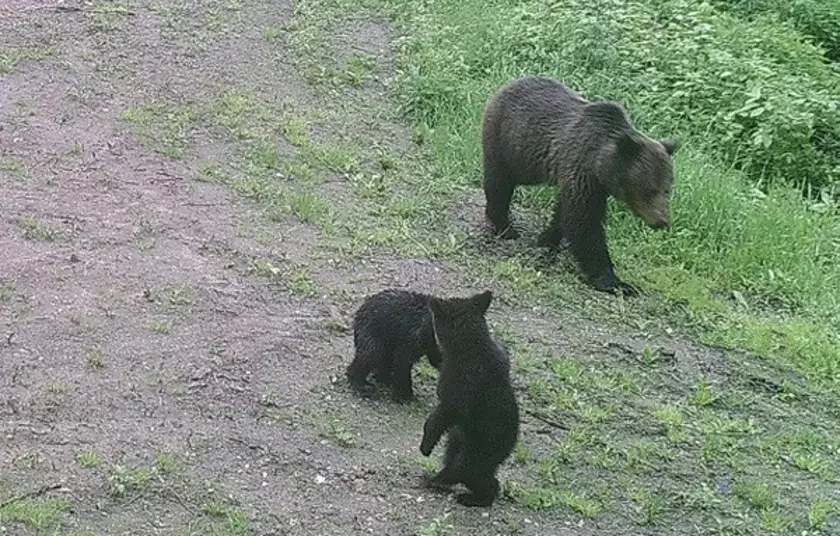
The Belarusian brown bear population belongs to the European subspecies and is not considered aggressive towards people, unlike, for example, the Siberian, Kamchatka subspecies, or the American grizzly bear. Belarusian bears have long lived in areas with high population density, thanks to which the animals show caution towards humans and do not perceive them as prey. Most often, an adult bear hears a person at a distance of 300-400 m and avoids direct encounters with them.
Most bears live in the eastern part of Vitebsk region, as well as in the territory of Borisov and Logoysk districts of Minsk region.
What to do if you encounter a bear? A bear can accelerate up to 30-40 km/h and make jumps of 7-8 m, so it's impossible to run away from it. The situation is especially dangerous if a person finds themselves between a bearess and her cub.
If you see a bear from afar, you should stop and assess the situation. If the animal hasn't noticed you, quietly leave, bypassing it in a wide circular path, or return the same way.
If the bear notices you at a close distance (up to 50 m):
- do not run away, do not turn your back, do not look into its eyes;
- remain calm, speak in a confident, calm voice — let it understand that you are human;
- you can make sounds (whistling, clapping);
- slowly move backward, facing it, for 10-20 m, then sideways;
- if your movement provokes the animal — freeze and continue to speak calmly.
At this stage, most bears prefer to leave on their own.
When a bear stands on its hind legs, it is usually curiosity, assessing the situation, not a threat. But if its ears are pressed back, fur is bristled, there is a snarl, tremors — these are signs of readiness to attack.
If contact cannot be avoided, it is advised to fall to the ground, lie on your stomach or curl into a ball, hands behind your head, remain motionless for as long as possible — this may stop the attack. If the bear continues to attack — use all means of defense (pepper spray, strikes to the eyes and nose).


The bassist of "Pyatlya", his 18-year-old son and the star of "Razbitaha Serca Patsana" — we tell you about the Belarusian-speaking band Prypiać, which presented its original "Kalykhanka"


Comments
Гэта ўжо не была сітуацыя, калі можна было спужаць яго або спакойна разысціся.
"Беларуская папуляцыя ... не лічыцца агрэсіўнай да людзей у адрозненне, напрыклад, ад сібірскага, камчацкага падвідаў або амерыканскага мядзведзя грызлі".
Сібірскія і камчацкія таксама бліжэй да беларускіх: таксама баяцца людзей. Розніца з мядзведзямі амерыканскіх запаведнікаў у тым, што ў Расеі і Беларусі пастаяннае паляванне на жывёл. Страх перад чалавекам перадаецца яшчэ малым звярам ад дарослых, у кожнае наступнае пакаленне.