


How Orthodox Latvians wanted to take over a church from Catholics near Vitebsk
In the summer of 1871, a real confrontation broke out in the Vyhreya estate near Vitebsk over a small church between Latvian settlers and local Catholics, who, after the 1863 uprising, found it increasingly difficult to defend their rights. All possible arguments were used: from legal and geographical to linguistic and architectural.
The detailed history of the rivalry is recounted by historian-archivist Kanstantsin Karpekin in an article published in the latest issue of the collection "Latvians and Belarusians: Together Through Centuries".
It all started when a group of Latvians from the Livonian Governorate bought a significant plot of land in the center of the Vyhreya estate (modern Lyozna district) from the landowner Venedikt Bahamolets. These were not poor laborers but wealthy owners: they acquired 1360 desyatinas of land, forest, and even a tavern.
Among the buyers were people with surnames that sounded exotic for the Belarusian hinterland: Bushman, Lindenberg, Tanne, Schmidt. Three-quarters of the colonists were considered Orthodox, a quarter – Lutherans.
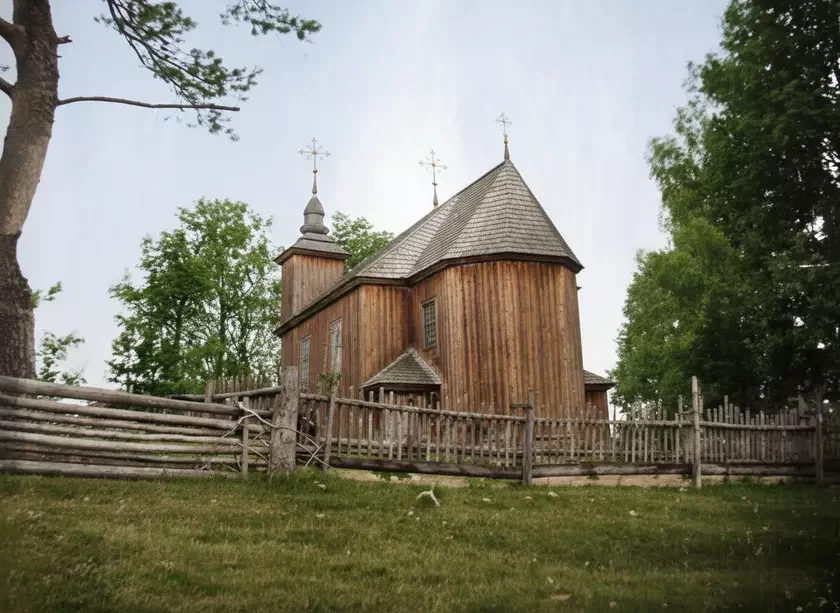
But they did not want to pray together with the local Belarusians. They needed their own church, and they quickly found a suitable object – a Catholic chapel that stood literally 250 meters from their new homesteads.
For the indigenous Catholics, this was a place of prayer, the center of life for an isolated community, and a memory of ancestors buried in the adjacent cemetery. For the new owners of the land, the chapel was a foreign sanctuary, but geographically – the closest.
Give us the church so we can Russify
The Latvians acted instantly and aggressively. Just a few weeks after moving, 34 representatives of the colony sent a petition to the Mogilev governor. The scheme for seizing the chapel was meticulously thought out.
They asked to re-consecrate the Catholic chapel into an Orthodox church, citing that it was too far for them to walk to the nearest Orthodox church in Pahostsishcha (though it was only 4 kilometers).
But the main trump card was political: the settlers promised to rebuild the church at their own expense and open a school there to teach their children the Russian language and the basics of Orthodoxy. For the Russian authorities, who were pursuing a policy of Russification of the region, this was an ideal scenario.
The local police officer immediately supported the idea, reporting that there were no obstacles to the transfer of the building.
Ancestral graves as an argument against Russification
When the Catholic community learned about the threat of losing their sanctuary, they mobilized. In January 1872, 53 believers sent their protest to the governor. Their arguments were devoid of political pathos, but pointed to a vital necessity.
Firstly, the chapel had always been Catholic and operated according to an indult (permission) issued by the metropolitan. Its status was repeatedly confirmed by the consistory.
This was also evidenced by the fact that its Catholic founders, along with members of their families, were buried near the chapel, and cemeteries where ancestors and relatives of members of the Catholic community were buried surrounded the chapel.
Secondly, Catholics pointed out that the chapel was assigned to the Babinavichy church, which was about 20 versts away, so elderly and sick believers could not reach it.
In spring and autumn, the roads became impassable due to the floods of the Charnitsa, Luchosa, and Sukhadrouka rivers, so it was easier to invite a vicar from Babinavichy to Vyhreya a few times a year.
The former landowner Venedikt Bahamolets also tried to help the Vyhreya Catholics. He sent a letter from Riga, in which he exposed a legal nuance that the Latvians "forgot".
It turned out that when selling the land to the colonists, the landowner retained a plot of two desyatinas, on which the chapel and cemetery stood.
Bahamolets had a personal interest: his father and grandmother rested in that cemetery. He reminded the authorities that after the mass closure of churches in the 1860s, i.e., after the uprising, Catholics in the district had nowhere to pray anyway. And the landowner virtually accused the Latvians of religious separatism, stating that they deliberately ignored the local Orthodox church and even buried their deceased separately, without inviting a priest, which cast doubt on the sincerity of their intentions.
Orthodox "landing"
On the other hand, the Orthodox clergy tried to convince the authorities that the chapel was "by itself" closer to the Eastern rite. The inspection reported: the building is cruciform, with a dome, and was once re-consecrated in honor of the Transfiguration of the Lord. Allegedly, it was a former Uniate church that later became Catholic.
The Mogilev bishop advised transferring the church to the Orthodox, and Archbishop Euzebius added another argument – a linguistic one. He claimed that Latvians did not understand Russian sermons, so they vitally needed their own church and a priest who spoke Latvian.
Resolution of the confrontation
The governor demanded facts – and received voluminous police reports. The police again counted the believers and found that the chapel was used by residents of eight estates and eleven hamlets – a total of more than 300 people. This was already a serious number that could not be ignored.
As a result, despite the active pressure from the Latvian community and the support of the Orthodox eparchy, the authorities did not dare to forcibly seize it. By May 1874, the issue was resolved: the chapel remained Catholic.
Historian Kanstantsin Karpekin believes that the Latvians were let down by underestimating the right of private property – the land still belonged to Bahamolets – and by a change in the political climate. In the 1870s, the wave of repressions against Catholics in the Russian Empire somewhat subsided, and the authorities began to act more cautiously, using soft power.
Documents from the 1920s indicate that the chapel remained Catholic until the advent of Soviet power.
«Nasha Niva» — the bastion of Belarus
-
A denarius of Vytautas and ornaments like those from early Christian cemeteries in Kernave and Vilnius found in Poltava region
-
17th-century coins found on the territory of the former Bernardine convent in Brest
-
Sofia, dotter till Volodar Glebovič. Danish Queen Sophia is still ours, a Princess of Minsk
Now reading


In New York, the Twin Towers were recreated in natural size using 2977 drones — corresponding to the number of victims of the September 11 terrorist attack


Comments