


A denarius of Vytautas and ornaments like those from early Christian cemeteries in Kernave and Vilnius found in Poltava region
During excavations of the Glinsk archaeological complex in Ukraine, researchers discovered a denarius of Grand Duke Vytautas and female ornaments identical to finds from early Christian cemeteries in Kernave and Vilnius.
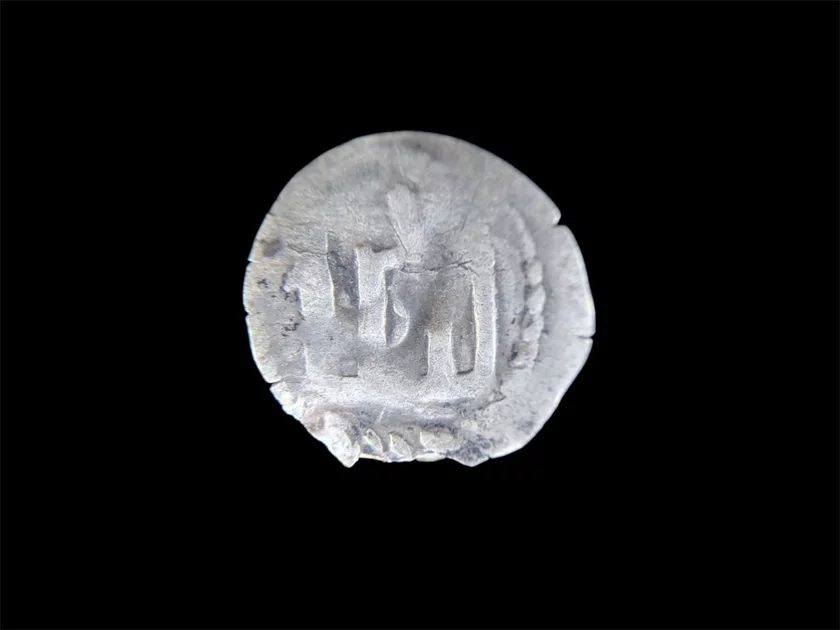
According to the publication «Aposhni Bastyon» (Last Bastion), the main find of the sixteenth season of research at the Glinsk complex on the Vorskla River was a silver coin with a diameter of 13 millimeters. On one side, the Columns (Vytautas' personal sign) are minted, and on the other, a spearhead with a cross.
The artifact has been preliminarily identified as a late denarius of Vytautas, the issue of which numismatists date to approximately 1411—1430.
As numismatist Vasil Zaitsau noted in his research, the minting of such coins of the Grand Duchy of Lithuania (GDL) on its eastern borders had a proclamatory purpose: they were used by the central authorities not only for trade but also to demonstrate their political influence in border territories.
In the catalog «Coins of the Grand Duchy of Lithuania» authored by Dmitry Hulecki, it is stated that coins of the type «Columns / Cross on a spearhead» remain poorly studied to date, and science lacks published hoards with precise metrological characteristics for their strict dating. The researcher emphasizes that in the 14th and almost the entire 15th century, the monetary circulation of the GDL was not nationwide. There was a clear division into northern and southern areas, where the only common means of payment was the Prague groschen and, possibly, the ingot-ruble.
For example, Vilnius coins depicting the Pahonia (Pursuit) practically did not penetrate the south. In turn, finds of denarii with a spear and a cross clearly tend towards the west of the state.
Ukrainian numismatist Rostislav Savvov developed this idea and proposed the hypothesis that this issue by Vytautas was carried out exclusively in Volhynia, probably in Lutsk. According to Savvov, the basic principle of coin type construction at that time was to place the ruler's personal sign in the form of the Columns on one side, and a territorial emblem on the other.
Dmitry Hulecki clarifies that the coin features a combined symbol of two of the most important parts of the western wing of the GDL: the cross was a widely known symbol of Volhynia, and the spear was the main element of the coat of arms of the Trakai Principality.
The coin at the Glinsk complex was found in a broad numismatic context. Nearby, archaeologists discovered Prague groschen, silver dangas, and a hoard of 118 copper pulos of the Golden Horde, as well as Crimean akçe. This set demonstrates the settlement's status as a major economic center at the border of the forest-steppe and steppe, where the trade interests of the Grand Duchy of Lithuania and the Golden Horde directly intersected.
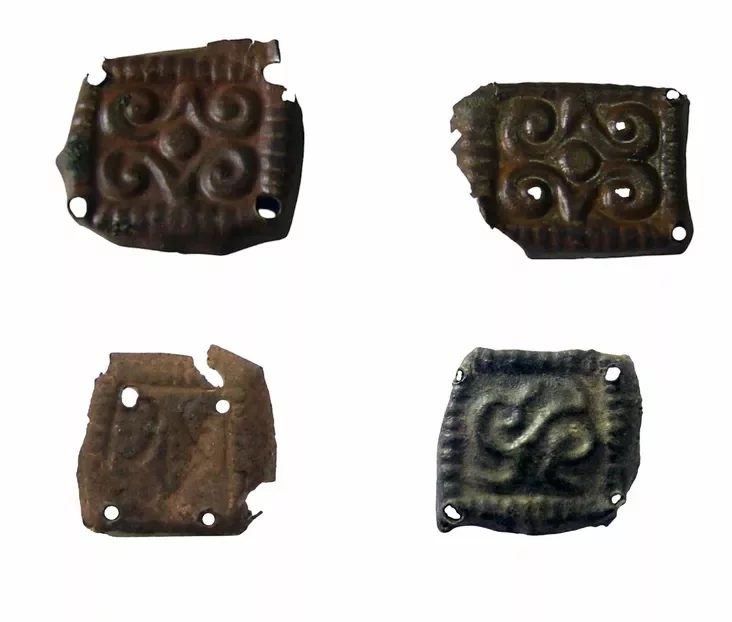
In addition to coins, archaeologists found plaques made of copper alloy, decorated with geometric, floral, and zoomorphic ornaments. They were used as sewn-on elements for women's headwear (forehead bands/acholli).
Such artifacts have precise analogues in the territory of modern Lithuania: identical plaques were found in the burials of the Kriveikiškės cemetery near Kernave, as well as at the Christian necropolis Civitas Rutenica («Ruthenian Town») on Bakšta Street in Vilnius.
For a long time, there was a discussion in science about whether these ornaments belonged to Slavs or were worn by assimilated Balts who adopted Eastern Christian fashion. As we previously wrote, DNA decoding of those buried in the Vilnius cemetery showed an absolute dominance of the typically Slavic Y-chromosome haplogroup I2a1 and the practical absence of the typically Baltic haplogroup N among early townspeople. This scientifically confirms the Slavic character of the population that used such ornaments in the central cities of the GDL.
Historical Glinsk and the Consequences of the Battle of Vorskla
Historians associate the Glinsk archaeological complex with the chronicle town of Glinsk, which, according to genealogies, was founded by the Tatar murza Mansur-Kiyat. His descendants later became the Princes Glinski and entered into service with Vytautas. The scale of the settlement is confirmed by research: during excavations in 2015, remnants of a smithy with preserved heat engineering structures and various iron products were found here.
The military presence of the GDL in this region was also recorded later. In 2016, in the tract Levadnyukova Hara (Levadnyukova Mountain), scientists found the burials of five armed horsemen, who likely belonged to Vytautas' army and died during the battle with the Golden Horde forces on the Vorskla in 1399.
As for the new artifact, as the author of the research, Ukrainian archaeologist Yuri Pugalovok, notes, a single coin does not prove that Glinsk was under the direct rule of the Grand Duchy of Lithuania. However, the discovery of a later denarius of Vytautas indicates that the Povorsklya region continued to exist in a common political and economic space between the GDL and the Golden Horde. The presence of coins and ornaments from various regions suggests that even after the defeat of 1399, the local community, located on the frontier, maintained extensive contacts and was familiar with cultural traditions spread hundreds of kilometers away.
«Nasha Niva» — the bastion of Belarus
SUPPORT US


Comments