


ONT launched an intellectual show where participants have to guess frames from Russian TV series 'Univer' and 'Daddy's Daughters'
We watched the show 'One on One' and tell you how to make money by knowing children's toys and Russian TV series.

An entertaining intellectual show 'One on One' appeared on ONT. It suspiciously resembles the global hit The Floor. There is no information on The Floor's resources that Belarusians were sold a license for the program, and ONT also does not disclose its sources of inspiration.
Like The Floor, ONT's show features a grid of cells: only there are 49 of them, not 100. On each cell, as in The Floor, stands a participant. They are assigned a category in which this person is supposed to know a lot. These are mainly general topics, in no way related to any particular country: for example, clothing, transport, the world of childhood, or Nobel laureates. There were also nationally marked categories, including Belarusian monuments, a map of Belarus, and Russian TV series.
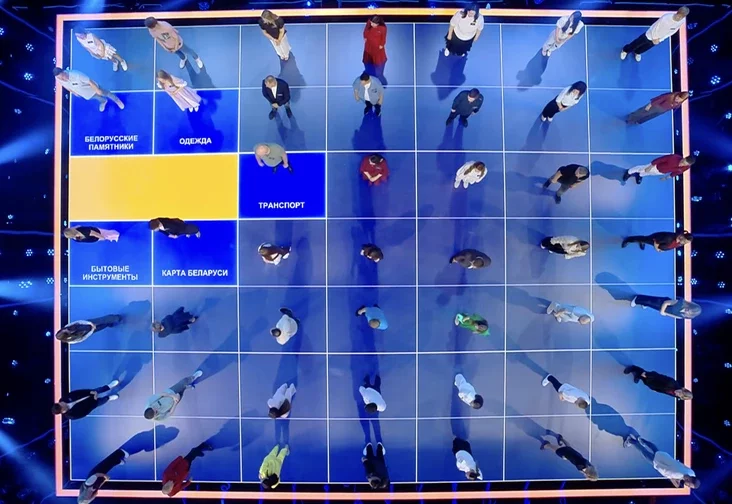
Players engage in duels with each other, with the first participant chosen by a computer, and then, if that participant does not refuse to continue the game, they choose a competitor from the cells around them. In each round, players have 45 seconds.
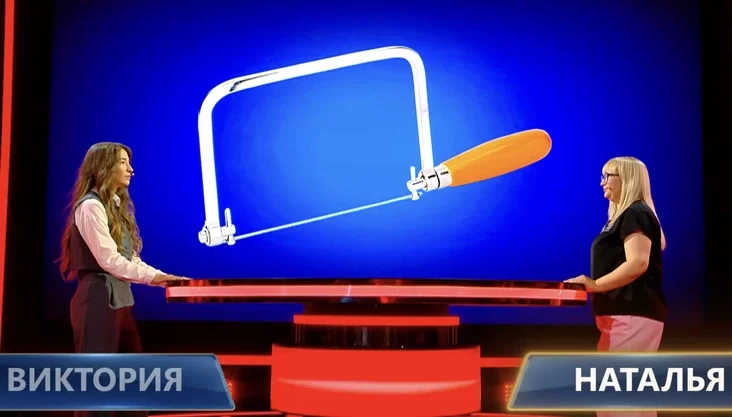
The game itself consists of showing players images of objects related to the category being played in that round, and participants must name those objects. If they give a correct answer, the timer stops, and the turn passes to the opponent; if not, the timer continues until a correct answer or until time runs out. If you don't know the answer, say 'pass,' and the picture will be changed, but you will lose three seconds of penalty time. If your time runs out faster than your opponent's, the game is over for you.
Pavel Filimonov was invited to host the project. The 40-year-old Minsk resident came up through the Mogilev KVN league and has been hosting weddings, presentations, and other events for many years. Filimonov's Instagram indicates that he works as a host on Super FM radio.
Let's return to the show. The first participant chosen was Alexander, a history and social studies teacher from a Minsk school. He was given the right to choose the first category. Alexander chose 'The World of Childhood' and dueled with Anastasia, a risk and process director at a fintech company, who conceded to him. The images shown to them were such that not everyone could quickly orient themselves: besides familiar dolls, there were also toys like yo-yos or Pop-Its.
It appears the organizers aimed to select participants from various professions and regions. For example, they showed a director from the Salihorsk Palace of Culture, who staged, among other things, the anniversary celebration of the newspaper 'Shakhtyor,' a housing and communal services employee from Cherven, and a boxing coach from Mogilev. Ilya, a site manager from a construction company in Salihorsk, came to ONT in an embroidered shirt (vyshyvanka) and confessed his love for Belarusian literature.

Belarusian questions were not reached in the first episode, but Russian TV series were touched upon. The category, however, turned out to be unsuccessful for the participants in that duel: from the frames shown to them, they could only guess 'Univer' and 'Daddy's Daughters' and passed on many other images.
The show also played with riddles — as Pavel Filimonov promised, they would be 'canonical,' ones 'we grew up with.' For example, there were riddles about 'the same color in winter and summer' or about a 'beautiful maiden'.

The winner of each round adds the opponent's cell to their own, and whoever pushes other players off the game board will receive the main prize — 10 thousand rubles. The first episode was not enough for this; it only determined an interim winner.
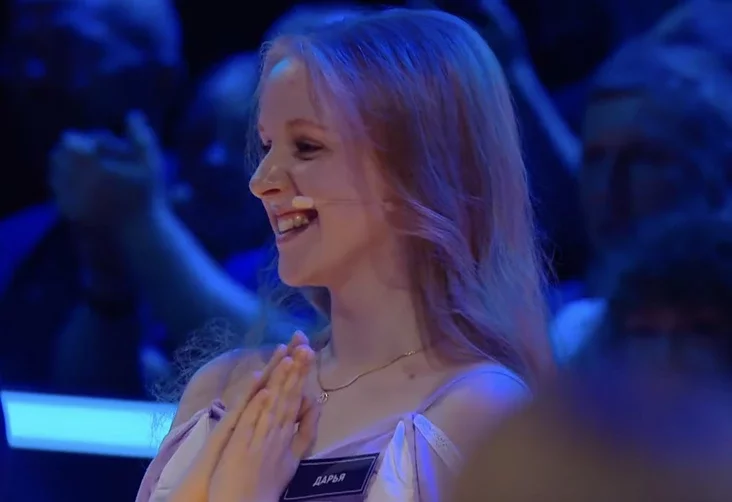
This is Darya, a student from Marjina Horka, who studies at the Academy of Management. The girl joined the game only towards the end of the episode but ended up gaining three additional cells. As the participant who occupied the most cells in the episode, she was given a thousand rubles.
«Nasha Niva» — the bastion of Belarus
SUPPORT US-
Airbnb service banned requiring guests to clean apartments and wash dishes
-
Pryluki near Minsk on a wave of hype — Belarusians massively went there for photos in the "Twilight" style. Locals are not thrilled
-
Brazilian man sold all his property and traveled 2000 kilometers for a woman. But he faced a harsh disappointment
Now reading


"Around 70% of Russian visitors turned out to be 'vatniks'." Ex-guide from the Museum of the Great Patriotic War, detained by his own tour group, is now popular in Warsaw — we talked to him

"Around 70% of Russian visitors turned out to be 'vatniks'." Ex-guide from the Museum of the Great Patriotic War, detained by his own tour group, is now popular in Warsaw — we talked to him


Tsikhanouski ironizes about his wife: Lukashenka helps and cares for her, even when there was a threat to children, all information was passed to Poland


Comments
Хотя.. может я и не прав,люди не не смотрят,одни какие-нибудь недоразвитые ябатьки.