


"This is done with Russian money." Belpol explains how Belarus is preparing for war
The Belpol association, in cooperation with the "Community of Railway Workers," prepared a comprehensive analytical report titled "Militarization of Belarus." The document describes in detail how the country's authorities are shifting the economy to a war footing, changing legislation for recruitment needs, and preparing infrastructure for the transfer of Russian troops. A closed presentation of the research took place at the Warsaw Security Forum. The "Zerkalo" publication reviewed the materials and spoke with a Belpol representative about the main conclusions of the document.

"From east to west"
The report consists of four parts, analyzing the preparation of society, the adaptation of civilian facilities for military needs, the operation of enterprises, and changes in laws.
"In previous years, we briefly discussed individual elements of militarization," explains Belpol representative Uladzimir Zhyhar. "Now we have additionally shown how military infrastructure is being built. If you look at the placement of various communication towers, we see that all this is being done along the main roads. In a normal state, this should be located from the center to the borders — so that the center can control the entire country. However, we see that in Belarus, the construction of infrastructure is proceeding from east to west. This is being done with Russian money and very often with components manufactured by the Russian Federation."
As an example of the masking of such structures, the study cites a logistics center in the Klimavichy district near Krychaŭ.
"As a result, the very same 'Areshnik' will be located there, but it is disguised as a logistics center. At the same time, we see that anti-drone defense systems, air defense systems, and much more are already deployed there," added the Belpol representative.
The authors of the document paid special attention to Belarusian Railway (BCh). The "Community of Railway Workers" obtained data on how, after the start of the full-scale war in 2022, the management of the railway was restructured. Now, military personnel are constantly present in the Transportation Control Center, and the system itself is ready for the rapid reception and transfer of large armed groups without using public stations.
The third part of the report is dedicated to the economy. The authors conclude that the production of weapons and ammunition for Russia has become one of the main factors supporting many Belarusian enterprises.
The fourth section describes changes in the legal framework. According to the authors, the abandonment of neutrality and non-nuclear status in the Constitution, as well as the signing of new agreements with Moscow, legally solidify the loss of sovereignty in the defense sphere.
"Collected valuable evidence"
The report was presented on October 12 during a closed round table at the Warsaw Security Forum. The event was attended by foreign experts, diplomats, and politicians. Sviatlana Tsikhanouskaya opened the meeting, noting the importance of the collected facts for the European region.
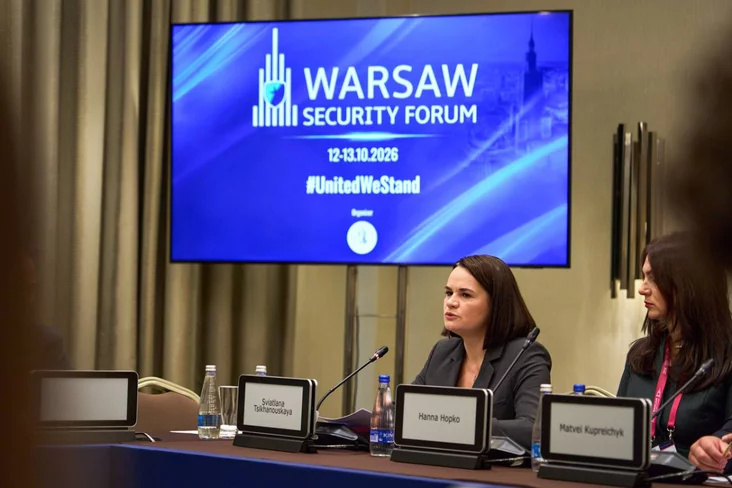
Belpol representative Uladzimir Zhyhar told "Zerkalo" what interested foreign participants of the round table at the Warsaw Security Forum the most.
"All 50 seats allocated for this event were occupied," noted Zhyhar. "The main emphasis was on understanding how the militarization of Belarus threatens the Baltic countries, Poland, and Ukraine. And the main question from Western partners was: 'What to do?' And in our report, at the very end, we describe what everyone needs to do today to ensure that this situation does not result in aggression against neighboring states."
Previously, Belpol had already provided non-public information about the militarization of Belarus to the Ukrainian side. The association also published a report on China's role in supporting the Belarusian military-industrial complex. Experts from the National Anti-Crisis Management and Belpol prepared a joint report "Children without a Future." It analyzed how Belarusian minors are systematically drawn into ideological processing, preparing them as a reserve for law enforcement agencies through a system of military-patriotic clubs.


Comments