


Sofia, dotter till Volodar Glebovič. Danish Queen Sophia is still ours, a Princess of Minsk
The discussion around the replica of the "Cross of Sophia of Minsk" has reached a new level, touching upon fundamental questions about the queen's own origin. Skepticism about the queen's father being Prince Volodar of Minsk is dispelled by the works of European scholars and dynastic calculations.

As we wrote earlier, during the discussion of the golden cross replica brought to Copenhagen, historian Roman Krytsuk questioned the unequivocal connection of Queen Sophia with Belarus. He noted that in science there is another version – about her Novgorod origin from Prince Vladimir Vsevolodovich. For an overview of the discussion on this topic, Krytsuk advised referring to the works of a number of researchers: Jarl Gallén, Nikolai Baumgarten, Vladimir Pashuto, Tatyana Jackson, and Andrei Kotlyarchuk.
Kotlyarchuk himself, who in 2005 was the first to publish an essay about Sophia of Minsk in "Nasha Niva", reacted to being mentioned in this context. The historian deemed it necessary to outline his position, presenting a series of historical arguments to refute the Novgorod trace and confirm Sophia's Minsk origin. He also noted that to dispute a well-established European historiographical tradition, a mere note is not enough, but a deep knowledge of Scandinavian literature is required.
The weakness of the Novgorod version is also confirmed by a chronological inconsistency. The Novgorod prince Vladimir Vsevolodovich died young in 1141, while the Minsk prince Volodar Glebovich, at the time of his daughter's marriage to the Danish king Valdemar in 1157, was not only alive but also maintained political activity.
Searches of European Historians
In his argumentation, Kotlyarchuk specifically mentions the classical work of the Danish historian Johan Peter Frederik Königsfeldt from 1856, *Genealogisk-historiske tabeller over de nordiske rigers kongeslægter* ("Genealogical-Historical Tables of the Royal Families of the Nordic Countries").
In the main part of the reference book, Königsfeldt, relying on the works of his predecessors, still allowed for the possibility of the queen's origin from Vladimir of Halych. However, in a special section "Corrections and Additions", he fundamentally changed the information, indicating that the second husband of Queen Richeza and the father of Sophia herself was Volodar Glebovich, Prince of Minsk (*Volodar Gliebovitsh Fyrste af Minsk*).
The author explains that this correction was made based on the *Antiquités Russes d'après les monuments historiques des Islandais et des anciens Scandinaves* ("Russian Antiquities according to the historical monuments of the Icelanders and ancient Scandinavians") published in Copenhagen in 1850, and supported by the authoritative Norwegian historian Peter Andreas Munch. Königsfeldt records in his reference book that the Minsk line is more probable than all previous hypotheses.
It was in *Russian Antiquities* that the version of Sophia's Minsk origin was first formulated and substantiated in modern historiography.
Its authors refuted the then popular hypothesis supported by the German historian Anton Wedekind. According to this version, Sophia's father was considered to be the Galician prince Vladimirko, son of Volodar, because historians mistakenly identified the name "Volodar" from the sagas with this more famous prince.
"Wedekind…, like his predecessors, apparently believes that in the entire family of Russian princes of that time there was no other Volodar or Volodarovich, except for the one we spoke of; therefore, they assume that Vladimirko and Volodar… are one and the same person… However, we dare to call his opinion erroneous and assert that the Volodar in question is the real Volodar (*Valadar ou Volodar* – the first form draws attention, which completely corresponds to the modern Belarusian pronunciation with *akanne*), namely Volodar Glebovich, Prince of Gorodets, and possibly even Minsk… He descended from Brachyslav Izyaslavich from the lineage of the distinguished Rogneda…

The birth of Queen Sophia, as Wedekind demonstrates, could hardly have been later than 1143, because, having been betrothed to Valdemar in 1154, she could not marry him until 1157 due to her youth."
The authors of *Russian Antiquities* showed that the Galician version is impossible due to chronological inconsistency, while the candidacy of the Minsk prince Volodar Glebovich fit perfectly. One of their key pieces of evidence was the work of Abbot Wilhelm of Ebelholt, who in the 12th century recorded important information:
"Abbot Wilhelm further informs us that Sophia's brothers still ("usque hodie") rule honorably in Rus'. Here we find not only new proof of the non-identity of Volodar and Vladimirko, for the latter's only son, Yaroslav, died in 1187, while Abbot Wilhelm wrote at least after 1193…"
This tradition has not only remained unchallenged but also finds confirmation in the latest research. For example, the Swedish researcher Mats Roslund, in his doctoral dissertation *Gäster i huset: kulturell överföring mellan slaver och skandinaver 900 till 1300* (2001) ("Guests in the House: Cultural Transfer between Slavs and Scandinavians 900 to 1300"), directly states the marriage of Valdemar to "Sophia, daughter of Volodar Glebovich of Minsk" (*Sofia, dotter till Volodar Glebovič av Minsk*).
A similar position is held by the German historian Roland Scheel in his monograph *Skandinavien und Byzanz* (2015) ("Scandinavia and Byzantium"). In Scheel's work, Vladimir of Novgorod is mentioned only once and without any connection to Sophia, while the queen herself appears as "Sophia of Minsk" on many pages of the book.
Dynastic Calculations
European sources from the late 12th century also testify in favor of Volodar Glebovich. Above, we mentioned Abbot Wilhelm of Ebelholt. In the 1190s, he compiled a detailed "Genealogy of Danish Kings" for the Papal Court. The document emerged as a result of a dynastic crisis: King Philip II Augustus of France wanted to annul his marriage to Sophia's daughter Ingeborg, citing a supposed blood relationship with his first wife, Isabella of Hainaut — an entirely fabricated and false claim. To refute this falsehood, the Danish court sent the Pope a precise pedigree, in which there was no reason to falsify Sophia's own origin.
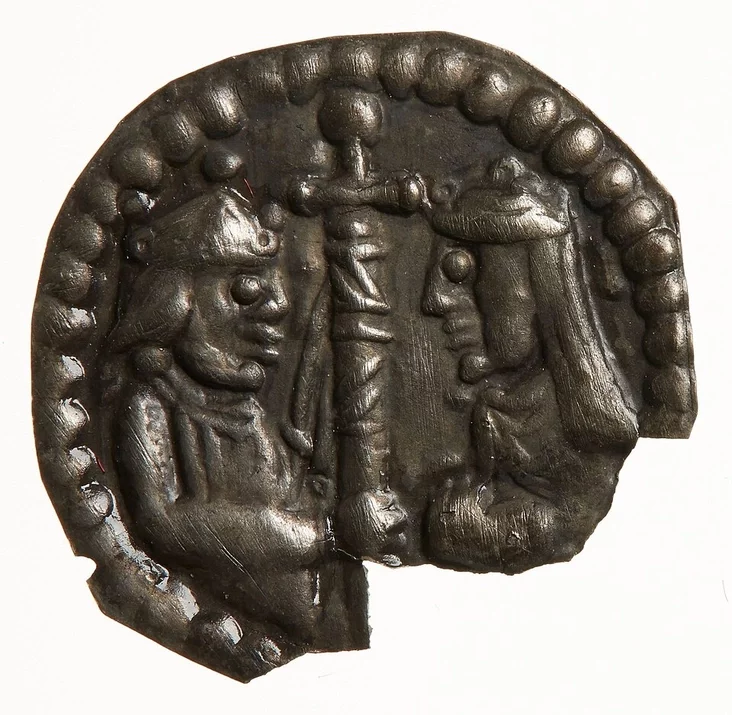

Abbot Wilhelm's testimony that at the time of writing the genealogy, Sophia's brothers "still successfully rule" destroys not only the Galician but also the Novgorod hypothesis: nothing at all is known about the sons of Vladimir Vsevolodovich. At the same time, chronicles record the existence of at least one son of Volodar of Minsk - Vasilko.
The Novgorod version also contradicts the strict rules of medieval dynastic marriages. Vladimir of Novgorod and Danish King Valdemar were cousins, as both were grandsons of Prince Mstislav. If Sophia had indeed been Vladimir's daughter, her marriage to Valdemar would have meant a close degree of kinship. No historical traces remain that the couple requested or received special ecclesiastical permission for such a union.
Additional indirect evidence of the connection between the Danish court and the Minsk Gleboviches is a historical episode involving gifts. In the 1170s, it was Volodar who sent valuable gifts to his daughter in Denmark. The gifts were intercepted by the Wends, which gave Valdemar a formal pretext to begin a military campaign and finally resolve the so-called "Wend question."
«Nasha Niva» — the bastion of Belarus
SUPPORT US


In New York, the Twin Towers were recreated in natural size using 2977 drones — corresponding to the number of victims of the September 11 terrorist attack


Comments
Як жылі раней людзі гэта вельмі цікава, але калі ў рэальнасці супольнасць перажывае цяжкія часы, то пачынаюцца казкі для дарослых. Вось Сафія Менская - "наша" у Даніі, дык нібыта я з вакна на Каменнай Горцы пачынаю бачыць Капенгаген, і што Беларусь багатая краіна, якая вынайшла папулярны лек. Засталося толькі вочы заплюшчыць