


Russia failed in its attempt to launch the Avangard hypersonic missile for the first time in 8 years
Russia has postponed a planned test launch of its newest Avangard hypersonic missile. This weapon is among the six types of so-called "wonder weapons" whose creation Vladimir Putin announced in 2018, writes The Moscow Times.
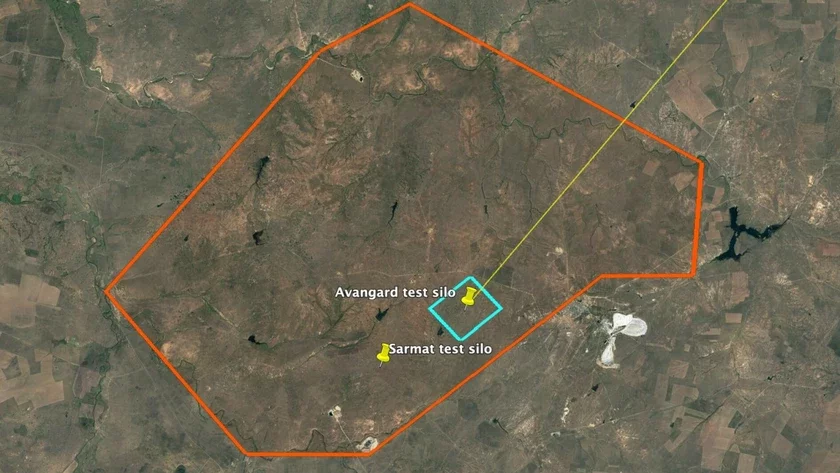
According to open data, the test was planned for September 3-5 at the Dombarovsky test site in the Orenburg region. This is where the only division of the Strategic Missile Forces equipped with Avangards is located.
For the planned dates, Russian authorities issued NOTAM aviation messages, which closed dangerous areas for flights. In the Dombarovsky area, the restriction covered the zone of missile silos with Avangards. Areas in the Tyumen region and the Khanty-Mansi Autonomous Okrug, where missile parts were expected to fall, were also closed. In addition, restrictions were introduced in the area of the Kura test site in Kamchatka, where the missile's warhead was supposed to land after the flight.
Local authorities also warned residents of several districts in the Tyumen region about the upcoming test. The main launch date was named September 3, with September 4 as a backup.
However, the launch of the UR-100N UTTKh intercontinental ballistic missile with the Avangard hypersonic glide vehicle never took place.
Pavel Podvig, a senior researcher at the UN Institute for Disarmament Research, believes that the launch was most likely not a failure, but rather canceled. If the missile had successfully launched, Russian authorities would likely have made a public statement about it, as Avangard has great symbolic significance for the Russian armed forces. If a failed launch had occurred, NOTAMs, according to the expert, should have been quickly canceled, but this did not happen.
According to Podvig, Russia apparently planned to launch Avangard from the Dombarovsky test site towards Kamchatka, but for an unknown reason was forced to postpone the test. He suggests that a new launch attempt may occur in the near future.
The last successful launch of Avangard took place in December 2018. Vladimir Putin then claimed that this missile "has no analogues in the world" and is invulnerable to missile defense systems. According to him, during flight, the block heats up to a temperature of about 3000 degrees, but at the same time retains the ability to receive control signals.
Former head of Roscosmos Yuri Borisov stated that Avangard is capable of developing speeds up to Mach 27. However, experts note that some characteristics declared by the Russian leadership raise doubts from a physics perspective.
At the same time, according to SIPRI experts, Avangard indeed exists and is in service with Russia. Unlike some other Russian projects, such as the "wonder torpedo" Poseidon or the nuclear-powered Burevestnik missile, which faced problems during testing, the existence of Avangard is confirmed by available data.
According to SIPRI, as of early 2026, Russia had 12 Avangard complexes in service. Their declared range is up to 10 thousand kilometers, and each of them is equipped with one warhead.


Comments