


A Man from Talachyn Became a Moscow Agent. He Had One Week Left to Live
Dzyamkouski remained silent, constantly staring straight ahead. Bahavoy shouted, waving his Soviet diplomatic passport, while Polish counterintelligence officers nervously gathered documents scattered across the car's interior, marked «Ściśle tajne» — absolutely secret. Mobilization military materials, maps, defense plans, notes, transcripts. The story is published by the 'Vitaut's Crown' project.

Soviet diplomat Vasil Bahavoy was released after his identity and diplomatic passport were verified. Dzyamkouski was handcuffed and immediately taken for interrogation.
The documents were so secret that it was now necessary to find out as quickly as possible which of them Dzyamkouski had already managed to hand over to the USSR. The calendar showed July 11, 1931.
Piotr Dzyamkouski was 36 years old. He was born in 1895 in the village of Harbachova near Talachyn. And who knows, perhaps his poor peasant Belarusian, yet probably happy childhood in the then Mahilyow region, flashed before Piotr at the moment of his arrest.
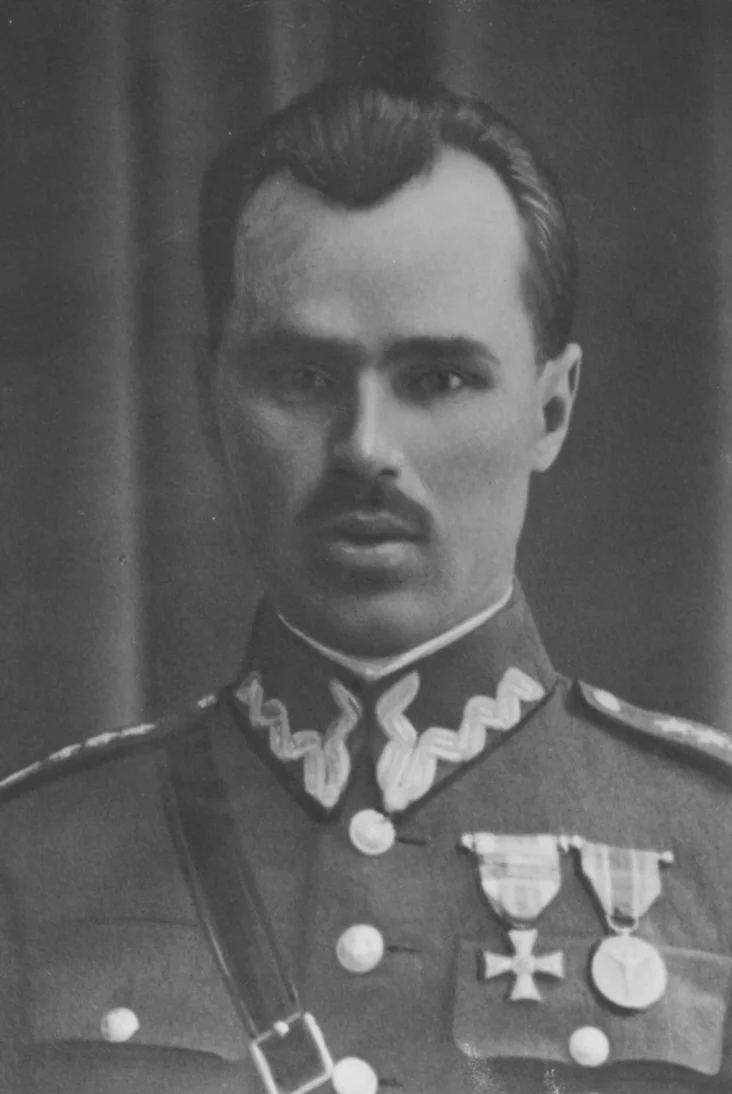
Dzyamkouski made a dazzling career in the Polish army: Major of the General Staff, veteran of the war with the Bolsheviks, three times awarded with Crosses. And now he was pulled out of a Soviet diplomat's car with secret documents in a folder.
Polish counterintelligence had been waiting for this moment for almost two months. Routine, daily surveillance of Soviet diplomats in Warsaw yielded interesting information on May 20, 1931.
On one of Warsaw's central streets, a well-built man in a light suit got into a Soviet embassy car. The special services decided to find out who this companion of the Soviet diplomat was. The man was put under surveillance.
And he didn't particularly hide. Ten days later, the same man, but now in the uniform of a Polish army major, with a thick dark folder, got into the same Soviet embassy car. A lead!
Polish operatives urgently requested photographs of all majors serving in Warsaw. The unknown man was identified — Piotr Dzyamkouski, Major of the General Staff, a hero of the war with the Bolsheviks. And most dangerously: he had access to the most secret documents of the Polish army.
Now counterintelligence was interested in everything they could find out about Dzyamkouski. He was born in Belarus, in Harbachova, now Talachyn district of Vitsebsk region, then Mahilyow region. In 1916, he volunteered for the Russian army, graduated from military school in Tbilisi, fought on the Austrian front, and studied gas warfare technologies. After Poland regained independence, he joined the Polish army and only continued to climb the career ladder. Higher Military School, the rank of major, finally, in 1930 — the General Staff.
At first glance — the biography of a successful officer. Attention was drawn to the fact that Dzyamkouski's wife, Antanina Myadzvedzeva, was Russian. Nothing special, Polish lands had recently been part of the Russian Empire. But while trying to obtain permission for her relatives to leave the USSR, Dzyamkouski once appeared at the Soviet embassy in Warsaw.
There he met the deputy Soviet military attaché Vasil Bahavoy.
Today, knowing the circumstances of the case, it can be said that Dzyamkouski himself sought contact with the Soviets.
«What must I do to atone for my past sins before the Soviet authorities and start working for them?» Dzyamkouski intended to ask Bahavoy. And he received the answer: no sacrifices are needed, it will be enough to perform a certain service in the military sphere.
Dzyamkouski began to hand over documents obtained from the Polish Army General Staff to Bahavoy: intelligence reports, meeting transcripts, army command schemes. Bahavoy would take the documents to the embassy each time, photograph them, and return them to Dzyamkouski on the same day.
The major neither took, demanded, nor asked for money for his services. During interrogation on the day of his arrest, Piotr Dzyamkouski would say:
«If a communist revolution were to break out, I would undoubtedly side with the communists».
He relentlessly criticized the organization of military affairs in Poland, but admired the Red Army: «Everything there is logically connected, intelligently constructed, and prepared for war conditions».
Polish special services decided to arrest Dzyamkouski at his very next meeting with the enemy.
And that day, as we already know, came on July 11, 1931. Operatives had been following Dzyamkouski since early morning. After work, he returned home with a tightly packed folder. After some time, he left the house in civilian clothes, also with a folder. He went to the Central Military Library, and two hours later, he left there and returned to the center of Warsaw by tram. The folder was with him the entire time. At that moment, a Soviet embassy car with Vasil Bahavoy at the wheel stopped nearby. Dzyamkouski jumped into the car. In the same second, two cars with Polish counterintelligence operatives, who were following both the Soviet car and Dzyamkouski, blocked the road.
The major's trial was extraordinary and swift — a death sentence. The lawyer appealed for a pardon to Polish President Ignacy Mościcki, but received a refusal on the very same day. On July 18, a week after his arrest, Piotr Dzyamkouski was shot.
The day before the execution, his wife, the Russian Antanina Myadzvedzeva, sent a statement to the press, disowning her husband:
«I completely and forever disassociate myself from my husband, Major of the General Staff Piotr Dzyamkouski, due to the grave and disgraceful accusation brought against him».
Soviet diplomat-agent Vasil Bahavoy almost immediately, in a hurried escape, left through Danzig for Moscow. A twist of fate — in 1937, he would be shot for espionage and counter-revolutionary activities.


Comments
Аднак насамрэч размова пра сталага польскага афіцэра, з 15-гадовым досведам, даўно не хлопца, які 3 месяца супрацоўнічаў з Саветамі, а тыдзень прайшоў не ад "стаў агентам", а ад затрымання да расстрэлу.
"Карона Вітаўта" таксама апынулася жоўтай.