


It is not the brightest of birds you can meet in a garden or park. But, as scientists have found, it is its song that is most pleasing to the human ear.
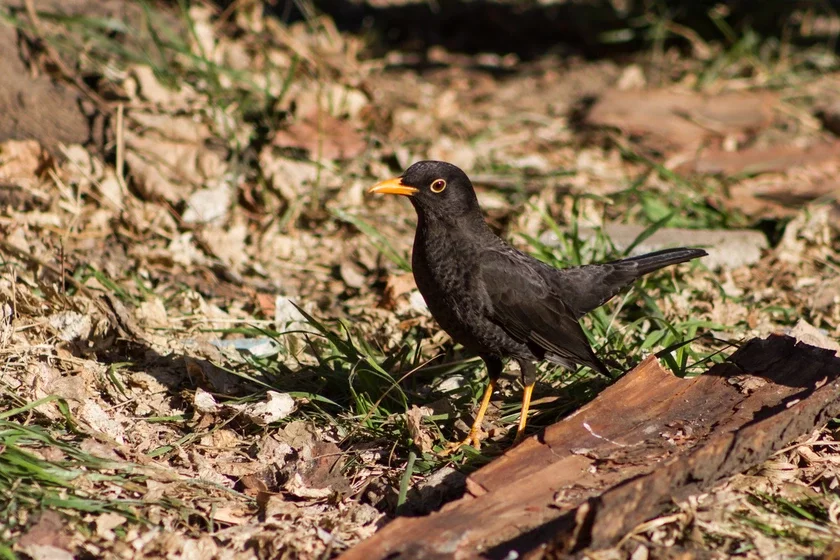
Is it possible to scientifically determine which bird sings most beautifully? As the Daily Mail writes, researchers from the University of Tübingen tried to do this — and at the same time found out what people like in bird voices.
For the experiment, they selected recordings of 123 species of wild birds common in Germany. Among them were renowned "singers" as well as species whose voices more closely resembled cries, wheezes, or honking.
84 participants were asked to listen to 15-second recordings of bird voices and rate their pleasantness on a scale from one to five. And people's tastes were similar enough to form a clear ranking.
The blackbird received the highest average score of 4.52 points. Its song is described as rich and soft, with clear, flute-like sounds.
In second place was the common chiffchaff with its gentle song, and in third place, the Eurasian blackcap, whose voice is distinguished by its richness and variety of sounds. Also in the top five were the Mistle Thrush (4.33 points) and the Garden Warbler (4.3).
However, the nightingale, traditionally considered one of the best bird singers, did not make it into the top five. It received 4.26 points and took eighth place.
People found the voice of the barn owl the least pleasant, rating it 1.32 points. This owl emits a harsh, piercing shriek that bears little resemblance to what is typically called birdsong.
Slightly better performed the Egyptian goose — 1.62 points. Its sound repertoire includes grunting, hoarse cries, and honking. Following it is the grey heron with its harsh, raspy voice. The five outsiders are rounded out by the peregrine falcon (1.67 points) and the Eurasian jay (1.73).
What Makes Birdsong Pleasant
But the researchers were interested not only in the ranking itself. They wanted to find out what unites bird voices that people find most pleasant.
The analysis revealed several patterns. People preferred complex and varied voices. Relatively high and not too loud sounds were also perceived as more pleasant, as were songs with a narrower frequency range.
A more specific feature was also observed: birds with high ratings less frequently produced sounds in the frequency range to which human hearing is particularly sensitive.
Interestingly, it was not at all necessary to be knowledgeable about birds to evaluate birdsong. Participants' knowledge of them, as well as their ability to recognize species by sight or sound, did not affect how pleasant the recordings seemed to them.
However, attitude towards the birds themselves did matter: participants who valued them more generally gave higher ratings to bird voices.
But why do such sounds appeal specifically to the human ear? Researchers do not yet have a definitive answer. The authors suggest that this may be related to how humans perceive their environment: diverse sounds of moderate loudness and frequency can serve as a signal for us of a safe and healthy place where one can relax and recover.
However, the experiment did not allow for all features of a bird's voice to be taken into account. For example, the researchers did not check whether the frequency with which a bird vocalizes matters, although this could also affect its perception.
The authors of the study suggest that their findings could help improve urban parks and enhance the sound environment of stress-inducing places, such as hospital waiting rooms. Additionally, this could contribute to nature conservation by popularizing birds with particularly beautiful voices.


Comments
Але лепей за ўсё знайсці месца, дзе ёсць ручаёк.
Вада журчыць, пераліваецца. А побач спяваюць рапухі.
Вельмі медытатыўна.
Што ў нас, што ў Гішпаніях, што ў Японіі.