


Tsikhanouskaya: I called Siarhei in the USA every evening, checked the children's homework. But he's a good man, he managed
Sviatlana Tsikhanouskaya told "Belsat" about her children, how she treated Karney, and how Hnia (Agnia) is very communicative and adapts everywhere.
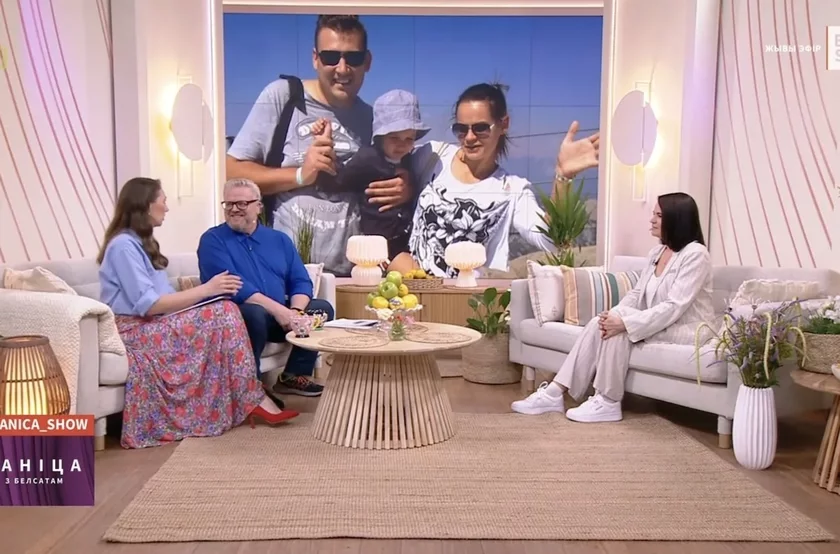
Sviatlana Tsikhanouskaya considers the ten years invested in her son's rehabilitation her main personal victory before entering politics: Karney, who was born without hearing and only heard his first sounds at two and a half years old, was able to go to a regular school, and now "talks non-stop."
In "Morning with Belsat," the leader of democratic forces sincerely answered personal questions: about the ultimatum at the CEC "either you leave, or to prison," about how Siarhei managed with the children after his release, and what she sacrifices for politics.
Propaganda portrays Sviatlana Tsikhanouskaya as an "ordinary housewife" who accidentally found herself in politics. Accidentally — yes, she agrees, but there were personal victories before 2020: for about ten years, she invested in the rehabilitation of her son Karney, who was born without hearing.
"There are already such systems of cochlear implantation — such artificial hearing.
And my son had such an operation quite late, at two and a half years old. Usually, such an operation is done in the first three to four months of a baby's life, and then rehabilitation proceeds like that of an ordinary person. But when my son heard his first sounds only at two and a half years old — we lost a lot of time. Every day we went to specialists, every day we practiced at home. We opened up the world of sounds," Tsikhanouskaya recounts.
She says there wasn't one single moment of victory: the victories were the first sounds, the first word, the first sentence. And the result – her son was able to go to a regular school, not a special one. Karney is now 16, and he "talks non-stop."
"And this is such happiness for me! I remember how we achieved this. There are difficulties, but we will cope with everything," says Tsikhanouskaya.
In early 2020, Sviatlana decided that she had done everything she could: "Well, that's it, I'll take care of myself." She went to work as a teacher in an online school, but, as she says, then "the year twenty happened."
Sviatlana also notes that all those years when she was busy with the children, Siarhei financially supported the family, as she could not work. "I have great gratitude to Siarhei," says Tsikhanouskaya.
About her daughter: "My soul doesn't ache as much"
Her younger daughter, Hnia (Agnia), grew up completely differently — "very communicative," she adapts everywhere.
"Now we are looking for a school for the children: Karney still has special needs, but Hnia will go wherever she goes. She adapts everywhere. Yes, maybe one shouldn't say it, but my soul doesn't ache as much for her, because, you know, when mothers are asked which child they love most, the answer is — the one who is having the hardest time now," Sviatlana explains.
About medicine in Belarus: "seven circles of hell" of commissions
In her own case, Tsikhanouskaya can't complain much about Belarusian medicine: the cochlear implant was purchased at state expense (though only one — in Poland and Lithuania, they do both ears at once), and rehabilitation was also provided. But the system for obtaining disability is a completely different matter.
"In Lithuania, I have one visit to the doctor and to social security — that's it. But I remember these endless commissions in Belarus: as if hearing might return, you have to go through these commissions again. It's very humiliating," says Tsikhanouskaya, hoping that the reforms currently being written will rectify this situation.
The hardest decision: to leave or to stay
In the conversation, Sviatlana recalled how in August 2020, after a meeting at the Central Election Commission, she was given a choice. "You either leave this office, or you go to prison," they told her. And they added about the children, who were already abroad at that point: "We know where your children are, don't think..."
"I think that was the hardest decision during the entire election campaign — to leave or to stay. It was a difficult internal struggle," Sviatlana admits.
Why did she leave? If Siarhei hadn't been in prison and there had been someone to look after the children – perhaps the decision would have been different.
"It was an internal struggle between a mother and an activist at that time. And perhaps a man in my place would have chosen activism, but my heart belonged to my children, and I understood that I had to take care of them," says Tsikhanouskaya.
At the same time, she emphasizes: at that time, everyone was making difficult decisions — both Maryia Kalesnikava, who joined the campaign instead of Viktar Babaryka, and state television employees who said "no." "I saw that people around me were also making difficult decisions. It was morally easier to do, because you know that you are not alone," Sviatlana recalls.
How Siarhei managed with the children
After his release, Siarhei Tsikhanouski took the children with him to America. Did the father, who before prison "didn't spend much time with the children, worked more," cope?
"No, listen, I called every evening, of course, checked their homework. But he's a good man. He managed. A five-year break — and he endured it all very well. And he only complained that he constantly had to cook, clean things, and that they were disobedient," Sviatlana laughs.
"I clean myself, don't worry"
Contrary to rumors that Tsikhanouskaya is served by many servants, the daily life of the leader of democratic forces looks quite ordinary: there is a nanny who takes care of the children when their mother is traveling: "take them to and from school and help with homework." The rest — she does herself.
"I clean myself, don't worry. I go to stores and cook," says Tsikhanouskaya.
How does she manage everything between international meetings? "Like any other woman. We are women, and that says it all," Sviatlana notes and adds without dramatization: thousands of Belarusians forced to leave have gone through the same trials.
"People think of themselves as much weaker than they actually are. And when life puts you in these circumstances, you just pull through," Sviatlana believes.
"I sacrificed my role as a mother"
Has she had to make decisions for the benefit of Belarus, rather than her children? That's how she has lived since 2020, Tsikhanouskaya admits.
"I even forget what grade my children are in. I am such a mother: I come on weekends to spend time with them — as if I'm catching up on what I couldn't do with them during the week. And yes, I think that I have now sacrificed my role as a mother for the sake of my role as a politician," she says.
Sviatlana talked a lot with her children about this: why their dad is behind bars, why they had to leave. "Such a fate has befallen you, and I hope you see these sacrifices," the mother tells the children, who miss their relatives, summer camps, and their apartments. And the thought of returning home "is constantly present in our family's life," notes the Belarusian democratic leader.
About threats to children: "This was the first time in such a format"
Recently, the media reported a story about the alleged preparation of an attack on Tsikhanouskaya and her children in Warsaw. Calls and strange messages on Telegram had happened before, the politician says, but threats specifically to the children were a first.
"I know that professionals are dealing with this case. But you understand that I don't put myself in any special position. I am just as much a Belarusian as many other Belarusians who are also being threatened. Therefore, I remain calm about it," says Tsikhanouskaya.
And she adds: it's good that such cases are exposed, as it helps to understand what to prepare for.
"Of course, take care of your safety. Because the fact that we, Belarusians, are united, that we have stood strong, that we have become stronger, that we continue our work – this, of course, greatly hinders any plans of the regime," the leader of the democratic forces urges.


Comments
Играла роль, а зрителем был я.
В душе её таинственной мирились ложь и истина
Актрисы непростого ремесла.
Ему единственно верна хотела быть она. (с)
Чытайце на НН!