


Forget the "white swan". The Saint Sophia Cathedral in Polotsk is proposed to restore its historical colored facade
Another restoration of the Saint Sophia Cathedral in Polotsk is set to begin soon. In this regard, architect-restorer Raman Zabiela proposes to abandon the familiar, but utilitarian, white paint and restore the main church of Polotsk to its true, colorful historical appearance from the mid-18th century.
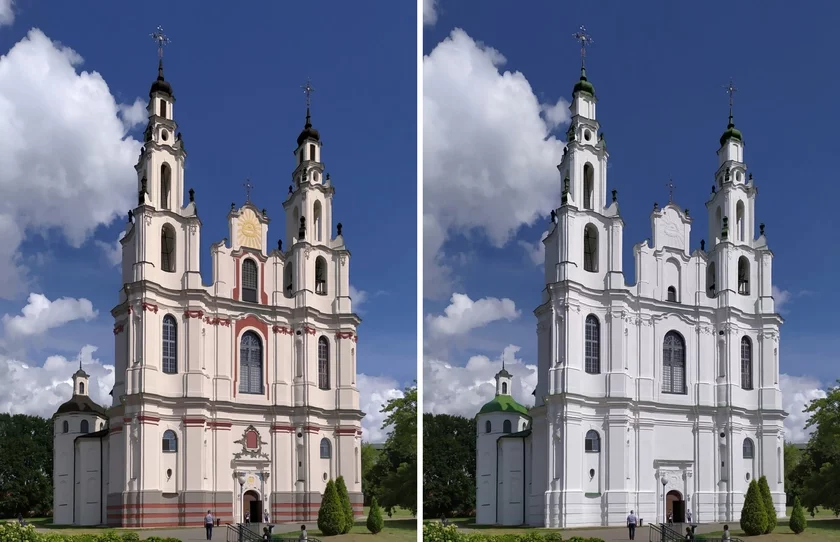
On his Facebook page, Raman Zabiela notes that the current snow-white image of the Saint Sophia Cathedral, which many poetically compare to a "white swan," is often mistakenly perceived as authentic. In fact, this appearance is the result of utilitarian repairs in the 19th century and restoration approaches of the 1980s.
“In the second half of the 19th century, the building was two-colored; later it was whitewashed, but the roof was dark, not such an active green. And historical lime whitewashes never provided such a long-lasting bright color that reflects light and makes the facade optically 'flat',” the researcher writes.
The specialist explains that the essence of repainting Baroque facades in a single light color during the Russian Empire was exclusively a practice of cheap regular repairs and unification.
According to the imperial decrees of the time, facades in cities were to be painted every 3-4 years and have a subdued pastel tone. This led to the loss of the unique distinctiveness of the objects. In restoration methodology, such a repair stage is not considered valuable and should not define the new appearance of the monument.
Baroque should be colorful
Today, the Saint Sophia Cathedral has the completed appearance of a Baroque church from the mid-18th century, into which the remains of an 11th-century church are delicately integrated. The restorer emphasizes that no new authorial or stylistically complete changes have occurred since then, so restoring the original Baroque coloring is an absolutely logical step.
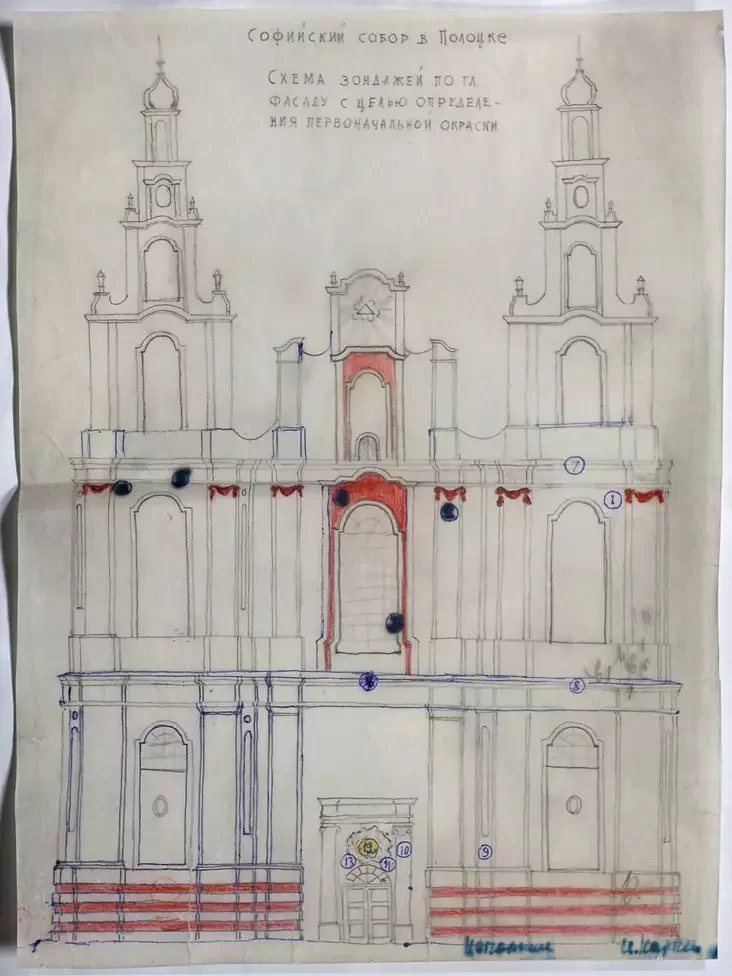
That the Saint Sophia Cathedral was colorful has long been no secret to specialists. This was confirmed by stratigraphic studies of paint layers in 1969, as well as later studies in 2002 and 2011. Based on these data, Raman Zabiela proposed a conditional graphic reconstruction of the cathedral's color scheme, where the facade acquires warm ochre hues with terracotta accents on decorative elements such as window frames, garlands on pilasters, and recessed plinth bands (similar to the Baroque architects' reference to striped masonry "with a hidden row," which the Polotsk school of architecture adhered to until the end - NN).
“Until now, I often encounter arguments against restoring the historical coloring: 'people are used to it', 'what if they don't understand', 'no need to risk it'."
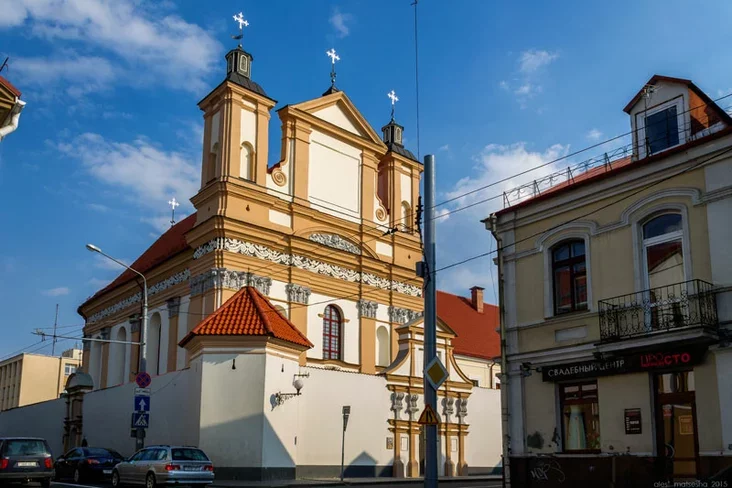
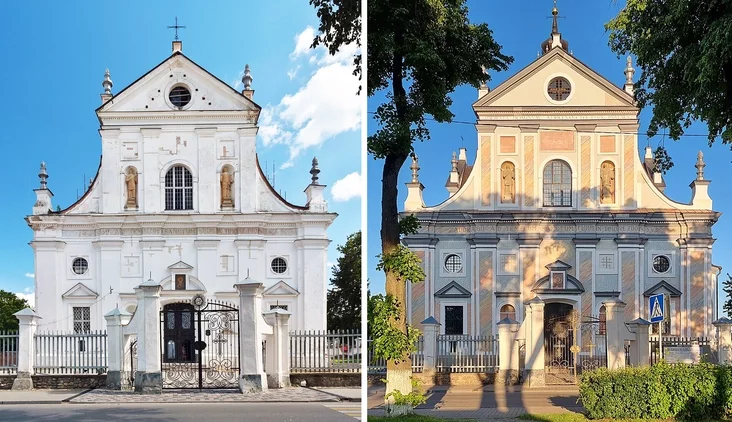
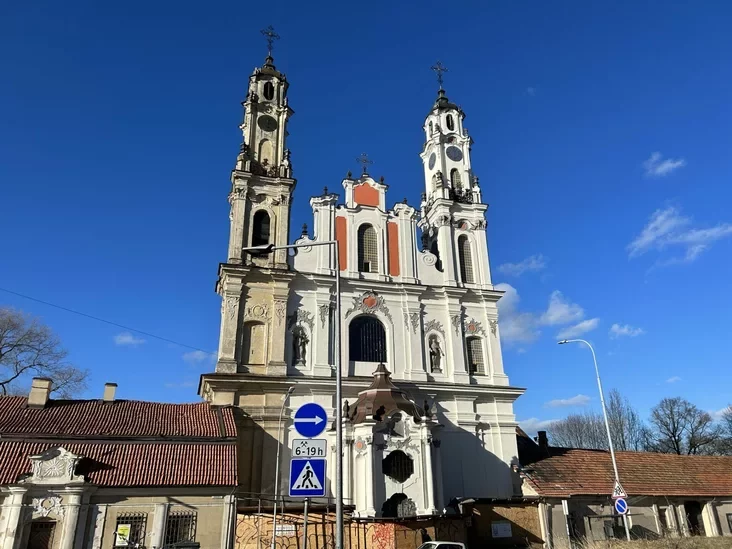
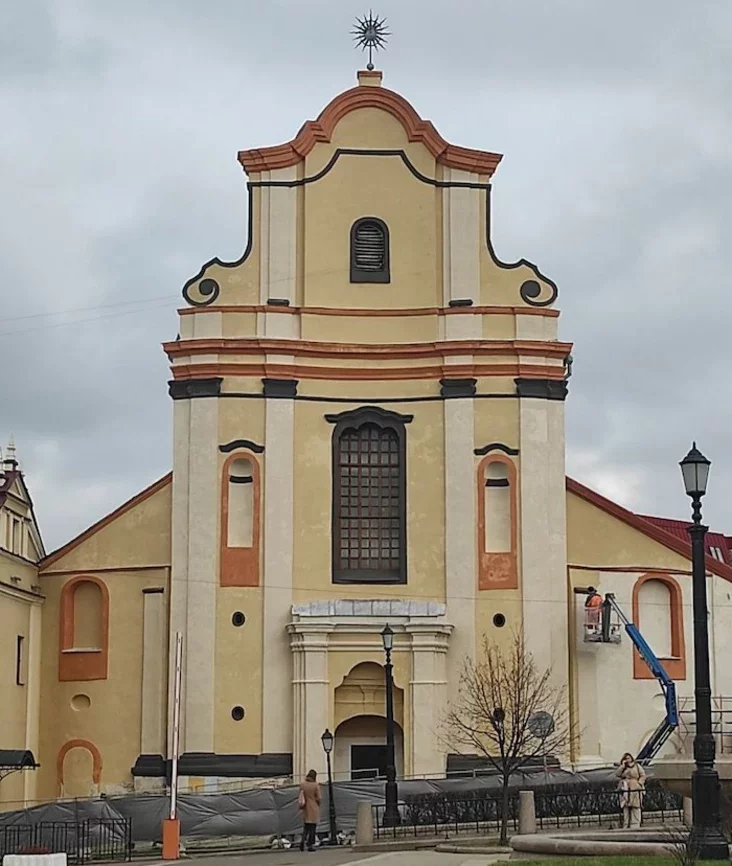
“In fact, restoring Baroque coloring is not something new in Belarusian restoration practice. Relevant works have already been carried out at different times and to varying degrees on the Brigittine Church in Grodno, the former Jesuit Corpus Christi Church in Nesvizh, the former Bernardine Church of St. Joseph in Minsk; and are currently underway at the Bernardine Church of the Immaculate Conception in Slonim. The result, both for the urban environment and for the perception of the monuments themselves… is exclusively positive,” the expert argues.

What needs to be done?
On the eve of the new restoration, the architect calls for formulating a precise request for a comprehensive study of the monument's historical coloring.
According to him, with each new repair, the information available for study on the facades becomes less and less.
Studies should be carried out not only through the examination of small samples in the laboratory, but also through layer-by-layer cleaning of each element directly on the facade by artist-restorers, as was successfully done at the church in Nesvizh and the Church of St. Joseph in Minsk.
In addition to the color scheme, Raman Zabiela considers it necessary to more clearly display the authentic remains of the 11th-century walls on the eastern and western facades, and also to raise the issue of restoring the historical height of the roof ridge. All of this will help Polotsk regain not a utilitarian-white, but a truly historical Sophia.
-
Main building of the National Art Museum to be solemnly closed for reconstruction
-
A Mathematician in Love with the Belarusian Language and a Priest Who Learned English from Agatha Christie's Detective Novels. 100th Birthday of Alyaksandr Nadsan
-
In Minsk, the famous "prison warden's balcony" disappeared from a historic house on Valadarskaha Street
Now reading


DDoS attack targets websites of several Belarusian media outlets simultaneously. It may be related to the sixth anniversary of the 2020 popular uprising and the "New Belarus" conference, which opened today

DDoS attack targets websites of several Belarusian media outlets simultaneously. It may be related to the sixth anniversary of the 2020 popular uprising and the "New Belarus" conference, which opened today

Statkevich: If mass protests start again, they will no longer be as peaceful as in 2020. And the EU has rightly stopped believing Lukashenka's fairy tales

Statkevich: If mass protests start again, they will no longer be as peaceful as in 2020. And the EU has rightly stopped believing Lukashenka's fairy tales
"Poland flourishes in Latin, Lithuania flourishes in Ruthenian". A patriotic masterpiece of the 17th century turned out to be a Russian forgery of the 19th century.


Comments
и выдается теперь за "лучшее решение" именно теми, у кого до сих пор нет мозгов.
только в цвете они все имеют законченный вид. а белые - убогие пенопластовые макеты.
Але той выгляд, які мы маем зараз, стаў ужо легендарным. Так што не вельмі ўпэўнены, што трэба аднаўляць гістарычная колеры.
А "сапраўдную Сафію" ўжо не вернеш, бо яна была знішчана падчас акупацыі Полацка Пятром I.