


«If not for «Spring-1996, we would be Tatarstan». 30 years ago, Belarusians already protested against Lukashenka and Russia — what it was like
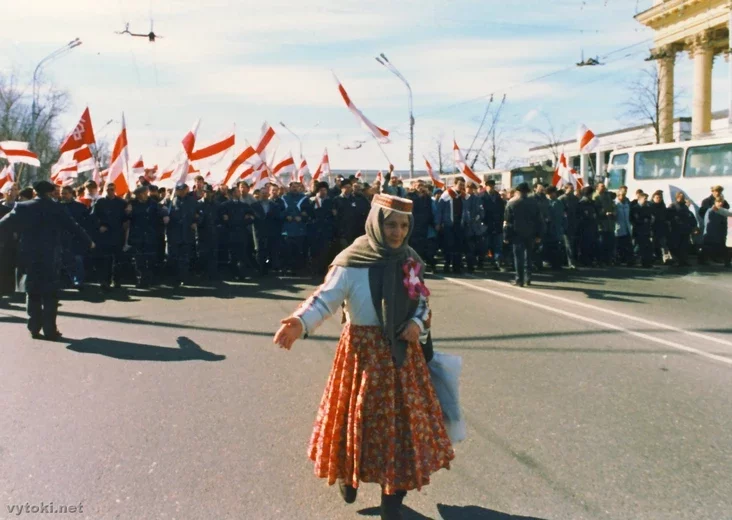
The series of street protests in 1996 is commonly called the «Hot Spring,» as the most massive actions took place precisely at this time — Freedom Day, the opposition to the signing of the treaty on the creation of a union between Belarus and Russia, and the Chernobyl Way.
Tens of thousands of people took to the streets, because at that moment, things had boiled over: deputies had already been beaten in the Supreme Soviet building, the 1995 referendum on replacing national symbols and granting Russian the status of a state language had taken place, and the first wave of electoral manipulations had occurred, resulting in the Belarusian Popular Front (BPF) having no deputies in the new parliament.
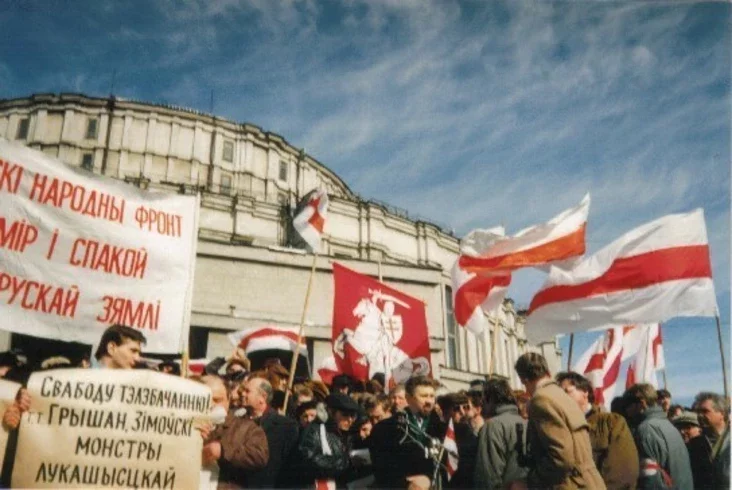
«Minsk Spring-1996 was a geopolitical protest, and that's how it will enter history. It could not stop the process of the so-called Belarusian-Russian integration — but it definitely stopped the annexation of Belarus by Russia. Our country is under the rule of bandits today, but legally we are independent — if not for «Spring-1996,» everything would be even worse: we would be Tatarstan,» — the direct participants in those events agree in their assessment.
30 years later, together with them, we recall the first blood on the streets of Minsk, the first falsifications, the first political prisoners, and the first political emigrants.
«The nationally oriented community was in depression»
The political year 1996 for Belarusians involved in the agenda began shortly after the New Year — on January 11, the Central Election Commission considered a complaint about mass falsifications in the Smarhon electoral district. It was there that they decided to nominate Zianon Pazniak for the elections, keeping in mind that the capital would be under special control, and also because, at one time, the BPF leader gained more votes there than both Lukashenka and Kebich in the presidential elections.
Unfortunately, the strategy did not work. Spoiled ballots, denial of access to observers, inability to meet with voters, dirty pressure on the opposition — all that would later become the «norm» in Belarus was tested for the first time then.
«A column of the BPF under white-red-white flags will never pass again,» — wrote journalist Anatol Maisenia. «The nationally oriented community was, it's no exaggeration, in depression.
Under such conditions, we had only one platform where the BPF had no competitors — the street. The events themselves dictated our tactic — holding small but regular pickets,» — recounts ex-deputy, politician, journalist Siarhei Navumchyk, who was the BPF press secretary at the time.
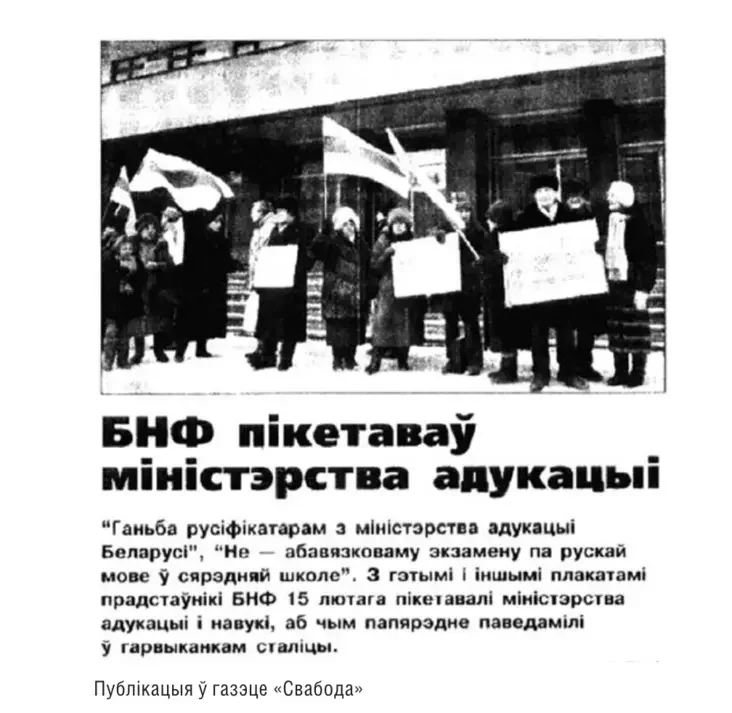
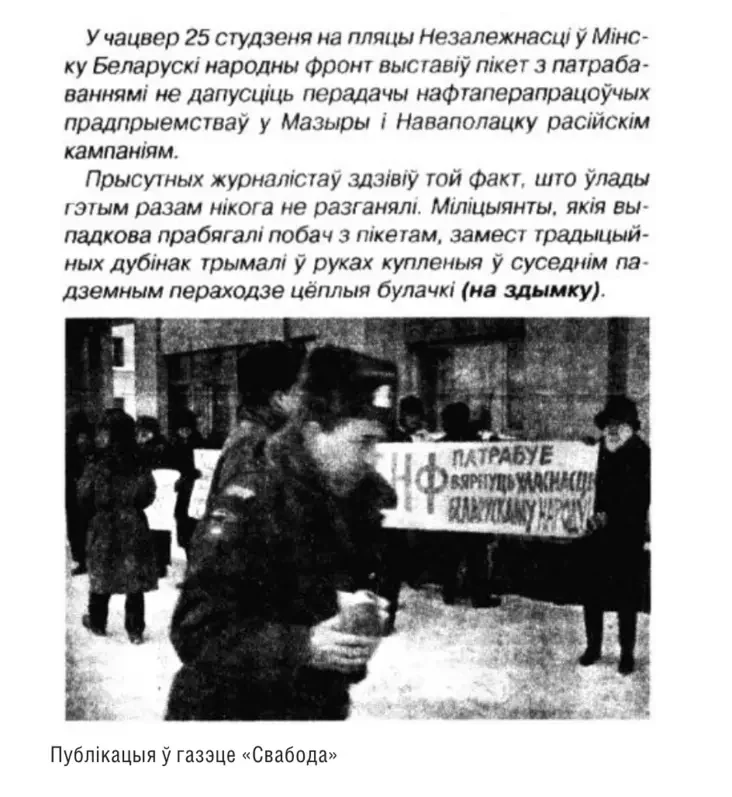
The opposition organized a whole bouquet of pickets, for which, by law, permits were not yet required — against the Russification of schools, against the persecution of Siarhei Antonchyk, who was tried for a report on corruption in Lukashenka's inner circle, against the transfer of the oil complex to Moscow, in defense of the Constitutional Court.
«About 20 people came to them. But the independent press wrote about it, people saw the pickets from trolleybuses — we were always under the white-red-white flag. And people understood: «No, the BPF has not left the arena, the Front members have not given up,» — recalls Siarhei Navumchyk.
«Lukashenka yearned to take the Kremlin»
At their own rallies and on every occasion, the Front members called everyone to a meeting in honor of the anniversary of the BNR's independence, which they additionally declared a protest against Belarusian-Russian integration.
«The looming threat of Russia's annexation of Belarus was very evident to everyone. Moreover, the desire for unification was mutual for the leaders of both Russia and Belarus. Moscow expected to gain a military-political foothold in the western direction, and Lukashenka yearned to take the Kremlin. He truly had good chances to replace the frail and ailing Yeltsin, and he had support for this both from a part of the Russian special services and from a number of regional Russian leaders (the so-called «red belt» of several Russian regions where communists were in power, who, in the dilemma of Lukashenka or Zyuganov, would prioritize the younger and more agile one in the case of a common state),» — Siarhei Navumchyk describes the «game of thrones» of that time.
«For the first time, more than a million leaflets were printed»
Thanks to the fact that the BPF had a branched network of structures in every capital district and at large enterprises, information about the BNR Day action, scheduled for March 24 (as the date fell on a Sunday), was instantly transmitted from one person to another. However, there were enough people who no longer believed that anything would succeed.
Politician Viachaslau Siuchyk, who at that time led the executive structures of the BPF, compares the mood of a certain part of society to the atmosphere at a funeral.
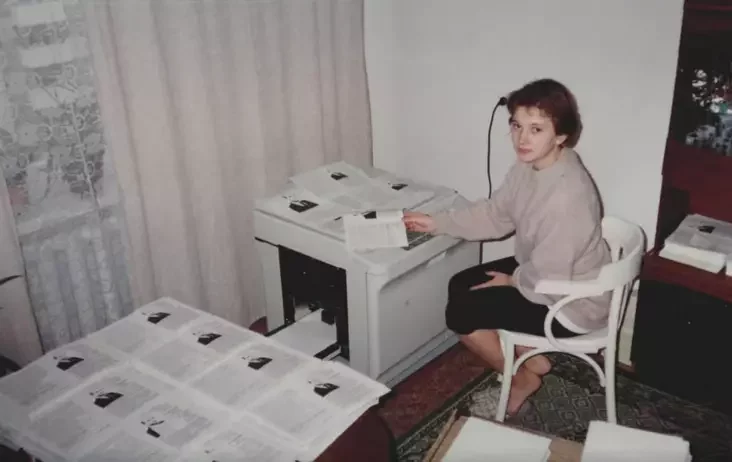
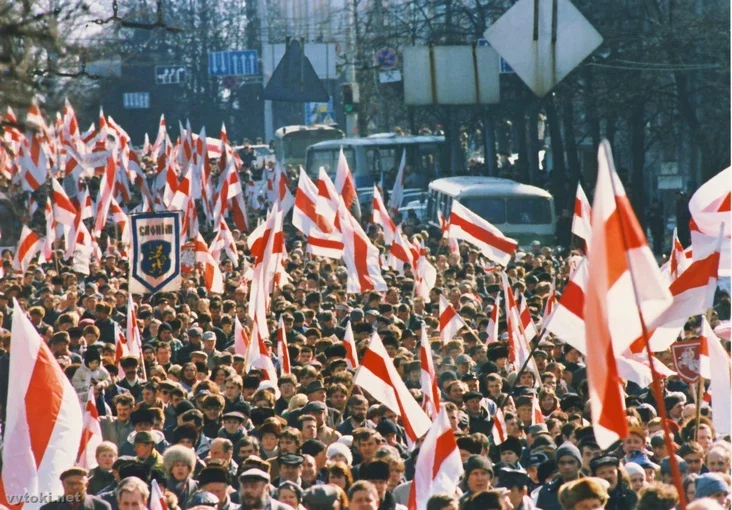
«For the first time, more than a million leaflets were printed. There were districts in Minsk where they reached every mailbox (all democratic parties were involved in this, including, for example, members of the United Civil Party and social democrats — NN). We also covered commuter trains in the main directions. At the same time, I remember people's tears, their disbelief that no one would come to the action because «our people are not like that.» But people came — a human sea unexpectedly flooded the city center for everyone. And they were much more determined than even we were.»
«Bykaŭ was one of the first to step off the sidewalks onto the roadway of the avenue»
For Freedom Day — 1996, the BPF prepared with maximum coverage — actions were planned in the regions, and star personalities joined the organizing committee. Along with Zianon Pazniak, for example, former National Bank chairman Stanislau Bahdankevich, recent Supreme Soviet chairman Mechyslau Hryb, politician and then-Deputy Speaker of Parliament Henadz Karpenka, as well as writers Ryhor Baradulin and Vasil Bykaŭ, marched there.
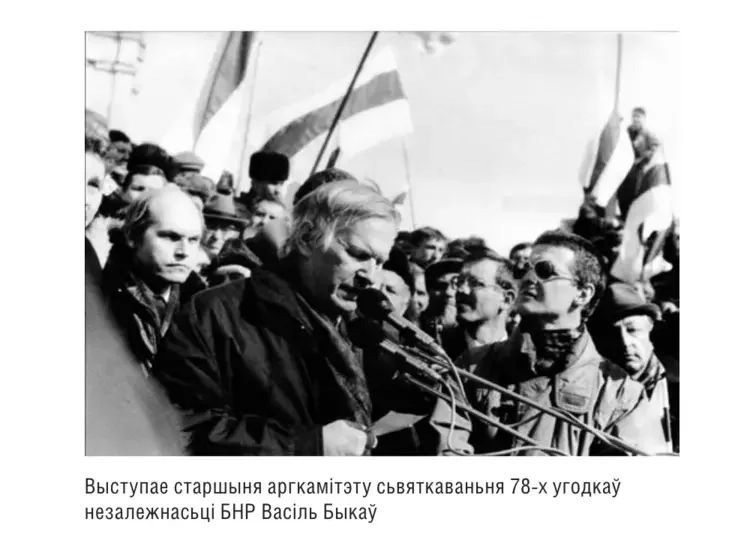
Today's Nobel laureate, former political prisoner, head of the Viasna Human Rights Center, Ales Bialiatski, was at that time a deputy of the Minsk City Council, secretary of the BPF, and also helped organize protest actions.
«Among other things, I carried stacks of «Narodnaya Volya» to the square, where people distributed them throughout the city. One time I returned to my workplace, went into a branch of the Maksim Bahdanovich Museum, but noticed some suspicious people in civilian clothes. I asked a branch employee to open another exit, climbed over a fence, and quickly left. The next day, he told me that after some time, these «plainclothes officers» entered the museum and asked him where I had gone,» — Ales recalls.
Viachaslau Siuchyk notes that for Freedom Day — 1996 turning out as it did, much thanks should be given precisely to Vasil Bykaŭ:
«Zianon Stanislavavich [Pazniak] went to Bykaŭ and asked him to become the chairman of the organizing committee — and his authority worked; everyone approached immediately agreed to join the organizing committee.»
True, such a figure had to be guarded diligently — people were very concerned about the writer's safety, as information about the desire to «remove» him multiplied.
«I put very specific security on Bykaŭ. Not even from the BPF activists (we had an organized squad back when we fought communists, and I led the squad members for a long time), but from people I knew personally,» — Viachaslau Siuchyk recounts.
«And then, when the procession started, I suddenly almost lost sight of Bykaŭ, which worried me greatly. It turned out that he was one of the first to step off the sidewalks onto the roadway of the avenue. And despite the fact that he already had serious health problems at that time, he walked the entire route with everyone and spoke at the rally.»
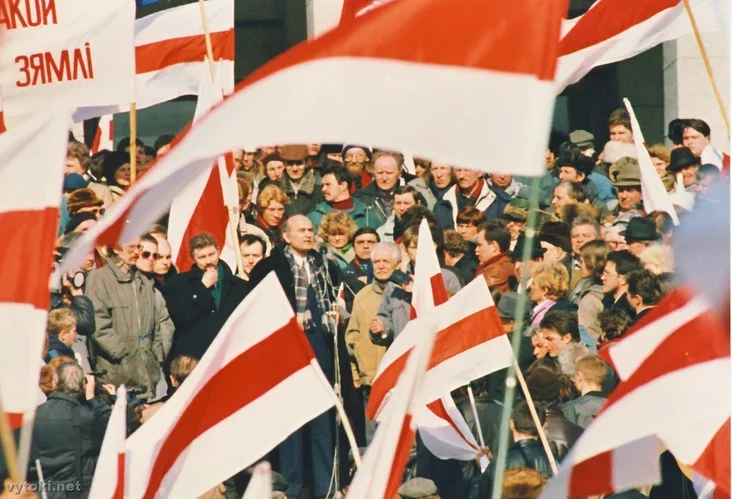
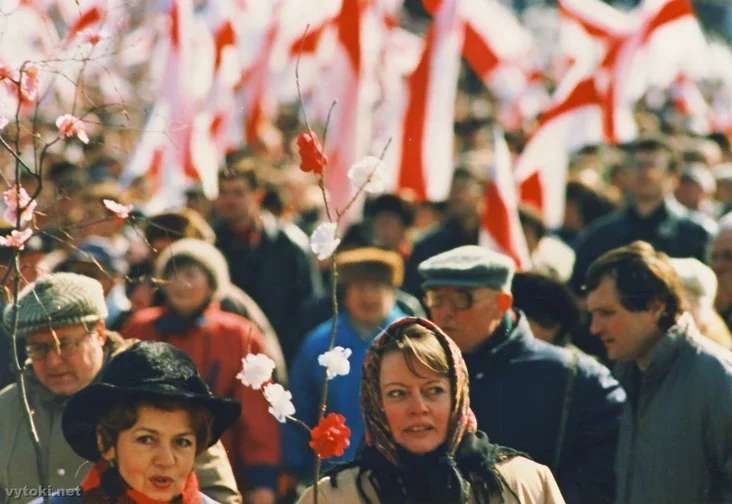
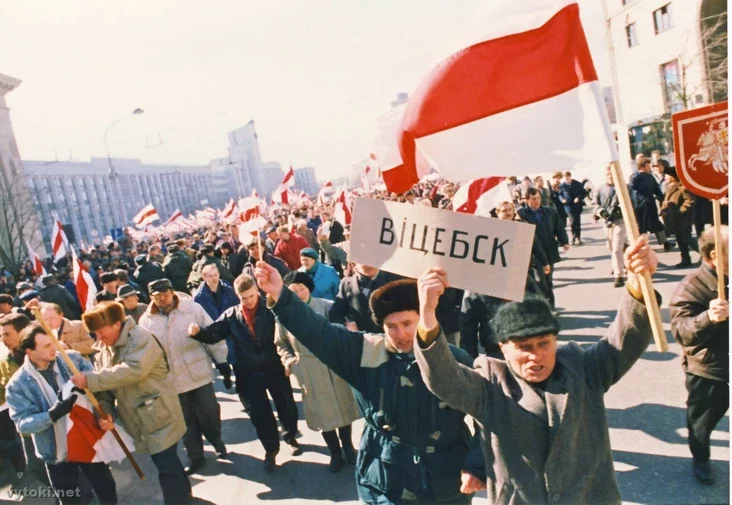
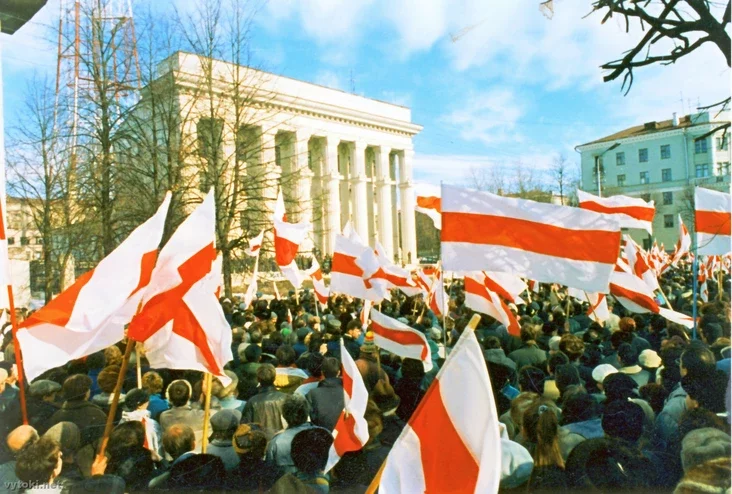
On March 24, thousands of people gathered in the square in front of the Government House with white-red-white flags and marched from there along the central avenue, which at that time bore the name of Francisak Skaryna. The prepared riot police (OMON) could not stop the crowd — the cordon was broken. Estimates suggest that when the column reached the Opera Theater, it already numbered about 30,000 participants.
Lukashenka was offered a one-way ticket to Moscow, the crowd sang Kasia Kamotskaya's hit «President, go home!» in unison, Zianon Pazniak called Lukashenka a traitor from the tribune.
«The man chosen by slaves, who betrayed the Homeland, who betrayed the people — this man ceased to be president. He put himself outside the Constitution and outside the law. From the moment these agreements [union, with Moscow] are signed, he ceases to be the official president. And each of us can no longer consider him president. He is subject to judgment, popular judgment, judgment of conscience, and our laws, which are in force and which we will protect.»
«They beat everyone — men, women, old people, children, some — to unconsciousness»
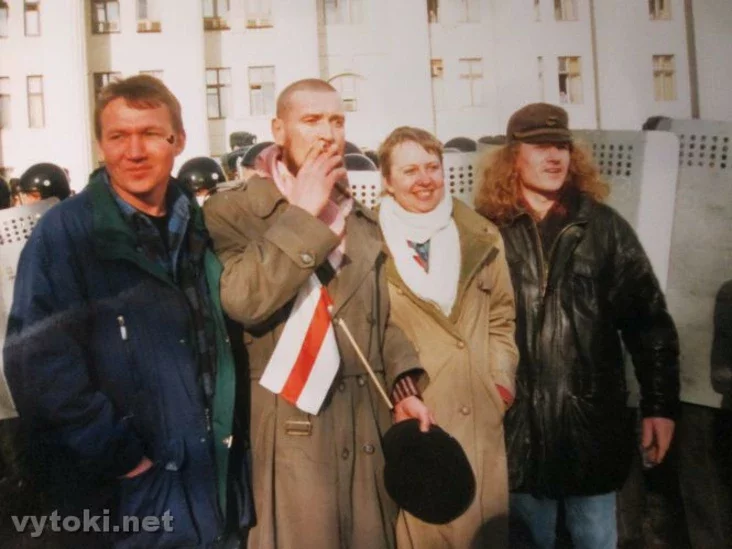
While the procession and speeches near the Opera House went rather peacefully, the brutality of events subsequently began to snowball.
The idea spontaneously arose to go to the TV center to demand airtime, as previous appeals to the chairman of the TV company Ryhor Kisial and the Presidential Administration requesting legal airtime for the opposition had yielded no results.
Near the TV center, a chain of security forces was already waiting for the column, which had dwindled to about 10,000 Belarusians — it was easily broken through. Zianon Pazniak, as well as MP Paval Znavets, were allowed into the building, where special forces were waiting for them. The politicians tried to reach the leadership, but it was Sunday. They called the then-head of Belteleradiocompany, Ryhor Kisial, but he did not answer the phone.
At the very same time, Siarhei Navumchyk tried to establish a dialogue with the police.
From the book "Ninety-Six":
«First, I appealed to the people to take three steps back so as not to create a crush and conflict with the police; I asked them to maintain order, and then I began to agitate the police with a megaphone. I told them what the unification of Belarus and Russia could personally threaten them with if they had to defend the Kremlin's interests in Chechnya and in various «hot spots.» I informed them that Belarusian legislation and international acts not only allow, but also require not to obey commanders' orders, if these orders are criminal.»
Unfortunately, none of the arguments worked, and the special forces rushed into the crowd, using their batons. They beat everyone — men, women, old people, children, some — to unconsciousness — witnesses to those events recalled. Additionally, gas was deployed. In the state press, as expected, it was written that all this was a response to snowballs and pieces of ice thrown at the security forces. Lukashenka, in turn, would call those who came out to protest «bought.»
«They brutally attacked from behind when some people had already started to disperse — a simply horrific massacre happened near the KGB, and for the first time, Belarusian blood was shed in the history of independent Belarus. They also attacked Pazniak then, but the BPF security saved him; the guys fought off the OMON officers,» — Viachaslau Siuchyk recalls. — «Immediately, as all this began, I ran to the BPF administration to hide all the lists with the names of our people, which we had not submitted to state bodies. Later, searches occurred in the administration, so this step was very saving.»
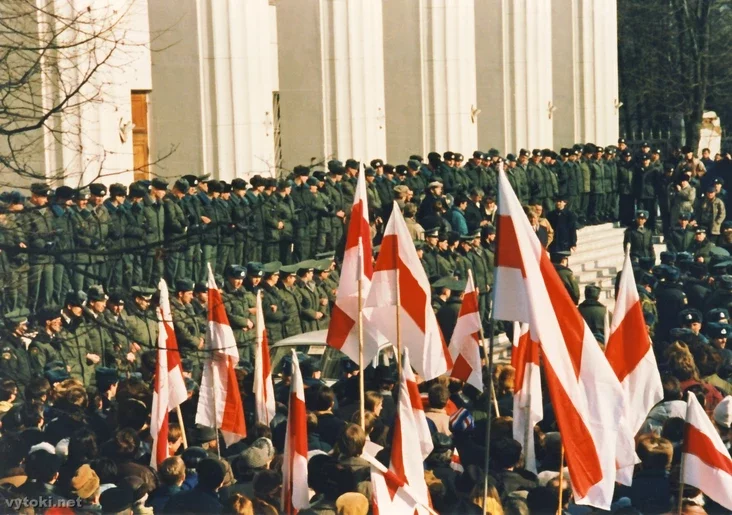
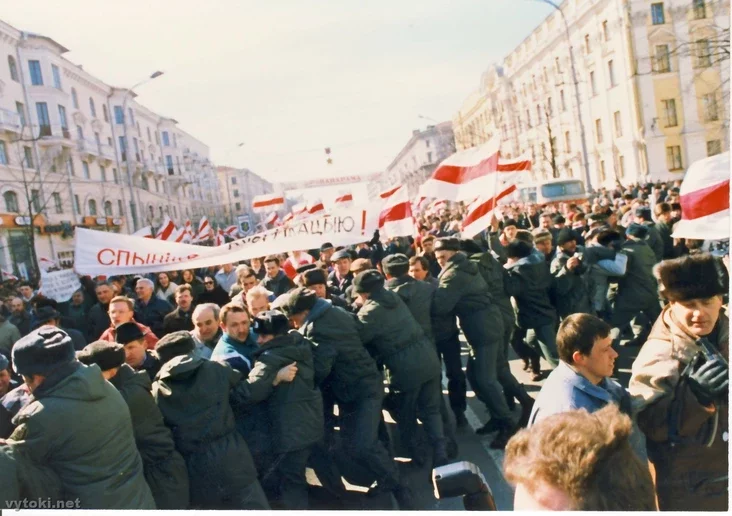
According to Siarhei Navumchyk, Lukashenka, in his reliance on force, was always inspired by the repressions in the USSR and Stalin.
«Stalin is his teacher. And the master class was given by the beating of deputies on the night of April 11-12, 1995, which was swallowed by the population. Then Lukashenka realized that he could do anything he wanted.»
«Lukashenka was honing his mastery of cruelty. Each time he gave harsher orders. His goal was to break the street protest movement,» — adds Ales Bialiatski.
«Information emerged about the decision to eliminate BPF leaders»
Following the events of March 24, about 30 people were detained, and a criminal case was opened against the entire leadership of the BPF.
«On March 25, I went to Hrodna, as on this day, Freedom Day actions were taking place in the regions. I found myself there as if in another world: the festive hall was overflowing with people, beautiful songs were sung in Belarusian, as well as in the languages of national minorities — Polish, Yiddish, Lithuanian. And in my apartment, a search had already taken place at night — all forces were thrown against the Front members. I was forced to go deep underground so that I would not be neutralized, while Zianon Pazniak and Siarhei Navumchyk left the country — this was a collective decision, as information emerged about the decision to eliminate them. While I was underground, Ales Bialiatski performed my functions,» — recounts Viachaslau Siuchyk.
«When we left, many accusations were hurled at us. Including from those, who eventually left themselves. These are good people, we just sometimes lazy to put ourselves in another person's shoes before reproaching them,» — recalls Siarhei Navumchyk. — «I then took with me only a diplomat case and a suitcase with a tracksuit, some underwear — well, like a person going on a business trip for a few weeks. We were not going to ask for political asylum. But in early July, Moscow announced that the CIA allegedly intended to kill two BPF leaders in Poland and blame it on Lukashenka. At the same time, the West was already beginning to recognize Lukashenka: he was solemnly received in Paris, a red carpet rolled out in the Élysée Palace.
As a result, our asylum application presented Washington (where international politics was formed, as it is now, mainly) with a dilemma: either grant asylum and, accordingly, revise its attitude towards official Minsk, or — refuse. The State Department, by the way, was not «for» asylum. But the Ministry of Justice decided, based on the principles of the value of human life and freedom. Immediately after we were granted asylum, the New York Times came out with an editorial titled «Tyrant of Belarus» — the attitude towards Lukashenka began to change, and the 1996 referendum took place with incomparably greater international attention than the previous one.»
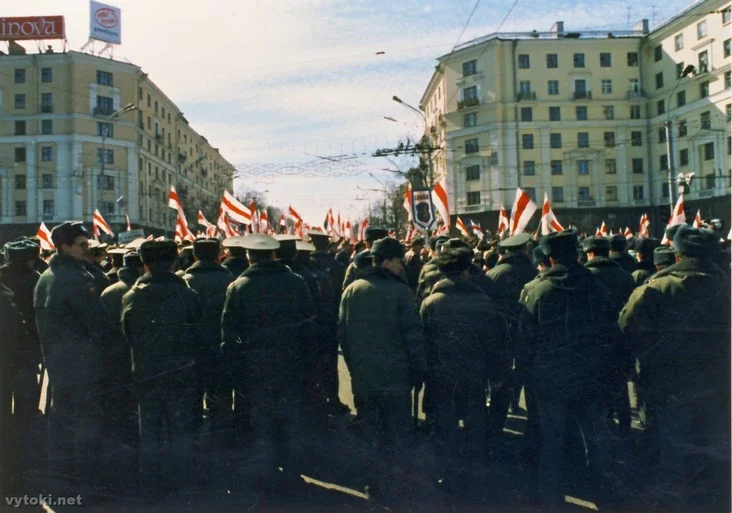
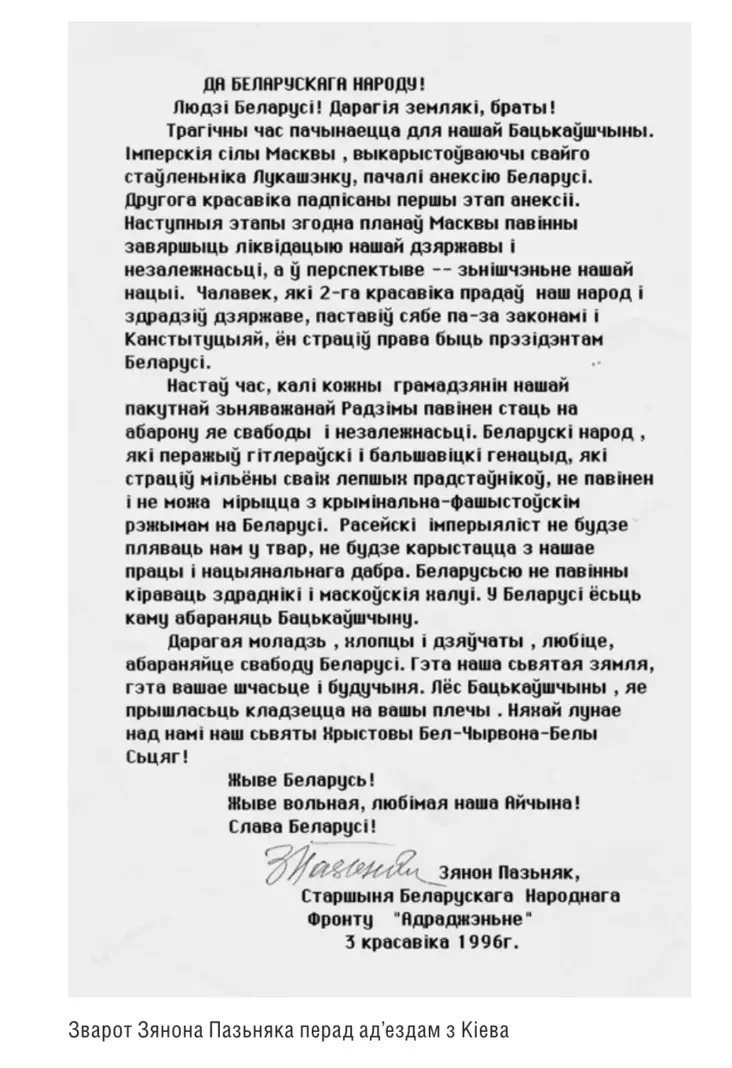
Despite the repressions, the next public turnout will take place on April 2, the day Yeltsin and Lukashenka will sign an agreement in the Kremlin on the formation of a Belarusian-Russian commonwealth. It would seem — that's it, this is definitely the end. Especially with the leaders abroad. However, on April 26, crowds will again fill the streets, and Zianon Pazniak will join them. But more on that — in the next article.
Now reading


Lieutenant Colonel Zara, whom security forces consider Sakhashchyk's analyst, found in KGB pre-trial detention center. How he ended up in Belarus is unknown

Lieutenant Colonel Zara, whom security forces consider Sakhashchyk's analyst, found in KGB pre-trial detention center. How he ended up in Belarus is unknown

A crowd of schoolchildren gathered outside the Mark Formelle store — the brand released a limited collection with a wildly popular singer from Baranavichy

A crowd of schoolchildren gathered outside the Mark Formelle store — the brand released a limited collection with a wildly popular singer from Baranavichy


Tsikhanouskaya frankly spoke about her son's illness and the invisible work of women. "Ten years of my life I dedicated to him and his rehabilitation"

Tsikhanouskaya frankly spoke about her son's illness and the invisible work of women. "Ten years of my life I dedicated to him and his rehabilitation"


Police revealed their version of why the guy who admonished a tourist for a cigarette butt in the center of Minsk spent the night in the police station

Police revealed their version of why the guy who admonished a tourist for a cigarette butt in the center of Minsk spent the night in the police station


"Threatened to leave for another." The Ministry of Internal Affairs revealed details of the murder of a 43-year-old pregnant woman by a hockey referee


Comments