


Released Ales Chumakou spoke about the accusation: "I played Belarusian folk music and thereby rallied the protest core"
Hussar and political prisoner Ales Chumakou was released from behind bars on September 16. In his first interview after his release, he told Svaboda how he listened to his own songs in court, how he was forced to carol in Kalodziščy, and why there will be no prison songs in his work.
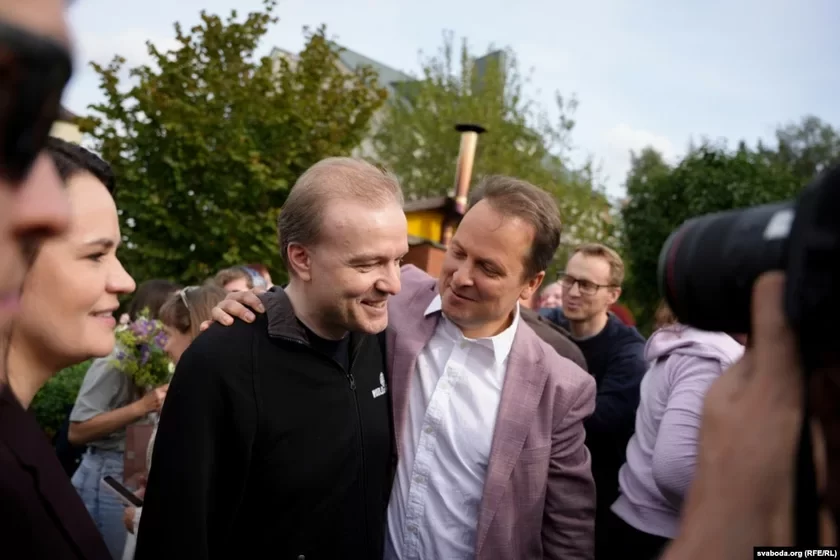
Ales Chumakou is still in Vilnius, from where he plans to move to Warsaw. Ales hopes that he will not have major problems with legalization in Poland. He admits that he is happy about his release, despite his forced departure from Belarus. This does not upset him; in Poland, he expects to return to his favorite activity — making music.
"I want to fully immerse myself in my creative musical life," says Ales. "In Warsaw, Tatsiana Yachnaya is waiting for me first and foremost, with whom we have had a duo for many years. We plan to reunite, as in recent years we worked on opposite sides of the border (Tatsiana lives in Warsaw; before his arrest, Ales Chumakou traveled there from Minsk for joint recordings). He traveled and traveled. It was inconvenient, only possible a few times a year. Now, of course, the work will go on. But Belarus has lost its gusli. This is a problem for modern Belarus."
Ales says that four days ago he was still ready for any turn of events. In the last days before his release, he was in Pre-trial Detention Center No. 1 in Kalodziščy with publisher Zmicier Kolas (who was also released and taken abroad on September 16). They were given to understand that release was possible, but the prisoners were not fully confident about their future fate.
"For three days we talked about all possible topics, played all possible intellectual games," Ales recalls. "We only had what we had in our heads. But Zmicier is a very interesting person. I hope I also managed to dispel his sadness. We were together only for the last three days. As it turned out, they were preparing us for this exchange. There were several other cells where people were being prepared for this. We only saw them on the bus when we were going to Lithuania."
Christmas in Kalodziščy
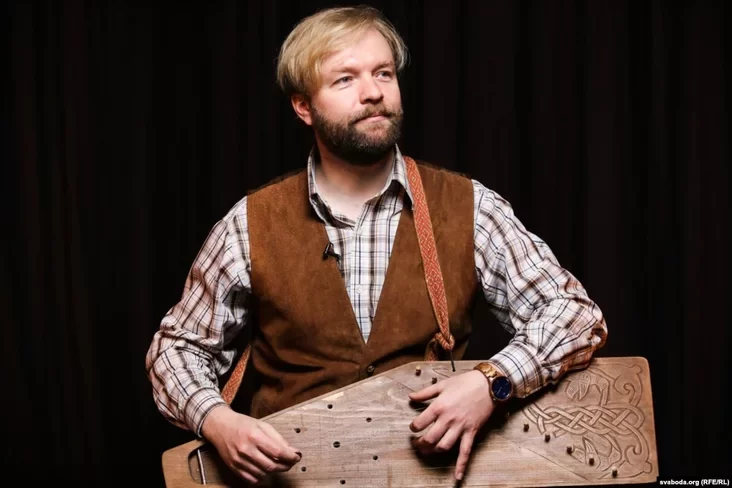
The guslar, longtime member of the band "Stary Olsa" and author of solo projects, Ales Chumakou, was arrested last December, just before Christmas. He spent the entire time of his imprisonment in Kalodziščy, never making it to a penal colony.
"I went for Christmas to Kalodziščy," Chumakou jokes. "Tatsiana Yachnaya and I have carols as one of our main creative branches. We make a Christmas journey around the world, where we sing Christmas songs of different peoples in Belarusian. From Poland to Venezuela. The entire Christmas world in translations by wonderful poets. And this year I sang Christmas songs for my cellmates in Kalodziščy. I organized a Christmas quiz – they guessed the countries from which the song came. My voice trembled terribly, but there was something."
Ales says he had the idea to write a song about Christmas in Kalodziščy, but ultimately abandoned it. There will be no prison songs in his work. He wants to return to what has always interested him — translations of interesting, high-quality poetic works. The experience of imprisonment, surprisingly, might even help Chumakou in this.
"I changed six different cells there," Chumakou recalls. "And in these different cells, I had different neighbors from different countries. And like Count Monte Cristo, I learned different languages. First, I learned Georgian with a Georgian, then Uzbek with an Uzbek. Afterwards, I brushed up on Polish grammar with a graduate of Warsaw University."
"There was plenty to do. And in recent months, I was with a Moldovan who speaks four languages quite well. Including, of course, his native Romanian. And I had seven notebooks with grammar, dictionaries. Eventually, our combined knowledge allowed us to translate Belarusian songs into Romanian. We translated the most famous song from 'Stary Olsa's' repertoire — 'Ruža-kvetka' (Rose-Flower). Someday it will be sung in Romanian at concerts, come listen."
Ales talks more about his neighbor from Moldova than about other cellmates. In a few months, this man managed to completely change his political views.
"He initially said he had traditional views," Chumakou recounts. "He advocates for Moldova's closeness with Russia. He would vote for Dodon (a pro-Russian Moldovan politician, a supporter of Lukashenka). But after sitting in our Kalodziščy and watching the news on TV, he eventually said he would not vote for Dodon. He started telling me that Moldova should be with Romania and that it would be in the European Union."
In total, Ales Chumakou spent about 9 months behind bars. Until that moment, he remained in Belarus, despite traveling abroad for recordings and concerts. Why did the musician stay in the country for so long, despite the widespread mass repressions targeting Belarusian cultural figures?
"You know, after my release, people approached me and asked if I needed a psychologist," Ales says. "And now I believe that psychological help is needed for those people who remained in Belarus and do not understand where they remained. Those who went through prisons, through torture, through abuse — they understood everything. And their minds and common sense are now on the right track. Where they should be. Before my arrest, they weren't there yet. No one could explain it to me then. Today, everything is in order."
"Played music, formed the core"
The trial in Ales Chumakou's case took place quite recently – in August. The musician says he heard the accusations there. Which consisted of him "playing Belarusian folk music and thereby rallying the protest core."
"Excuse me, but with such accusations, you can arrest and imprison any person on the street," says Ales. "I did all this sincerely for the state. And it turns out that I was rallying the protest core. This means that the state does not need its own language, its own culture, its own folk instruments. Everything became clear to me."
Chumakou was ultimately convicted under Article 361-1 of the Criminal Code for participating in an extremist formation. He was named a member of the Belarusian Council of Culture, although Chumakou never had any connection to such an organization.
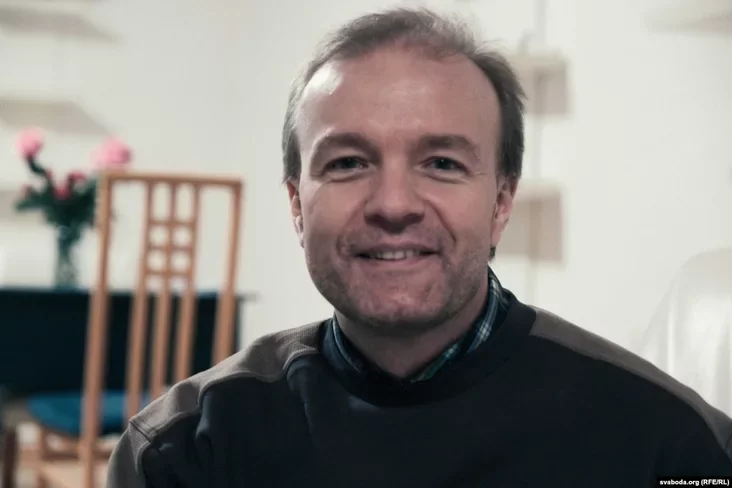
"I was surprised that I was released now," Ales Chumakou admits. "No one explained anything to me, I still don't know who to thank. Who influenced me to be included in such a priority list. 25 people is a meager number. So many innocent people are sitting there. I feel very uncomfortable in front of those people who have been sitting there much longer than I was, who suffer much more. I sincerely feel sorry for the people who should have been released before me."
Drugs and fraud
Along with Ales Chumakou, three musicians from the band Tor Band were released from behind bars. In Kalodziščy, the leader of "Palace," Aleh Khamenka, was there at the same time as him. Ales says he knew about his arrest, but he never met Khamenka personally behind bars.
"I found out from letters," Chumakou recounts. "The fact that Aleh is sitting there is a huge loss for us. Aleh must be released."
"His health is not good, Aleh had operations. And then suddenly this detention and sentence. This is a catastrophe. He must be saved. In general, there are many people from culture there. Even those I know personally. Aleh Laryčau has serious health problems. He was brought as a witness to my trial, he didn't look well. Human rights defenders need to know about this, to prioritize his rescue. No one should be there."
During the conversation, Ales Chumakou also mentions his non-political cellmates. He notes that many of them can also be considered political prisoners, as a large number of people behind bars ended up there if not completely by accident, then simply because it is much easier for the Belarusian law enforcement system to simply imprison a person than to search for evidence of their guilt.
"Drugs, courier services for fraudsters," Ales says. "The majority are there on these two articles. Real fraudsters, thieves, drug lords — they are not there. Accidental people who were deceived, or they didn't even know what they were doing. Prisons are overcrowded because the system is too lazy to investigate real criminal offenses. There is no evidentiary basis against the arrested, in any other country they simply would not end up in prison."
Is there music behind Belarusian bars? Ales Chumakou says that apart from his own music and singing Christmas carols behind bars in Kalodziščy, there is a lot of music, but it would be better if there was silence. According to the musician, what prisoners are forced to listen to on the radio can only be called torture for him.
"I want to warn the employees of Belarusian radio stations, which can be listened to behind bars, that they are participating in torture," Ales says. "Perhaps they don't realize it."
"But in all institutions of the Department of Penal Enforcement, the radio is turned on compulsorily. They play the same playlist. Even if Radio 'Stolitsa' has a more or less diverse broadcast, other radio stations have a playlist of three and a half songs that are looped one after another. And for me, a musician, this is direct torture. I lost my hearing there. All this at unlimited volume. They turn it on - a screech, pressing on the ears. The anthem every morning at enormous volume. If, as a Belarusian, my country's anthem used to inspire me, then you stop respecting it. You consider it an element of torture."
Ales adds that behind bars, he most dreamed of listening to silence. That's what he, as a musician, missed most there. Not some favorite recordings or musicians, but precisely silence.
"I developed hearing problems," the musician says. "And I had them before my arrest, but after prison, they worsened. The clanging of iron, alarms, sirens, loud shouts, dogs — all of this strongly pressed on me, on my hearing. People in a confined space constantly talk, there can be four conversations at once. All of this is very loud, catastrophically pressing on a musician. For us, every sound is work. The brain processes, breaks down these sounds, searches for harmonization, analyzes. Constant brain work. There, I wished to hear silence all the time. Something that is not there."
Music behind bars
Ales Chumakou admits that he tried to play music behind bars using whatever was at hand. He even created some semblance of musical instruments. The main ones were his own hands. Prisoners try to play a primitive wind instrument by combining their fists near their mouths. Ales says he also learned to do this and could even get several different notes this way and combine them into a melody.
"From various threads and elastic bands stretched between beds, prisoners even make something similar to a gusli," Ales recalls. "I didn't do it, but the guys fooled around. I tried to make an organ from the lid of Korean carrots, from plastic. Something more or less worked out. Something sounded, I got a couple of notes. It pulled me to play. Whistles could be made. But I tried not to bother my cellmates. Especially since I studied languages for several hours a day. That wasn't in silence either."
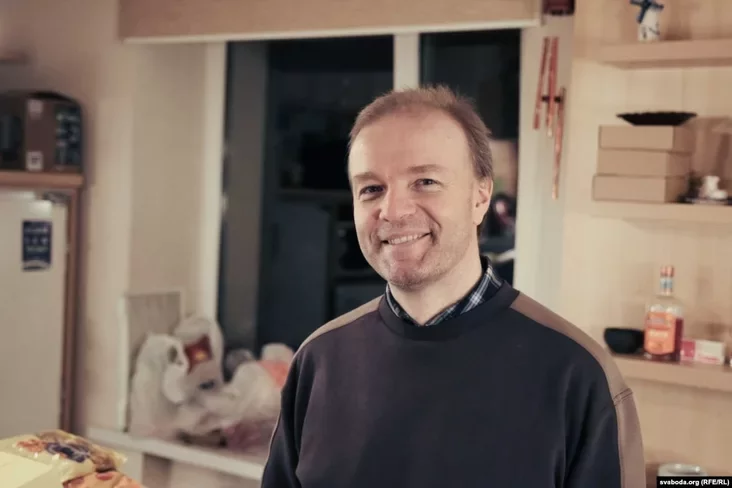
After his imprisonment, Ales Chumakou is full of creative plans. He talks about the imminent release of an album of Christmas songs, recorded jointly with Tatsiana Yachnaya, the same album that was played at his court hearing.
"The song it will start with, itself begins with the words 'Let's sit down, let's chat'," Ales says again with a laugh. "There's no escaping this fate. I will choose a different title for it, I won't reveal which one yet. I announce it as one of the most 'expensive' albums in Belarusian music. Please listen to it and decide whose side you are on - the investigators' or the prosecutors'."
What else? Ales Chumakou says he already knows about several projects he would like to release. Among them is an album of translations of Viktor Tsoi and Kino's songs into Belarusian, which he plans to play on the gusli.
An album with Belarusian translations of Vladimir Vysotsky's ballads, performed on Belarusian medieval instruments. It will include seven works. Ales would also like to release an album with Belarusian translations of songs by Minsk bard Aaron Krup, who died in the Sayan Mountains in the 60s and whose songs Belarusians still sing in Russian on hikes.
"This is what classical author's song in Belarus began with," says Ales. "A wonderful bard, born from the Belarusian tourist movement. Krup was born in Dvinsk, studied in St. Petersburg, lived in Minsk. This will be a restoration of the tradition of Belarusian author's song. Arik Krup will sound in Belarusian. I contacted his relatives, and they approved the project. They said it must be done."
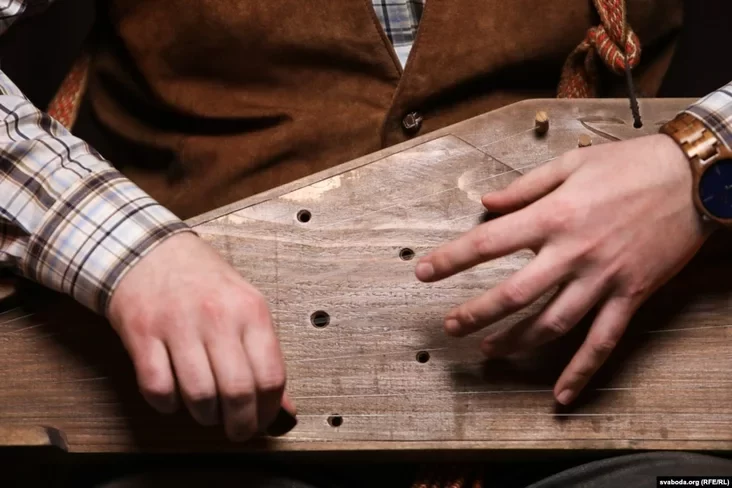
Ales still intends to create music and play it mainly on the gusli. He says that this is the second time he has lost his collection of these instruments. The first time happened during a fire in his workshop, now they remained in Belarus.
"For the third time, like a phoenix from the ashes, I will have to restore everything, build anew," Ales says. "I will restore it. For now, the priority, of course, is to check my health. Then I need to get all the necessary papers to legalize. And I will get back to playing the gusli."
Now reading


Half were denied, a third were granted refugee status. August results of reviews of Belarusians' applications for international protection in Poland have become known


Comments
там уже сотни беларусов сидят как в клетке без действующих паспортов и без побытов, без проездных доков, без международки... без банков, без разрешений на работу.
и поляки НИЧЕГО не делают.
да, сейчас ему что-то дадут, но когда придет время продлять, он пополнит их ряды с вероятностью в 99%.
но один товарищ сказал, что "няма кейсау". наверно так и есть, а я все придумал.. ну-ну..
У цытатнік:
"Псыхалягічная дапамога патрэбная тым людзям, якія засталіся ў Беларусі і не разумеюць, дзе яны засталіся.
Тыя, хто прайшоў праз турмы, праз катаваньні, праз зьдзекі — яны ўсё зразумелі. І галава і глузды ў іх сталі на свае рэйкі."
(Пра непалітычныя справы) "Турмы перапоўненыя таму што сыстэма лянуецца расьсьледаваць сапраўдныя крымінальныя злачынствы. На арыштаваных няма доказнай базы, у любой іншай краіне яны проста не трапілі б у турму".
"Супрацоўнікаў беларускіх радыёстанцый, якія можна слухаць за кратамі, я хачу папярэдзіць, што яны ўдзельнічаюць у катаваньнях".
Што з дзіўнай справай, за якую яго затрымалі? Казалі пра экстрэмісцкае фармаванне «Да Зораў», у якое яшчэ ўваходзіў Сямён Малашэнкаў. Гэта за яе судзілі ці яна развалілася?
І аўтары сайта, зараз не выкарыстоўваеце тыя магчымасці, якія дае сайт і што было прынята раней. Кантэксту (напрыклад, спасылкі на навіну з затрыманнем) няма, тэгі па асобах даўно не выкарыстоўваеце, блок "Чытайце яшчэ" не рэлевантны. Што адбываецца, чаму так?
Усім раю ягоны канал на youtube gusliby. На прыгаданыя ў інтэрв’ю пераклады Крупа таксама даўно звярнуў увагу.