


"Russia's offensive pace has decreased significantly." Military analysts on how the course of the war in Ukraine changed over the summer
How drones and fuel shortages slowed down the Russian offensive. Military analysts summarize the results of the last months of the war in Ukraine: the pace of the Russian army's advance has dropped significantly, and Ukrainian long-range strikes on rear areas are creating serious logistical problems for the enemy, reports "Current Time."
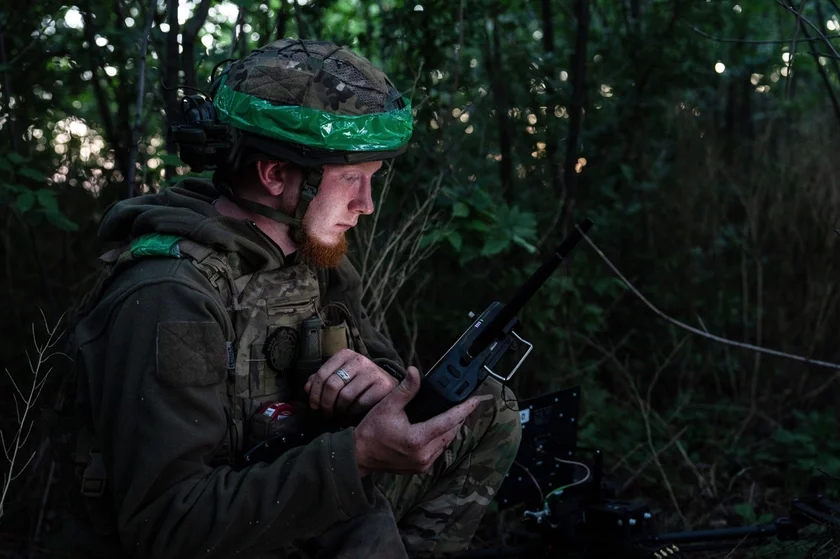
The Ukrainian cities of Kostiantynivka, Lyman, Dobropillya became a symbol of Ukraine's defense this summer — it is there that the main strike of the Russian Armed Forces is concentrated. And in the south of the country — in Zaporizhzhia Oblast, near Orikhiv, Huliaipole, and Novosilka — analysts record the advance of Ukrainian troops.
"Under the command of Drapata, they advanced approximately 25 kilometers. This is a very significant distance in the current war. In July, we liberated as much territory as the enemy managed to capture. We have parity. And this is measured in 25-30 kilometers," military analyst Oleksiy Hetman comments to "Current Time."
In general, since the beginning of the year, the Ukrainian Armed Forces have liberated about 700 square kilometers of territory. The Russian Armed Forces captured approximately the same amount. This is the main result of the summer military campaign, analysts say: Ukraine is still defending; it is not appropriate to talk about a transition to a global offensive. But the Russian army will not be able to capture the Sloviansk-Kramatorsk agglomeration by the end of summer: its pace of advance has decreased.
"Compared to what it was a year ago or more — by 10 times. Or even more. By and large, the resources that were strategically allocated are being depleted in the Kostiantynivka and Lyman directions. Summer is ending. In fact, the first task has not been completed," says military analyst Pavlo Lakiichuk.
The slow advance of both armies, in particular, is due to the specifics of the war. Drones have made rapid advances impossible. Many analysts link the decline in the pace of the Russian offensive precisely to air attacks.
This summer, Ukraine increased the number of middle strikes (from English "middle strike" — "medium-range strike," note: NV) on the rear areas of the Russian army, which complicates all logistics, and deep strikes (from English "deep strike" — "strike into the depth," note: NV) on Russian territory.
"Deep strikes prevent the delivery of fuel and all necessary supplies to operational rear areas," explains military analyst Denys Popovych. "And now we can say that there is a shortage of fuel at the front, primarily gasoline. With diesel, things are easier due to the specifics of Russian refining. But there are big problems with gasoline. Everyone says the army consumes diesel; that's true.
But gasoline is needed for generators. And generators are needed at the front line to charge batteries, to charge drones, radios."
The second point on which military analysts agree: the war has become cheaper. To hit a hypothetical warehouse 200 kilometers from the front line, a missile costing several hundred thousand dollars is no longer needed. This is also confirmed by Firepoint, a company that produces Ukrainian missiles and drones.
"The goal was to create a product that would be simple, understandable, repeatable, and wouldn't require months of training. In our case, a fresh look at the industry, at how some things should be done, helped us significantly reduce the price on the market and show that the same results can be achieved, but with greater speed and at a lower price," says company CEO Iryna Terekh.
Drone attacks, she adds, are aided by the scale of Russian territory: it is impossible to cover it with air defense systems. Over the country and annexed Crimea in 2026, more drones were shot down than in the previous three years, according to the publication "Proekt."
And the oil refining industry is not the only target for UAVs, says Firepoint head Denys Shtylerman.
"We need to finish off Wildberries and Ozon: if we take them down, it will inevitably lead to the collapse of a huge number of banks. This is a disruption of established daily life, the collapse of tens of thousands of businesses that sustain this army with taxes, this madman [Russian President Vladimir Putin], and pander to Russia's imperial ambitions," he is convinced.
According to Shtylerman, Ukraine plans to produce four ballistic missiles per day by the end of the year. Ukrainian ballistics are currently in the final stages of testing.
Military experts are confident: this will be a significant argument already during the winter military campaign.
Now reading


DDoS attack targets websites of several Belarusian media outlets simultaneously. It may be related to the sixth anniversary of the 2020 popular uprising and the "New Belarus" conference, which opened today

DDoS attack targets websites of several Belarusian media outlets simultaneously. It may be related to the sixth anniversary of the 2020 popular uprising and the "New Belarus" conference, which opened today


"Poland flourishes in Latin, Lithuania flourishes in Ruthenian". A patriotic masterpiece of the 17th century turned out to be a Russian forgery of the 19th century.

"Poland flourishes in Latin, Lithuania flourishes in Ruthenian". A patriotic masterpiece of the 17th century turned out to be a Russian forgery of the 19th century.
Statkevich: If mass protests start again, they will no longer be as peaceful as in 2020. And the EU has rightly stopped believing Lukashenka's fairy tales


Comments