


Russia attacks the Black Sea, Ukrainian ports and vessels under strike. How critical is this?
Russia has intensified missile and drone attacks on the port infrastructure of Odesa and the region. Commercial vessels are also under attack, writes the Ukrainian service of the BBC.
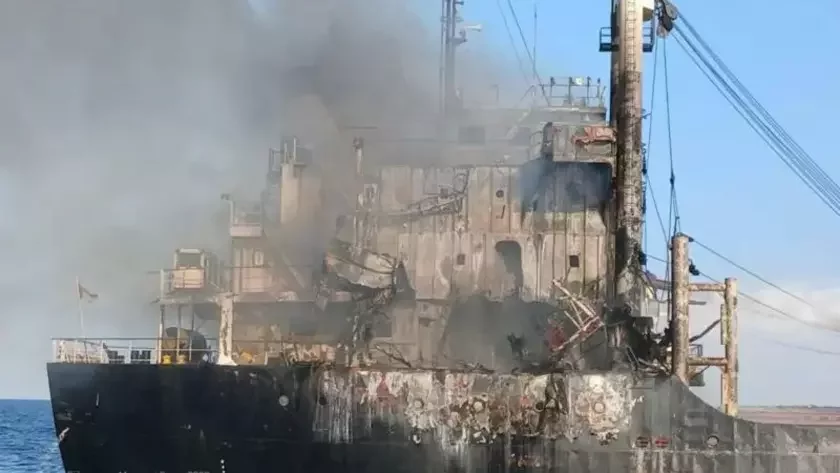
Thus, on July 19, Russian troops attacked the cargo ship GOLDEN LEO, owned by Turkey and sailing under the flag of Guinea-Bissau, with three X-59/X-69 type cruise missiles. At the time of the strike, it was moving out of the combat zone with a food cargo; on board were 17 citizens of Syria and India and a Ukrainian pilot.
According to the new Prime Minister of Ukraine, Serhiy Koretsky, a fire broke out on the vessel after it was hit, but due to the threat of a repeated attack, rescuers were forced to withdraw to a safe zone.
"Together with the military command, we are preparing decisions that will enhance the safety of navigation and help protect civilian vessels and sailors from criminal Russian attacks," the Prime Minister of Ukraine announced.
He called such Russian actions an attack on the freedom of navigation and the principles of the UN Convention on the Law of the Sea.
Meanwhile, the Minister of Restoration, Infrastructure, and Transport, Mykola Kalashnyk, stated that this is "a Russian war crime and a blow to the safety of international shipping and global food security."
In total, over the last month, according to the Odesa Regional Prosecutor's Office, the Russian army has struck 28 commercial vessels in the ports of Greater Odesa.
Meanwhile, the Odesa Regional Military Administration emphasizes: since July 13, the Russian army has launched about 300 aerial targets at the region, killing 18 people and wounding 69 others. Throughout the week, the Russian Ministry of Defense, in its public communication, particularly highlights strikes on the Odesa region and does not hide that it is also hitting vessels.
Humanitarian catastrophe?
While local authorities in Odesa region ask residents and guests not to ignore alarm signals and to take care of their safety, Ukrainian officials call on the international community to pay attention to Russia's current tactics, otherwise, it could turn into a humanitarian catastrophe.
Amid Russia's attacks in the Black Sea, Ukraine has requested an urgent meeting of the UN Security Council and proposes to convene it on Monday, July 27.
"Russia is holding global food security hostage... Today, not a single vessel passed through the Ukrainian maritime corridor in the Black Sea – precisely in the midst of the harvest season. This is a deliberate act of economic and humanitarian terror... If this terror continues, millions of families in Africa, Asia, the Middle East, and Latin America could face rising food prices and hunger," stated Ukrainian Foreign Minister Andriy Sibiga.
On July 21, the Ministry of External Affairs of India summoned Russia's Chargé d'affaires Vladimir Ladanov and expressed "serious concern" over the death of Indian citizens as a result of a Russian strike on a commercial vessel.
"Attacks on commercial vessels and, as a result, the death of innocent civilians are unacceptable and must be avoided," the Indian ministry stated.
In response, Putin's press secretary Dmitry Peskov stated:
"Our Armed Forces are striking and will continue to strike those vessels that are involved in transporting ammunition, weapons, etc. for the purposes of the Kyiv regime."
"Worst conditions since 2023"
The American Institute for the Study of War (ISW) noted the intensification of Russian strikes on Ukrainian port infrastructure in the Odesa region and on vessels entering Ukrainian ports. According to its analysts, this situation has escalated at least since July 10.
At the same time, ISW notes: such Russian strikes are not a new tactic for Russia. It is now, according to estimates, aimed at deteriorating the Ukrainian economy and reducing the country's export capabilities. These strikes can also be considered a response to Ukraine's recent strike campaign against Russian vessels in the Azov and Black Seas, ISW adds.
Some of the most authoritative sources in global shipping, Lloyd's List, report that due to the latest Russian attacks in the Black Sea, shipowners are increasingly refusing to enter Ukrainian ports, as working conditions have become "the worst since the suspension of the grain agreement in 2023."
Additionally, as Lloyd's List adds, against the backdrop of these events, freight rates, insurance costs, and overall logistics costs are rising, while the number of available vessels is decreasing, even though ports continue to operate. It is now known that one of the world's largest carriers – the shipping company Maersk – suspended service through the Chornomorsk Fishing Port on July 21.
Maersk became the second key company to suspend operations in Chornomorsk in July. Kernel Holding, Ukraine's largest grain exporter, also ceased operations at the city's main port last week due to a series of Russian strikes.
Ukrainian authorities, meanwhile, remind: the decision to take such measures was approved by the shipowners themselves; the state has not introduced any restrictions on movement.
"Just yesterday, four or five vessels were entering the ports. It's not many, but there was movement. As of today, vessel entry has stopped. This is a decision by the shipowners – the state, for its part, has not restricted anything," stated Ukrainian Minister of Agrarian Policy Taras Vysotsky during communication with journalists on July 23. At the same time, he emphasized that "it's too early to talk about a complete blockade of maritime exports," and added that the government is working on solutions that should help restore navigation.
Ukrainian strikes on Crimea and at sea
Kyiv seeks to isolate the Crimean peninsula, which Russia illegally occupied in 2014. From July 6-19, the Unmanned Systems Forces of the Armed Forces of Ukraine disabled three out of five ferries that ensured the operation of the Kerch ferry crossing, likely reducing its throughput capacity by 75%.
On July 18, the Unmanned Systems Forces also struck 13 vessels of the "shadow fleet" in the Black and Azov Seas: eight dry cargo ships, a tanker, a gas tanker, a tugboat, and two floating cranes.
The vessels that were hit, according to the Ukrainian General Staff, were used to supply fuel and lubricants to Russian military groups, as well as to transport oil products circumventing international sanctions.


Comments
адна пустэча
толькі дроны будуць шмыгаць.