Literature11

Who are the two characters who didn't drink in interwar Vilnius, how Zoska Veras was awakened from lethargy, and is the story about Karatkevich and the restaurant true?

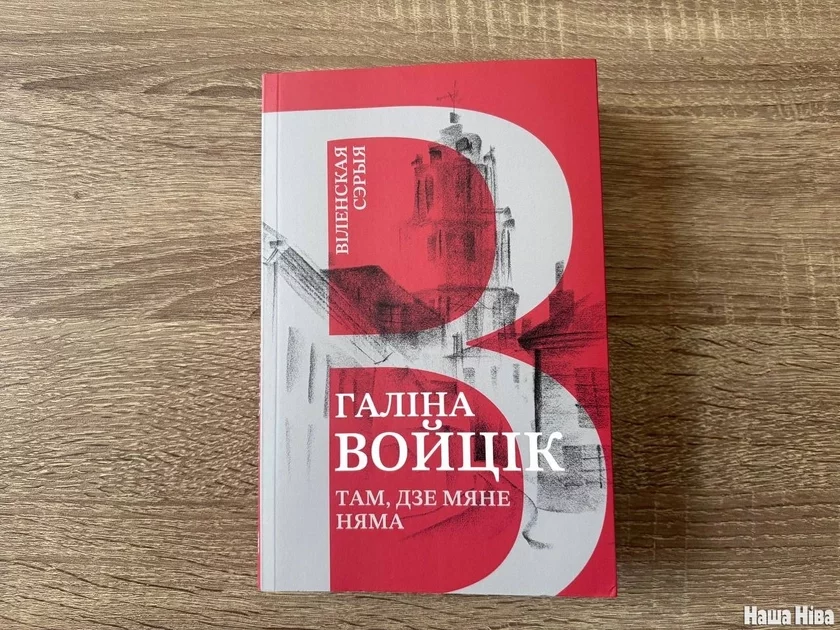
Halina Voitsik's book "Where I Am Not" contains many interesting details about Vilnius and the Belarusians who lived there in the 1930s-1990s.

This spring, Skaryna Publishing House launched the "Vilnius Series". It plans to publish works by Belarusian authors from Vilnius, both past and present.

The first book in the new series — "Where I Am Not" — comprises the memoirs of Halina Voitsik (1927—2007). The author was a Germanist, Candidate of Philological Sciences, taught German at the Vilnius and Grodno Pedagogical Institutes, and worked at the Belarusian Department of the Vilnius Pedagogical University.

Halina Voitsik in the first half of the 1950s, photo from the archive of her son Yaroslav Voitsik

She was also the daughter of Zoska Veras and the wife of Liavon Lutskievich, author of the book "Journeys through Vilnius".

"Where I Am Not" is an excellent tourist guide to Vilnius, just like her husband's "Journeys". One wants to take the book under their arm and go explore the places the author leads you through.

Halina was born on July 1, 1927, to Liudvika Sivitskaya (Zoska Veras) and Anton Voitsik.

The family then lived in Novaya Vileika (today — Nova Vilnia) to the east of the city, in the so-called "Railway Colony," where many Belarusians lived.

In 1940, the Voitsiks moved west of Vilnius to an area beyond today's Vilkpėdė (Halina Voitsik calls it "Wolf's Paw" — how the name translates from Lithuanian to Belarusian). It was there that Anton Voitsik built the house that later became Zoska Veras' famous "Forest Lodge," a place of pilgrimage for the Belarusian intelligentsia.

The most interesting aspect of the memoirs is the author's perception of the city and its people.

From 1920 to 1939, Vilnius was under Polish occupation, and Halina Voitsik writes that it was a very provincial and neglected city, unlike the capital Warsaw. The Poles built only a handful of buildings there. In 1939, Halina went on an excursion to Kaunas, which was the temporary capital of Lithuania from 1920-1939, and she was impressed by the European character and beauty of that city.

As for Vilnius, "now the composition of the population has changed significantly, but then the Jewish population predominated, followed by Poles. And Belarusians, Lithuanians, there were not many of them. Practically — the Belarusian intelligentsia. But the whole surrounding village was Belarusian. And in the markets, only Belarusian was spoken, and those same Jewish vendors also spoke Belarusian, because they had to talk to the peasants."

The author writes that people drank a lot. She jokes that in Vilnius in the 1930s, only the Atlases on the Tyszkiewicz Palace didn't drink, "because their hands were occupied."

This building housed the editorial office of "Nasha Niva" in 1907-1909, and in the 1890s, Francišak Bahuševič worked there as a lawyer. Photo: "Nasha Niva"

Voitsik describes how Christmas and Easter were celebrated. She writes that the family was not overly religious, but preparations for Christmas began in mid-October. Buying decorations for the Christmas tree was not a problem, but it was believed that they should be made by hand. The necessary paper was bought at Stanisław Stankiewicz's bookstore ("bookstore"), located at the corner of Ostra Brama and Subačiaus streets.

The girl initially studied at a girls' school located at the corner of today's Barboros Radvilaitės and Maironio streets, opposite the entrance to Bernardine Garden. She remembered the theology teacher there, a Bernardine monk who always wore bronze monastic clothing and sandals in both summer and winter. And he loved to joke. At the end of his lecture, he would begin a proverb that needed to be completed.

"For example, the Bernardine would say, 'Whoever gets up early…' We would shout in chorus, 'God helps them.' And he would smile. 'No. Not like that. They want to sleep all day long.'"

Voitsik holds no enchantment for interwar Poland; for Belarusians, it was an unfriendly stepmother.

 "In the 1930s, the fascization of Poland began. Belarusian organizations were closed one after another, newspapers were under strict censorship, 'Khadeckiya newspapers' and magazines were supported. Belarusians often had searches, looking for anti-Polish literature. Opposite our house lived a policeman, Maciejewski. He often warned our parents that a search was imminent. And when the police came, they found nothing in our house. True, once they took a brochure about pig breeding, because it was published in Minsk."

"Materially, our lives got worse and worse. My father was unemployed. He took on all sorts of jobs. For a while, he had a consumer store at the corner of Zavalnaya and Vialikaja Pahulianka (Pylimų — Basanavičiaus), but he quickly went bankrupt because he had no talent for 'gesheft' (business). My mother grew flowers for seeds, which two stores, Kryŭski's and Vilnisheŭski's, both on Zavalnaya, eagerly bought."

Malaja Pahulianka, by the way, is today's Kalinauskas Street.

During the German occupation, Voitsik studied at the Belarusian Gymnasium. These were dark times. The end of World War II brought relief, but also repression. Dozens of Belarusians, cultural figures, and gymnasium teachers were exiled.

Her brother Tonik (Anton Shantyr, by Zoska Veras's first husband's surname) also disappeared. He was "found" only in 1958, returning sick and exhausted from Siberia. He was not allowed to live in Vilnius; he lived somewhere in the suburbs.

The girl enrolled in Vilnius University to study Germanistics, but in her fifth year, she was offered a job at Hrodna University. The fact was that the lecturers of the Belarusian studies department in Hrodna had been arrested and sentenced to 10 years in camps. There was no one to teach the students, and the administration turned to Vilnius for help.

"They gave me phonetics for the first to third years, theoretical phonetics for the fourth, and lexicon for the third. So, I, a fifth-year student, was teaching third-year students! I was 22, but I looked younger. I wore a short black skirt and a black and white checkered blouse. Well. A complete girl."

The 1950s were a time of rapid development for Vilnius. Halina Voitsik built her teaching career during this time, completed her Germanistics degree, and traveled to the GDR several times. She married Liavon Lutskievich, who had returned from exile. Belarusian life slowly revived, people returned from the camps.

Yurka and Liavon Lutskievich upon their return from the camp. Second half of the 1950s.

And in the 1980s, the Lithuanian revival began. And after it, the Belarusian. Voitsik recounts an interesting fact.

"Meanwhile, perestroika was underway, things became freer, conditions emerged for the revival of Belarusian national life, for the organization of communities. Shameful as it is, it must be admitted that the initiator of the creation of the first Belarusian community was a Lithuanian, the doctor-narcologist Valdas Banaitis. He worked in Novaya Vileika (Naujoji Vilnia) in a psychiatric hospital, where Tsotka once worked, became interested in her personality and the Belarusian revival movement of the early 20th century, mastered the Belarusian language, and created a corner of Belarusian books in the bookstore. He even brought books from Astravets himself. He began to organize the first meetings with Belarusian figures. He once invited literary scholars Adam Maldzis and Uladzimir Markhel. With Banaitis's light hand, an initiative group was formed to organize the first Belarusian community in Lithuania."

Psychiatric hospital in Naujoji Vilnia, where Alaoiza Pashkevich (Tsotka) worked at the beginning of the 20th century. During World War I, she worked at the city hospital on today's Kauno Street. Photo: Google.maps.

In 1997, when Halina Voitsik's husband Liavon Lutskievich died, Vytautas Landsbergis spoke a few warm words about him, Ivan, and Anton Lutskievichs at the funeral.

The author somewhat debunks the apocryphal story about Karatkevich. In Vilnius, on St. Ignatius Street, there is a restaurant called "Boču". And there is an opinion that Karatkevich loved it so much that he rhymed "On the way to Boču, I will never stray."

But the thing is, Uladzimir Siamionavich often visited Vilnius to work in the archives and always stayed with his friend, archivist Hienadź Kisialiou, who lived there, and there was also the archive where Karatkevich worked. So on the way to Boču — it was also on the way to the archive.

Now, in place of "Boču," immortalized by Karatkevich, is the restaurant Boheme. Photo: Google.maps.

And the author also tells a touching story about her mother Zoska Veras and Arsen Lis. The poet, publisher of children's magazines, Zoska Veras, had not written or published anything since 1939. Times were dangerous.

But in Minsk, a young student, Arsen Lis, who later became a renowned researcher of West Belarusian literature, was studying. He stumbled upon Zoska Veras's publications in the Minsk archives. He found out she lived in Vilnius and visited her.

Zoska Veras

"Later Lis recounted that my mother once told him, 'You awakened me from a lethargic sleep.' And indeed, from 1939, Zoska Veras essentially busied herself with her home, garden, and vegetable patch, writing nothing. Now [after Arsen Lis brought her name back], scholars and writers, artists and journalists, students and schoolchildren began to visit her. And to everyone she gave something new, spiritually enriching them."

Or here are warm memories of Claudius Duzh-Dusheŭski, the author of the white-red-white flag:

"K. Dusheŭski, a well-known Lithuanian architect and Belarusian activist, was arrested in 1940, released from prison when the Germans occupied Kaunas, then ended up in a German concentration camp, and after the war, again in a Soviet prison — he was freed in 1954. Arrests, prisons. The abuses did not break him. He was not afraid to write letters to the guys in Kolyma."

At the end of the book, Halina Voitsik, summarizing her life, writes:

"Who am I? I never liked it when I was introduced as 'Zoska Veras's daughter,' 'Liavon Lutskievich's wife' — that's not my merit. I always wanted to be myself, to achieve not a position — that didn't interest me — but respect and esteem for my work, first as a Doctor of Science in Germanistics, and in recent years in the field of Belarusian culture. What I managed to achieve, let others judge."

The book can be purchased, for example, in the Belarusian store "Kropka" in Vilnius, price — nine euros.

Comments1

  • Набуду
    22.06.2026
    Трэба набыць...такая кніга павінна быць у хатняй бібліятэцы

Now reading

Propaganda prepares society for Lukashenka's mysterious "long business trip" 39

Propaganda prepares society for Lukashenka's mysterious "long business trip"

All news →
All news

Lukashenka is going abroad for a long time 57

Lavrov: Belarus is being drawn into the Ukrainian conflict 11

Salary like an IT specialist: a Belarusian tractor driver is offered up to 10 thousand rubles. We figured out what the secret is 5

Ukraine created four problems for Putin at once 13

Russian Investigative Committee named responsible persons and perpetrators who, according to its version, attacked a bus with Belarusian children near Bryansk 17

26-year-old Maxim from Baranavichy — a new victim of the war 12

"This is a unique case!" Bird of the Year spotted near "Minsk World" 1

Chalk Factory Building in Belgorod Oblast Destroyed by Drone Strike 1

The Order of the White Eagle, taken from Zelenskyy, has returned to Poland. What will happen to it now? 4

больш чытаных навін
больш лайканых навін

Propaganda prepares society for Lukashenka's mysterious "long business trip" 39

Propaganda prepares society for Lukashenka's mysterious "long business trip"

Main
All news →

Заўвага:


Закрыць Паведаміць