


Ilya Andreev: I try to see the opportunities that forced emigration has given us
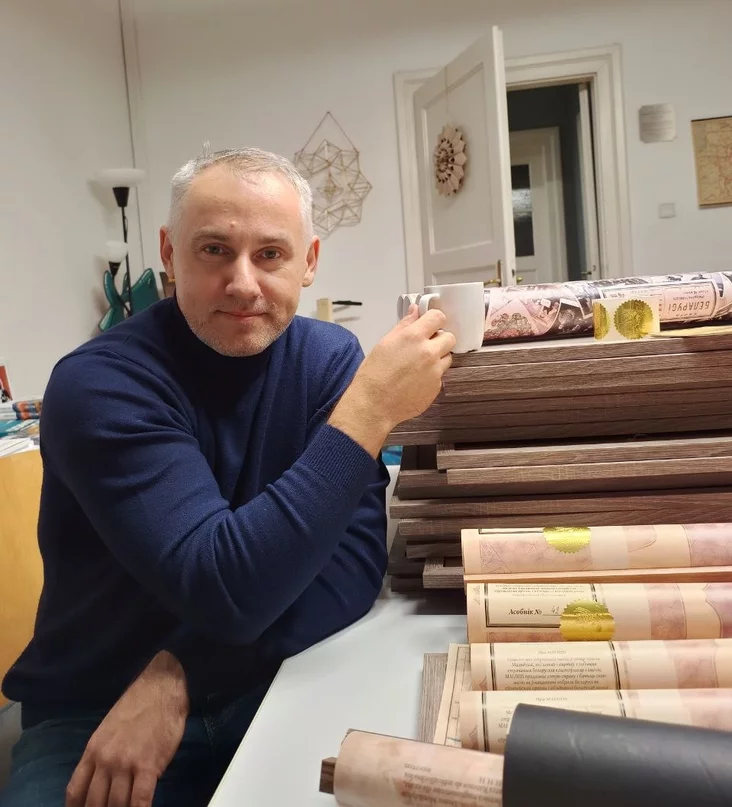
Cultural manager and historian Ilya Andreev told the publication «Salidarnasts» about having hands untied, the quick end of the war, and what he would advise those who emigrated.
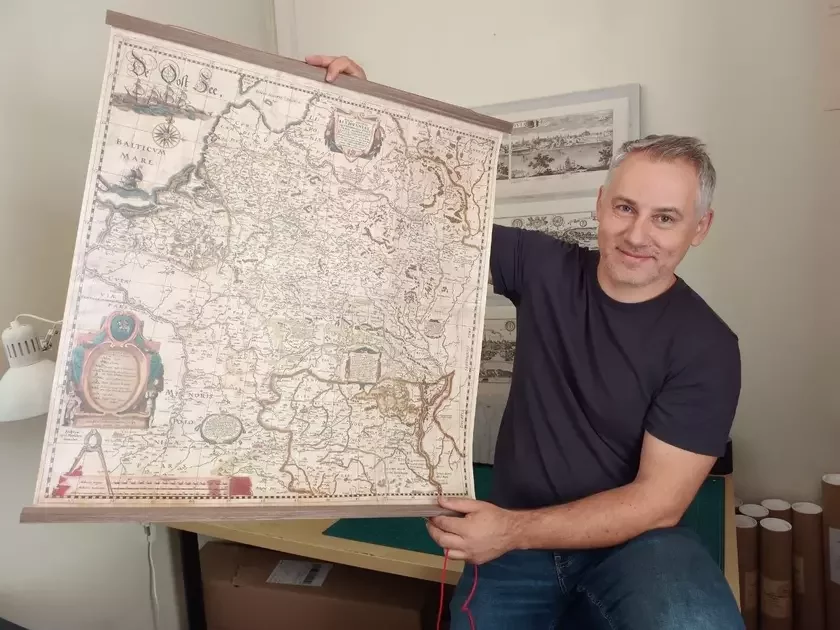
Once, Ilya became interested in ancient Belarusian maps. The internet helped; over the last 15 years, information from many archives and historical funds has been digitized and made accessible.
— I think the interest in maps arose from those eternal questions "where are we from?" and "what for?" It was interesting to find the villages or towns of my great-grandparents on old maps.
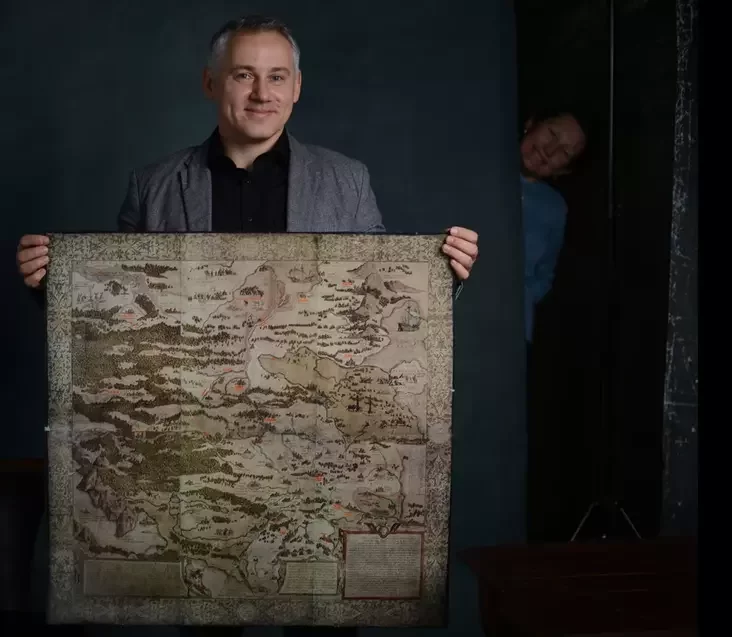
Over time, a personal story grew into something more: a whole world of ancient cartography opened up, and it was possible to build a Belarusian community "by interests," thanks to which I met antiquarians and historians, including foreign ones, well-known former and current politicians, and simply people who were fascinated by old maps.
Over time, a demand emerged from Belarusian society. Until 2020, such projects were supported by the state. We published a map of the Belarusian People's Republic, printed copies for the 100th anniversary of the BPR in 2018. We sent them to state museums, and received acknowledgments from them. We cooperated with state publishing houses, and the Ministry of Foreign Affairs purchased our items.
There were plans to publish albums, engage in the reconstruction and restoration of historical artifacts, develop a graphic workshop—many, many plans and hopes. But 2020 became a turning point…
In Belarus, we had opportunities that, unfortunately, we do not have in emigration. Because many other obligations appeared.
At first, it was even scary, definitely difficult. But looking back at the last 4-5 years, I realize that it was actually like a roller coaster. Therefore, I believe everything was done correctly. Although, living in Minsk, we had no intention of leaving anywhere.
— I've heard many reviews about emigration — sadness, longing, depression. But never that it's a "roller coaster." Why is it like that for you?
— Perhaps there was no time to be sad, because I was immersed in various projects. In three years, I learned Polish to a very good level. I received a diploma from Jagiellonian University. I hope to continue combining work with studies. It was difficult, but also interesting.
I have many acquaintances who miss Minsk. But I, to be honest, never loved Soviet Minsk, because, studying the history of the city, I realized that I love a different Minsk — completely destroyed, 18th-century Minsk. I know and recognize it in modern Minsk. But the "city-sun," formulated by Artur Klinau, is not appealing to me.
It seems that for some who were born in Minsk and were forced to leave — for them, a whole world truly collapsed.
Valentina (Ilya's wife, head of Gutenberg Publisher. — "Salidarnasts") and I are, in principle, long-time emigrants within Belarus. I was born in Vitebsk, lived in Orsha, Mogilev, went to university in Gomel. Then I moved to Minsk.
Valentina and I did everything together, by ourselves. So, for us, it was simply a change in the scale of relocation. Because even before 2020, we were already seasoned travelers, easy to pick up and move. Perhaps that's why it was a bit easier for us.
However, during the first two years in emigration, there was an impression that everything was constantly getting worse, and worse, and worse. Leaving, the constant worsening of the attitude from the Belarusian authorities, then the war in Ukraine, everyday worries and problems. On occasion, I tell "newbie emigrants" about this, saying that afterwards it will definitely become easier.
— How did you react to the news that you, Valentina, and the publishing house she manages, were added to the list of "extremists"? And really, what for?
— This isn't exactly about "it will get easier"; this was another downturn. But here's a fact, and what to do with it is unclear. Because, firstly, we constantly, even in emigration, tried not to do anything dangerous, sometimes refusing politicized projects and publications.
It seemed to us that this way our work would be built more effectively, and that in this way we would retain the Belarusian audience that remained in the country. People bought our books and took them to Belarus. And therefore, there was a certain self-censorship to remain within the Belarusian context.
Why was I added to the list of extremists? Apart from occasionally working on Gutenberg projects, I think it's also a bit for past "merits."
The decision was made by the KGB, where we were perhaps under surveillance since the time of older Belarusian projects. They were allowed, but too Belarusian to remain without control.
In my opinion, all this is being done to cut off, to divide the Belarusian cultural emigration. Because literary and cultural life in general is indeed more intense in emigration now. Therefore, all these lists of "extremists" stem from the authorities' desire to reduce the influence of emigration, which can afford to write about anything.
So, of course, there were immediate emotions, but in principle, we took it with a joke. In the first few days, deciding whether to go to "Lidl" or "Biedronka" today and what to buy, we noted that, well, we held an "extremist" meeting, because my wife and I are both "extremists." Now we simply communicate less with those who live in Belarus or travel there, for the sake of people's safety.
However, thanks to the internet, all information about what the Belarusian community creates in emigration is available. It cannot be hidden. And no "extremist" statuses can create the illusion that everything is good there, and nothing at all is happening here with us, and everything is bad.
— The authorities, in fact, have untied your hands. Self-censorship is now unnecessary.
— That's right. Now we freely identify ourselves as authors, do not use pseudonyms, and calmly tell the audience what we consider important.
Indeed, there's a plus in this. Because there are so many "extremists" now that we all, it seems, are on this honorary list. Not everyone has been labeled yet, but it's still a very broad circle. Everything that is done not under state control is effectively on the "extremist" list. That's their logic.
This is also one of the valuable outcomes of 2020. We now clearly see that the current government in Belarus is essentially anti-Belarusian, and it is important for society (and political leaders) to distinguish between the fight against authoritarianism and the manifestations of Russian colonialism. One must be fought with one set of means, the other with different ones. These problems have different historical dynamics, different value systems.
But be that as it may, what truly remains alive and free, that today remains Belarusian.
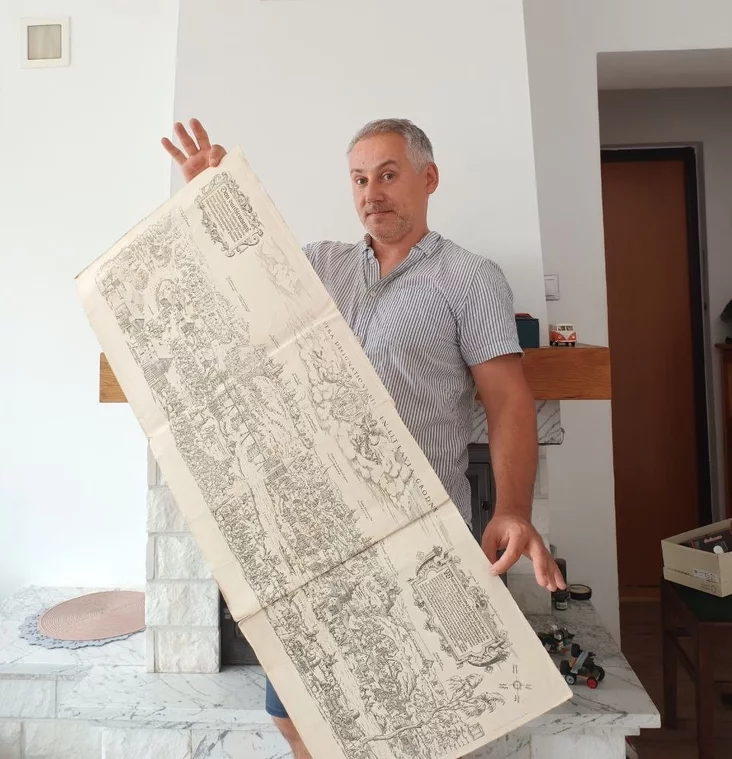
— Very interesting about Minsk and its ancient maps. How did the idea come about, and have you and Valentina published such books for all regions of Belarus?
— Here we return again to sad thoughts about unfinished plans (smiles) This idea actually came from state structures. And I was the one who had a good understanding of the matter and could offer a more modern solution.
With Valentina in Belarus, we published a book of ancient maps and plans of Brest; it was prepared for the city's millennium. The publication about Minsk is more substantial; it was released by a state publishing house and received recognition. Unfortunately, some thoughts in it remained between the lines, but I observe how it lives its own life, how it is referenced, and receives good reviews.
There were plans to prepare similar publications about Belarusian Padzvinnie and Padnyaproue. Unfortunately, this is currently impossible. But the superheroes of our time from the "Maldzis" initiative offered support in preparing such a publication. I hope we can bring it to fruition. In this regard, the fates of our predecessors come to mind: Arkadz Smolič, Vasil Rusak, Viktar Astroŭski, and countless other creators and researchers in emigration who simply didn't manage to finish what they had planned.
In general, there are many parallels between the Belarusian emigration after 2020 and previous waves. The emergence of initiatives and cultural centers, educational centers, the creation of publishing houses and entire distribution systems, the collection of archives and valuables — all this was done by our predecessors.
At the same time, they also faced disappointment, disputes, and even betrayal. And now we can look back at their experience, try to see — what was truly important and valuable, what remained?
I try to see the opportunities that forced emigration has given us. Despite everyday difficulties, we can freely engage in culture and creativity. Moreover, this is an excellent opportunity to show Belarusian culture to the world.
It is also important, as someone said, to "live Belarus," — in the sense of participating in Belarusian cultural life abroad.
Here I would like to mention a project from the Culture Council, Art Born Belarus, which brings back the names of Belarusian artists, such as Chagall, Soutine, Sofia Federovich, and others. It turned out that the number of artists who left Belarusian territories at various times runs into the hundreds.
This is also one of the most important features of our culture: Belarusian ethnographic territories have long been suppliers (or even donors) of talents to the world. And it doesn't matter that a significant part of these people might have belonged to different confessions or lacked Belarusian national consciousness. They were born in Belarus, as it was at the end of the 19th — beginning of the 20th century. A bit faceless, multi-confessional, and mostly "local," still very young and unsure of its beauty.
Of course, we are talking about the modern stage of our history here. I currently have no doubt about the question: how much of this is truly Belarusian history? Looking at the creativity of these artists, I am greatly impressed by the sheer scale.
These are not only artists of the Belarusian school; these are dozens of natives of Belarus in art directories of the USA, England, and Poland of the 20th century. Without a doubt, they are an integral part of Belarus's cultural code.
And this story continues. When it comes to emigrant artists, it's a bit easier for them. Because they express themselves in a visual language universal to all.
It's more difficult for writers. But we see how Eva Vezhnavets' translations travel all over the world. We see our classics — Uladzimir Niakliayeu, Uladzimir Arlou; I think it's not easy for them, but they continue to create, and their works are translated. Many young authors have emerged who use modern tools for both work and promotion of their texts.
Also, notable English-language works by Belarusian researchers are appearing. Could they create this in Belarus? Yes, it would be easier for them to live there, but I don't think they would have such opportunities. I believe that in the coming years, there will be a significant entry of Belarusian texts into the wider world.
Another unexpected aspect. Periodically, while living in Belarus, I would acquire some artifacts from abroad, and it was always a difficult quest to bring them in. Now again, when I come across something interesting, I buy it, and — oh wonder! — how much easier and more accessible it is.
Most recently, I acquired a lifetime graphic portrait of Mikołaj Radziwiłł "the Orphan" (initiator of the publication of the well-known map of Lithuania). By chance, in Lithuania, I bought a portrait of Father Vincent Hadleŭski painted by Piotra Serhiyevich.
These items have been preserved in Europe, but it would have been difficult to import them into Belarus. However, there is hope that they will someday return to their homeland.
— What was the hardest part of your emigration? And could you have stayed in Belarus, quietly waited it out? Because someone might think that you were involved in historical matters, not even current ones, and seemingly not politics. Why did you leave?
— In my case, waiting it out wasn't an option. Because one acquaintance was arrested, then another… None of us expected such a reaction for people simply going out and openly expressing absolutely justified distrust of the authorities. Moreover, we didn't expect such inhuman treatment and malevolence. And I decided to leave.
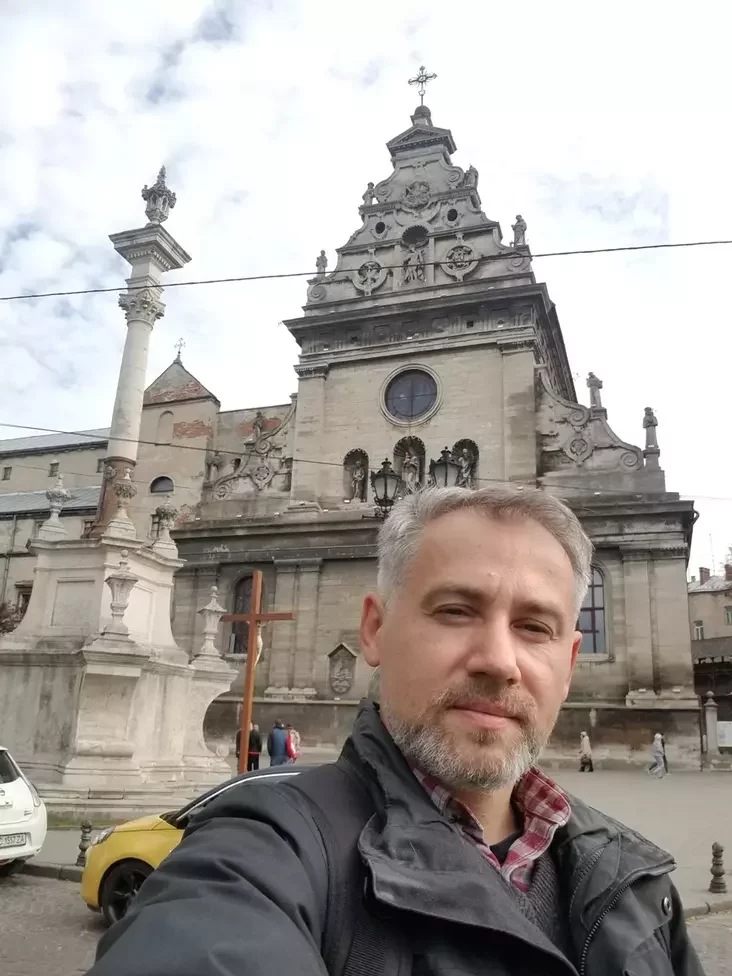
It was like stepping into open space, uncertainty. I think many of us have similar stories. But I recall that time with pleasure. In the two months while waiting for a Polish visa, I managed to process archives in Kyiv and especially the rich collections in Lviv.
To this day, I feel sadness that I, as a Belarusian, cannot go to Ukraine. Because our state takes the wrong position. It is difficult now to explain anything to Ukrainians, who have suffered great trauma, great offense, with the participation of our compatriots. And we bear this responsibility. We have relatives there, and had many close friends.
— What helps you in difficult times? How do you view the fears of emigration and how do you avoid giving up?
— What definitely doesn't help are clarifications of relationships, discord, and disputes. I try not to participate, and I want to advise everyone to weigh their words. What I see, especially recently, is upsetting. It seems we lack wisdom.
In uncertain times, friends, family, and sports provide support. But when it's tough, I usually don't wait for help; like a cat, I simply find a warm place and withdraw for a while. Because I know it will pass, I know that projects and people are waiting for me. And moments of weakness will pass. After a difficult climb, one should rest and hope that the path ahead will go downhill.
Sometimes we lack certainty. Perhaps the biggest mistake, my personal one, when I found myself in emigration, was rushing to make decisions, to resolve something. It would have been good if someone had told me then that emigration is a process; you will recall it later as an adventure, but don't forget it's lengthy. And don't look for quick solutions.
It's a natural human desire to be safe, to see a clear perspective. That's why we demand certain guarantees from each other: "Tell me what will happen in a year. Tell me — are you for black, or for red?"
But the situation in emigration is dynamically changing. And here, wisdom, calmness, and patience are needed.
It seems to me that the main salvation from sadness is joining the Belarusian community. It exists in almost all cities abroad, and if not — create one. There will be true communication and true rest. Yes, in your own modeled and local, but still Belarus.
This is what should be done. Because nothing from our past can be corrected. Was it great? I remember 2020 — it was great! The fact that we all came out, and everyone said "No!" — that was cool. The price for this, of course, is very high. But it's too early to settle accounts; we need to move forward.
These processes are global, and changes will come. They will be fast and more likely positive. But there is a lot of work ahead.
The last five-year period was difficult, full of challenges. I know people who are struggling, psychologically as well. And there is only one way out — to unite.
If you don't want to or can't buy books — come to book exhibitions just to see each other, come to meetings, to concerts in your cities. Because it's worth continuing to live, including with Belarusian culture, the Belarusian language. Here and now. Find strength, pick yourselves up, go and communicate in Belarusian communities. Meetings in Krakow Space — that's what helped me a lot in the first year.
— Why will changes happen quickly?
— Because the war is ending, and it's ending in a way no one could have imagined. History suggests that every time Russia withdrew from a war without fulfilling its "wishes," it began to reformat its system. And for them, this always turns out very brutally.
For Belarusian society, this is a chance to change something. Our year 2020 showed colossal public potential; people have already chosen to build a democratic society. Therefore, let's unite and hope for the best.
Now reading


In the Mironets family, the mother and three sisters have already been convicted for political reasons. Now the husband of one of the sisters has been arrested


Comments