


West Belarusian Odyssey: a fiery communist who became a staunch anti-Soviet
The only one who managed to escape from Stutthof concentration camp. A partisan who became a writer. A fiery communist who became a staunch anti-Soviet. On April 14, Alyaksey Karpyuk would have turned 100 years old. Written by Ales Kirkievich.
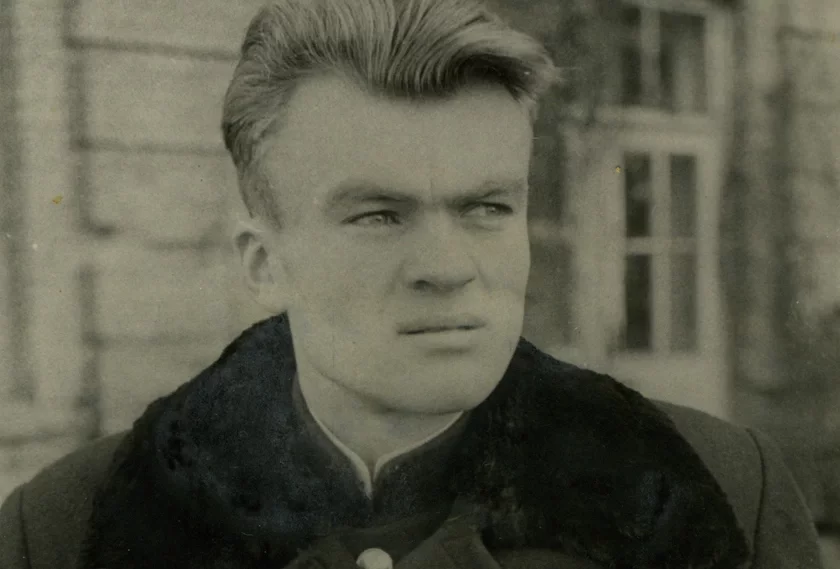
In his memoirs "Long Road Home," Vasil Bykau recalls Alyaksey Karpyuk, with whom he was friends. Bykau characterizes Karpyuk as a man "who fought his fate all his life."
Bykau and Karpyuk are like symbols of two merged sources — West and East Belarus. Bykau was born and grew up under Soviet rule, knowing what to expect from it and what it was capable of. He had fame, recognition, awards, and multi-thousand circulations. At the same time — periods of persecution and censor's scissors. Bykau hardly ever had illusions about the Soviet government; he did not praise it, but at the same time, he did not openly engage in dissidence.
Karpyuk was only 19 when Soviet power came to West Belarus. He spent his entire childhood and early youth in the difficult atmosphere of interwar Poland, from where Soviet Belarus seemed like a fairy tale, and the arrival of the Soviets — a dream. He dedicated the next several decades of his life to honest service to this country of dreams. Later — he became just as honestly disillusioned with it.
Bykau and Karpyuk complemented each other wonderfully, these writer friends. Just as East and West Belarus harmoniously make up one country.
The first "Christians"
Alyaksey Karpyuk came from the village of Strashava. Today it is Poland, but literally a couple of kilometers away, beyond Babrouniki, Belarus begins. On both sides of the border, these are areas densely populated by Orthodox Belarusians.
The family was not poor under Poland, owning 30 hectares of land. But the Karpyuks, like other Belarusian villagers, did not respect the Polish chauvinistic government. From afar, it seemed to them that the communist East lived much better and more justly.
The interwar West Belarusian village was overcrowded. There was no work in the cities. In the village — little land. Young people were drawn to culture and education: they joined the Belarusian School Society (see Andrei Vashkevich's article about it in "Nashaya Historyya" No. 3/2019), subscribed to books and newspapers. The most radical ones — joined the Communist Party of West Belarus (KPZB).
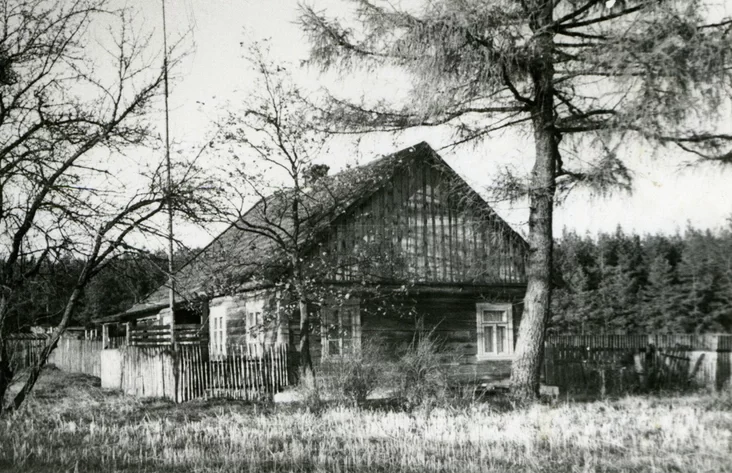
In the 1980s, Karpyuk would write that the KPZB members (and he among them) resembled the first Christians. They also gathered in small groups in houses at night to read incomprehensible texts aloud. They also believed sacredly and uncritically. They were also ready to endure any suffering: under police batons, in a concentration camp, even to death.
Before the war, Karpyuk managed to avoid prison: his father had money and sent his eldest son to preparatory courses at a gymnasium in Vilnius. Vivid sketches of that Vilnius, the "Kryvian Mecca," can be found in the novella "Danuta" — perhaps the writer's most romantic and successful work.
Freedom — above all
1939. Tank tracks, distrustful commissars, and Red Army soldiers tired from marching. Here it is, finally, the "light from the East." And then a surprise! Karpyuk's father, a KPZB member and ideological communist, turned out to be a kulak for the new government. The land, of which Nikifar Karpyuk had "too much," was subjected to an inhuman tax.
But even in these new circumstances, his father continued to believe in old ideals, thinking that all misfortunes were temporary. One episode illustrates this. One day, a bird pecked open the straw roof where the Karpyuks kept communist leaflets from Polish times. The wind blew — and they scattered all over the yard. Nikifar Karpyuk crawled on his knees, collecting them, cleaning off the dirt, and repeating: "Everything will get better, everything will be fine..."
Meanwhile, the family feared imminent arrest and exile to Siberia — a common occurrence at that time. If that had happened, Karpyuk's own fate might have been completely different. Karpyuk wrote that he had always loved freedom above all else, so he probably would have escaped. Then, under the Germans, he could have easily worked in some Belarusian Committee in Bialystok.
But the Karpyuks were not deported, and Alyaksey still managed to enroll in the Novogrudok Pedagogical College, where another future famous Belarusian writer, Uladzimir Kalesnik, was studying at the same time. There he met June 1941. With great difficulty, Alyaksey managed to return home to Strashava. To experience new hardships there.
In early 1943, all the men of the family — Alyaksey, his father Nikifar, and his brother Valodzya — were arrested. His father was released after some time, but the brothers were sent to the Stutthof camp. Whether it was due to help given to encircled Soviet soldiers, or as children of an old communist — it is unknown. At that time, with the connivance of Polish policemen who knew former KPZB members and Belarusian patriots by heart, the Germans actively thinned out the West Belarusian intelligentsia. A denunciation accusing someone of "communism" was enough.
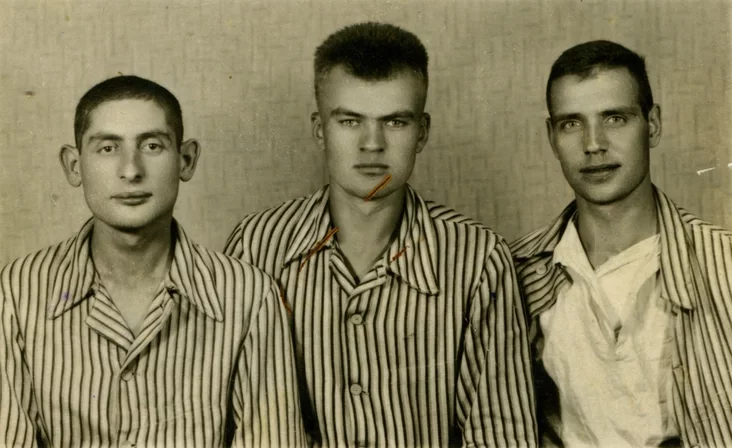
Stutthof, located near Gdansk, was not an extermination camp, but surviving there was not easy either. Escaping was unrealistic. But Alyaksey Karpyuk — the only one in Stutthof's history — succeeded. The only thing was that his brother did not go with him, refusing at the last moment. The remorse about this tormented Karpyuk for a long time, although his brother, horribly tortured by the Germans in revenge, still survived.
By some miracle, the escapee met captured Poles and Englishmen who were working for German farmers, and they gave the boy a German railway worker's uniform. Alyaksey knew German, so he made his way home without much difficulty. In a black railway worker's uniform with eagles on the lapels, Karpyuk entered his native home, and there — German soldiers. It turned out that soldiers were quartered in the house, and his parents had been moved to an annex. Karpyuk realized that fate could not always be on his side, so he decided to join the partisans.
Kastus Kalinouski Detachment
The nearest partisan zone was between Ivacevichy and Pruzhany. Karpyuk met partisans, told them about his adventures, but... they didn't believe him. How so, "escaped from the camp"? Or maybe he was released with a mission? Karpyuk was put in a special prisoner's dugout, and his further fate depended entirely on the commander's mood. They could investigate and let him stay, or they could shoot him without trial or investigation. The young man decided not to leave his fate to chance even here, dug a tunnel, and escaped.
During his wanderings through forests and farmsteads, he came across Mykola Voytsiakhouski's special group. The former Leningrad engineer had been sent to West Belarus with the task of creating a partisan brigade. Symbolically, that brigade was named after Kastus Kalinouski. Voytsiakhouski believed Karpyuk but told him to return to his areas and create a detachment there.
Karpyuk obeyed. He returned to the Kryniki area and in early 1944 created a detachment — also named after Kastus Kalinouski. The detachment numbered about 60 people. They derailed three trains — real ones, not just on paper, as with many other commanders. Karpyuk also created a camp in the forest for civilians hiding from the Germans. Alyaksey Karpyuk would later tell his war adventures in detail in the novella "Puscha Odyssey."
For most partisan commanders, the war ended in 1944. Rank-and-file partisans were mobilized into the army and driven further, to Königsberg and Warsaw. Commanders, however, were left in their places. They were the golden personnel reserve of the Soviet government in the unpredictable expanses of West Belarus. Karpyuk also received a deferment. But already in the autumn of 1944, he himself went to the military enlistment office. If everyone else was still fighting, why should he, young and healthy, hide in the rear?
During the storming of Berlin, barely a week before the end of the war, he was severely wounded. A shrapnel piece pierced his overcoat and tore out a piece of his lung. Until September 1945, Alyaksey was forced to recover in a hospital in Poznan. The writer's wife later recalled that the shrapnel remained in his chest forever.
Antagonistic neighbors
After his military adventures, Karpyuk returned to Hrodna and enrolled in the pedagogical institute. He was an exemplary student for those times: a partisan, a front-line soldier, wounded, with medals. There he met his future wife Inna, the daughter of Anatol Alsheuski, the NKVD-tortured secretary of the Komsomol of West Belarus, and the famous West Belarusian communist underground activist Fanny Tsyhelnitskaya.
They lived in a student dormitory on Savetskaya Street. Next door lived another student, Uladzimir Kisiel, a member of the anti-Soviet Union for the Struggle for Independent Belarus. In 1949, Kisiel was arrested: he received 25 years in prison and returned only in 1960. Karpyuk would help him find work.
At that stage, Karpyuk was still an ideological communist. Among his notes, one can find lines about how he cried on the day of Stalin's death — all day long. A year later, Karpyuk debuted in print with the cheerful novella "In One Institute."
KGB trusted person
In 1961, Karpyuk headed the Hrodna bureau of "Intourist." This organization dealt with foreigners' affairs. The head of such a structure in those days could not but be connected with the special services.
Karpyuk's cooperation with the KGB is also evidenced by documents recently found in Lithuania. His name appears in reports about how Larysa Hienijush was monitored and processed. After a long list of agents, the term "trusted person" suddenly appears in relation to Karpyuk.
Here it is worth clarifying the terms. A KGB agent has a pseudonym, a file is opened on him, he gives written testimonies, he meets at safe houses. An agent can also receive money for services. "Trusted persons" were ideologically vetted individuals who operated without a pseudonym or money. They did not provide written reports, and a штатный (staff) KGB officer could even come to such a person at work. Everything was open.
Karpyuk ardently persuaded Larysa Hienijush to accept Soviet power as a fact, to obtain USSR citizenship. Larysa Antonauna quarreled with him and fiercely criticized him in letters. Only in the 1970s, when Karpyuk himself experienced persecution by the Soviet government, did Hienijush become much kinder to him. In their hardship, they finally understood each other.
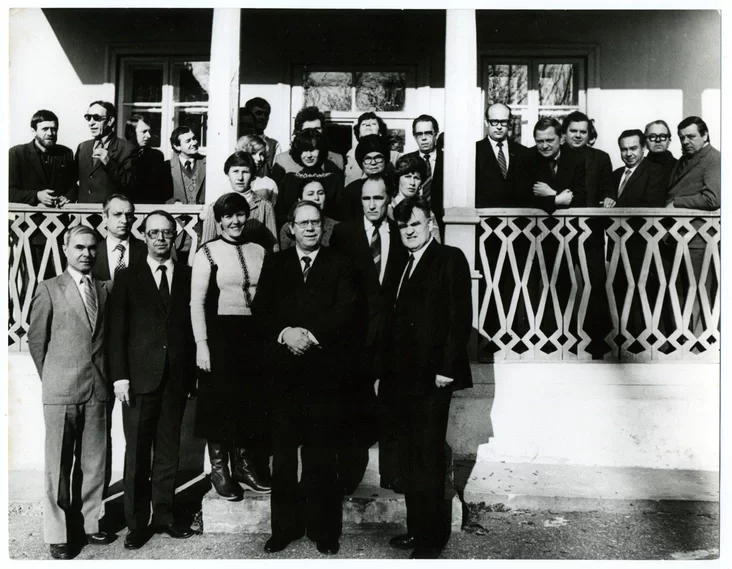
At the same time, Karpyuk's own internal evolution continued. He became increasingly disillusioned with the ideals he had devotedly served. The Prague Spring of 1968 played a significant role in this.
In the late 1960s, a free-thinking triangle formed in Hrodna: Vasil Bykau, Alyaksey Karpyuk, Barys Klein. They not only discussed and criticized but also disseminated "questionable" literature: works by Alexander Solzhenitsyn, Eugenia Ginzburg, and other dissidents.
This did not remain a secret. The Hrodna "anti-Soviets" were investigated by Yuri Andropov himself, Chairman of the KGB of the USSR. In June 1969, he prepared a memo for the Central Committee of the CPSU, in which he wrote about Karpyuk's and Bykau's "unhealthy political sentiments." The text of the memo clearly stated that "special measures are being prepared" to counteract the hostile ideological antics of the named individuals. It was decided to neutralize each of them separately.
The easiest was with Barys Klein. He was Jewish, and his brother was homosexual (which was a criminal offense in Soviet times). Barys Klein was stripped of his Kandidat degree, fired from the university, and forced to earn a living as a loader. Bykau, the most famous of the trio, was persecuted for his novella "The Dead Don't Feel Pain," criticized for "falsifying the history of the war," but they did not cross the line. But Karpyuk was dealt with seriously.
"Kapo's Assistant"
In April 1971, the first secretary of the Hrodna Regional Party Committee, Ivan Mikulovich, received a letter from the KGB Directorate for the Hrodna Region with a dossier on Karpyuk consisting of 53 pages! The document stated that Karpyuk had unauthorizedly stolen documents from the archives in 1965 concerning his activities in the 1930s — perhaps he was an agent of the Defensywa? Karpyuk's partisan past — just fabrications, unconfirmed by anything. Moreover, Karpyuk allegedly covered up real thugs: former fighter of the "Dirlewanger" battalion Rychard Shcharmunkis and Bialystok SD agent Karpovich!
To all this, Martin Hrushauski, the former headman of Strashava during the occupation, was also implicated. After the war, Hrushauski was exiled for five years for aiding the Germans, but allegedly unjustly. Allegedly, Karpyuk himself wrote a denunciation against Hrushauski in 1944 based on "personal animosity."
Finally, the control shot. Karpyuk was accused of not being an ordinary prisoner in Stutthof, but a "kapo's assistant." Virtually, a warder among the prisoners. A note from the camp was found, according to which Karpyuk had received 20 Reichsmarks several times. Why would a prisoner receive them?
All this lasted almost three years. Karpyuk was stripped of all his positions. Expelled from the party. After the Stutthof story, it was no longer about reputation, but about the prospect of a trial, and then a prison sentence or even execution. Karpyuk went to Voytsiakhouski, the commander of the Kalinouski brigade, but he openly said that they had already visited him regarding this matter. He turned to the archive, but there was no information at all about his partisan detachment.
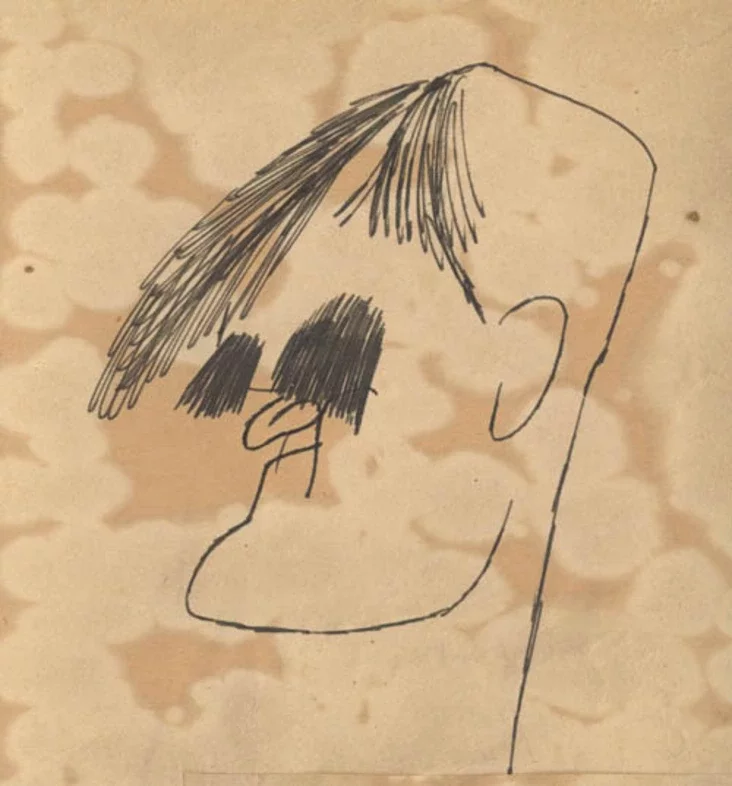
Eventually, Karpyuk went to Pyotr Masherau, a former partisan and head of the republic. It seemed he believed him. Meanwhile, a Polish journalist, a friend of Karpyuk, went to Stutthof and inquired about the note with the Reichsmarks. He learned that it was money from parents, which could be sent to any prisoner.
Gradually, the wave of persecution began to subside. In the party, they limited themselves to a strict reprimand and reinstated Karpyuk into its ranks. Barys Klein was returned to the university. Vasil Bykau moved to Minsk, divorced his wife. He would recall Hrodna as a city where one could live unnoticed, but not live life to the fullest.
Why did the government and its repressive machine "work" so harshly with Karpyuk specifically? The answer for me is obvious: they were taking revenge on him as "one of their own" who did not stick to the rules of the game. An ideological communist and even a trusted KGB person who criticized the government was a much more serious enemy than an ordinary anti-Soviet. There is even a mention in the documents that Karpyuk's activities were forbidden to be discussed at meetings of the party organization of the institution where he worked. They were afraid that he might convince his colleagues of his righteousness.
"Farewell to Illusions"
The 1980s marked a completely new stage for Karpyuk. He was appointed director of the Museum of the History of Religion and Atheism in Hrodna. Similar museums were also created in Vilnius and Lviv — the most religious, in the opinion of the Soviet government, western regions of the USSR at that time. Karpyuk is still remembered as the best director of that museum, who secured funds for the reconstruction of the former Basilian monastery building, organized expeditions, and also took his staff to the forest for community work in spring. Former colleagues recall that Alyaksey Karpyuk was a difficult person, sometimes overly categorical, but he spoke with everyone equally: with a janitor, as well as with the chairman of the regional party committee.
In the times of glasnost, when the end of the Union was already near, Karpyuk went into his last battle. He wrote an article "Sad Stories" in the form of a confession. He supported the Adam Mickiewicz Polish Culture Society (the prototype of the Union of Poles), believing that "if the Poles wake up, the Belarusians will wake up after them." The former "builder of a new world," Karpyuk spent nights in an 18th-century building when it was targeted for demolition to expand Lenin Square.
But the empire was still alive and capable of meeting challenges. A new wave of black PR began against Karpyuk: letters from "front-line veterans," articles in the official "Politicheskiy Sobesednik" (Political Interlocutor), all the same false accusations about stolen documents and Stutthof. At the end of his life, Alyaksey Nikiparavich left the party but kept his membership card — as a reminder of the illusions of youth. He wrote that he had always done the same in life as his father. And if his father had lived to this time, he would also have spoken about how much they had erred. Young democratically-minded youth, including Zmitser Kisiel — the son of the very anti-Soviet Uladzimir Kisiel — came to Karpyuk's defense against overly active "veterans."
Hrodna residents, including my mother, well remember the tall figure of the giant who descended Horkaha Street with a wooden cane. Karpyuk was already finding it difficult to walk, as, in addition to the slanders, another misfortune had been added — cancer. Having overcome the Polish Defensywa, the threat of exile, German dungeons and damp dugouts in the forests of Podlachia, persecution and a painful farewell to illusions, he could do nothing more against nature. Here he lost the struggle with his fate.
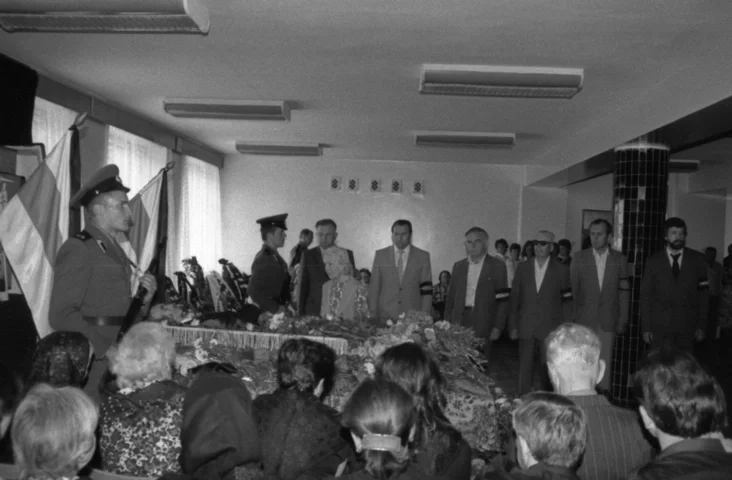
Alyaksey Karpyuk died in the summer of 1992. He was solemnly buried with a military orchestra, and his coffin was draped with a white-red-white flag. His wife, Inna Anatolyeuna, would outlive her husband by a decade and a half and preserve the typewritten manuscript of his last book, the typesetting of which was scattered in 1995. This book would be published only in 2008 by the non-governmental "Hrodna Library" under the title "Farewell to Illusions."
-
This is what Maksim Bahdanovich could have looked like on a 50-ruble banknote PHOTO FACT
-
Architect Shabuneuski was repressed for "criminal bridge construction" across thezh. There are still problems with the crossing there
-
Passions around the "Cross of Queen Sophia" do not subside. Sergei Ablameika defended it, and Krytsuk analyzed the primary sources
Now reading


Natalia Kalegova spoke about helping Belarusian refugees, her family, her attitude towards Tsikhanouskaya. And explained who "beavers" and "hares" are

Natalia Kalegova spoke about helping Belarusian refugees, her family, her attitude towards Tsikhanouskaya. And explained who "beavers" and "hares" are


Back to pen and paper and smartphone ban: universities are forced to change the format of classes and tests, otherwise AI prevents both teaching and assessment


Comments