


"The lights went out — and everything happened." New testimonies about the death of Andrei Padniabenny in the penal colony
Exactly one year ago, on September 3, 2025, 36-year-old political prisoner and father of three children, Andrei Padniabenny, died in the punishment isolation cell of correctional colony No. 15 in Mahilieu. He had spent two years in the penal colony. Sentenced to almost 17 years of imprisonment, he endured constant placements in punishment isolation cells, provocations from the administration, beatings, and attempts to break him psychologically. During another power outage, when surveillance cameras were not working, Andrei committed suicide. The Human Rights Center "Viasna" collected testimonies from eight former prisoners of colony No. 15 and human rights activist Valiantsin Stefanovich about the conditions in which Andrei was held and why his death should be considered the result of systemic incitement to suicide.
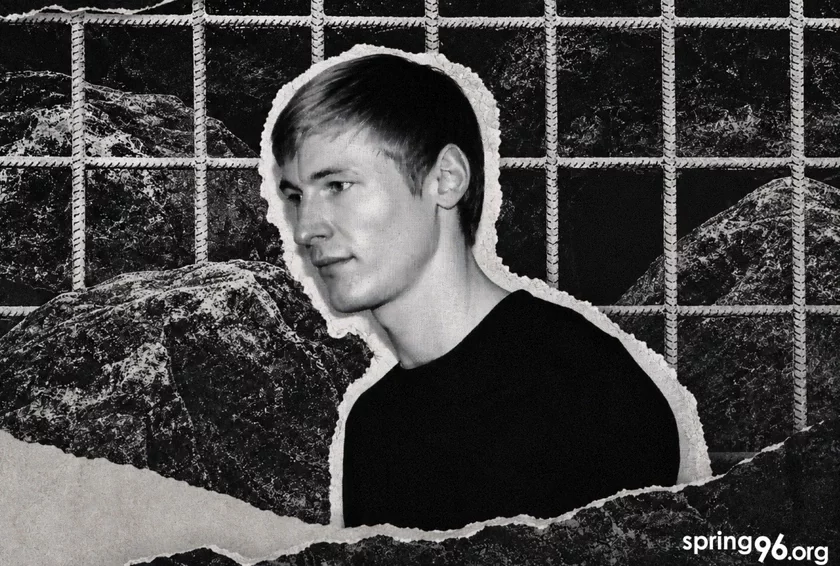
Strained relations with squad activists and the last placement in a punishment isolation cell after an inspection
A former political prisoner (name not disclosed for safety reasons) told human rights defenders that he saw Andrei on the day of his death — September 3, 2025.
According to him, Andrei smiled, asked about the news, and inquired when everyone would be released. Andrei planned to attend a concert to meet other political prisoners, but he didn't come — he was placed in a punishment isolation cell (ShIZA).
Another former prisoner, on condition of anonymity, said that Andrei was placed in a punishment isolation cell after a search with the removal of personal belongings. As another political prisoner notes, this often becomes an excuse to "rummage through political prisoners' belongings" and issue them a violation.
"This is a check of the prisoners' belongings against the inventory. It's a legal opportunity to put a political prisoner in a punishment isolation cell if there's a corresponding 'order' for him."
According to the prisoner, Andrei had strained relations with the supply manager (head of economy) of the 18th squad, Vadzim Meliukh. Other prisoners believed that the political prisoner was placed in the punishment isolation cell precisely with the assistance of this supply manager.
According to the observations of other prisoners, Andrei had been receiving more attention from staff recently. Prisoners who communicated with him in recent months said that he was clearly not in the best moral state, had withdrawn, and read more books.
After his death, his belongings were taken away at night, and rumors were spread that Andrei was supposedly being transferred to a prison regime to cover up the incident.
Another political prisoner, also anonymously, reported that at the moment it happened, the lights went out in the penal colony. According to his estimates, this could have lasted up to half an hour. During this time, Andrei committed suicide.
As a former political prisoner recounted, according to conversations in the colony, Andrei might have hanged himself on the bars in the punishment isolation cell, using his own pants.
They tried to "push him into 'low status'"
Human rights activist Valiantsin Stefanovich of "Viasna," who was held in Mahilieu correctional colony No. 15 from May 2023 to October 2024, spoke about meeting Andrei Padniabenny:
"I met Andrei on the very first day of my transfer from a punishment isolation cell to a squad. I ended up in a punishment isolation cell on the third day of my stay in the colony's 'quarantine.' After I had brought my belongings and mattress to the squad and was waiting for further placement, I went out into the local section (sector). Our sector had three squads — 3, 4, and 14. I could communicate with convicts from these squads. Two political prisoners came out to meet me, among whom was Andrei Padniabenny. They said they were very happy to meet me in person and had been waiting for me to leave the punishment isolation cell. They gave me some advice about staying in the squad and everyday matters, and also asked if I needed anything.
Andrei was a tall, lean guy, significantly younger than me. He seemed quite friendly and open. Later, I spoke with him several more times, but I didn't maintain constant contact, as our 'schedules' didn't coincide due to both of us frequently being in a punishment isolation cell. Then Andrei was transferred to the 18th squad, which was located opposite our sector."
As the human rights activist explains, the 18th squad mainly held pensioners or prisoners who worked "light jobs" due to health conditions. They went to the "industrial zone" twice a week — to clean cables. There were very few political prisoners in this squad.
"Andrei worked as a cleaner for the local section, so he wasn't taken to the industrial zone, and consequently, I didn't have the opportunity to talk to him. We only greeted each other with a nod from a distance. But information and rumors spread quickly in the colony. From other political prisoners, I learned that he was often in a punishment isolation cell, that they tried to 'push him into 'low status',' and that supposedly because of this, protesting against such actions, he bit his own hand. According to unwritten rules, you have to get out of such a cell by any means within a few hours. I can assume that he had reasons to do so, as such actions by convicts — demonstrative self-harm, swallowing objects, and so on — are a known form of protest against the lawlessness of the administration of places of detention. Apparently, Andrei was protesting against something in this way."
The human rights activist learned about Andrei Padniabenny's death after he had already been released — in March 2026. Valiantsin draws attention to the fact that the lights were off during the incident:
When I was in the cell-type premises (PKT) and punishment isolation cell (ShIZA) in colony No. 15, there were emergency power outages, sometimes for quite a long time. During this period, the surveillance cameras installed in the cells also did not work.
Valiantsin Stefanovich also notes that the chains on which bunks were attached in the colony were referred to as an easy means of suicide:
Wrap the chains around your neck and hang — the weight of your own body is enough for self-strangulation, even if your feet remain on the floor.
But the main question that requires a thorough investigation, the human rights activist notes, is the reasons for Andrei's act.
"It is important to note that merely being in places of detention and being sentenced to a long term are strong psychological factors. Many convicts are in a difficult psychological state, often falling into depression and despair. This can especially happen when facing difficult life circumstances — divorce from a wife, which is a common occurrence, especially with long sentences, or the death of loved ones. In such a situation, convicts need professional psychological help, which is practically non-existent in PC No. 15. The colony staff includes several psychologists, but this help is very formal and is mainly limited to issuing sedatives or just valerian pills."
According to the human rights activist, Andrei Padniabenny was on two prophylactic records: No. 10 — "prone to extremist and other destructive activities" and No. 7 — "prone to suicide and self-harm."
"According to the testimonies of other convicts, Andrei had suicidal thoughts and moods and clearly required psychological help. In the case of political prisoners, the situation is complicated by the fact that the administration's task is not to help them, but to exert constant pressure on them, create maximally harsh conditions, and organize various kinds of provocations. In such an atmosphere, the psychological state deteriorates even further. Moreover, political prisoners were afraid to consult psychologists, as they did not trust them. They feared that the information they shared would be passed on to the colony administration, and also that they might be given another prophylactic record — No. 7, 'prone to suicide and self-harm'."
They worked with him more harshly than with others
A former political prisoner (name not disclosed for safety reasons), who was in the same squad — the fourth — with Andrei for some time and calls him his comrade, believes that he was driven to suicide by the pressure exerted on him:
"The situation is complex. Many believe that he was a depressive person prone to suicide. But I have a different opinion. I am convinced that he was pushed to suicide. They 'worked' with him, meaning they exerted pressure, more harshly than with others. This was due to the fact that he set fire to a car belonging to some head from the Department of Penitentiary Institutions (DVP). From above, they asked to 'cheer him up' a bit. He was intimidated with 'low status.' He had previously cut his veins, so he wasn't classified as 'low status'."
When Andrei Padniabenny died in the punishment isolation cell on September 3, 2025, our interlocutor was in another cell. He recalls what it was like:
"Everything happened maximally strangely. For some time, the lights went out in the punishment isolation cell — and everything happened. But there's a generator in the isolation unit — the lights shouldn't go out there. At that moment, I was also in the punishment isolation cell. But I didn't hear any panic in the corridor — nothing was happening. The lights went out — they shined a flashlight. They asked: 'Is everyone alive?' We answered that everyone was. Then the lights came back on, but nothing happened. And when I left the punishment isolation cell, I learned that a person had committed suicide at that time.
Committing suicide because you were given seven days for two apples, when you've already served a hundred days, is maximally strange. According to the police version, which they spread through activists, Andrei allegedly received a letter and read something in it. But a letter couldn't have arrived in a punishment isolation cell. If he really received a letter, then why didn't he commit suicide immediately in the squad? It's an emotional outburst, an instantaneous desire. It's as if he was waiting to be sent to a punishment isolation cell, and then the lights would go out... I don't believe that. Probably, it was another attempt at humiliation, which he couldn't endure. You can push someone to suicide even with words.
A similar situation happened with Dzmitry Shletgauer, who didn't even make it to the squad and hanged himself in a punishment isolation cell. They also 'worked' harshly with him. The police also spread rumors that it happened because of a letter he received. I think it happened due to pressure, and he was also driven to suicide. Everyone has their own threshold for perceiving pressure. But I didn't know Dzmitry personally. I only heard that a political prisoner had hanged himself."
The former political prisoner remembers Andrei fondly and hopes that those involved in his death will be brought to justice:
"Andrei was a very strong and strong-willed guy. He was very kind. It hurt me when I found out what had happened to him... To break him, they would have had to try hard. I remember how, after being transferred to another squad, he said with a smile that he was unlucky to be the only political prisoner in the squad. He presented it not with a dejected look, but with a smile.
At the same time, Andrei was apathetic. He always had such sad eyes, as if a person had already served 20 years. As if for him, one day passed as three.
This situation cannot be left unaddressed and forgotten. Personally, I will not forgive it. If it takes 20 years to restore justice, I will wait and preserve this information. I will do everything possible to ensure that those guilty of Andrei's death are punished."
Andrei did not resemble a terrorist or an instigator of passions
Former political prisoner and writer Aliaksandr Fiaduta spoke in a column for Belarusian PEN about meeting Andrei:
"Andrei did not resemble a terrorist or an instigator of passions. Tall, calm, intelligent, he apparently read a lot and thought even more.
Our squads were neighbors: the sixth — mine, and the eighteenth — Andrei's. We often talked. Mostly about some political and economic problems, which he understood much better than I did. But everything ended the same way. Andrei would ask me:
— Iosifovich, when do you think this will end?
Andrei was not taken to the 'industrial zone' for work. He swept the yard. We were colleagues: I was listed as a cleaner in the workshop."
He gave me his green tea and watch
Former political prisoner Siarhei Ivantsou, who was for some time held with Andrei Padniabenny in the 18th squad, recounted:
"On August 30, 2025, I returned to colony No. 15 after another transfer to the hospital. I was immediately placed in 'quarantine.' I was moved to the 18th squad on September 10. In total, there were only three of us political prisoners in that squad. I looked: there were only two of us, and Andrei was not there. I asked other prisoners where Andrei was and looked around. And two 'white-shirted ones' (referring to administration/informers) said: 'Quiet!' — and pointed a finger to their lips. Then one of them pointed a finger downwards. I thought that meant he was placed in a punishment isolation cell. But when he saw that I didn't understand, he pointed a finger upwards. Then I asked: 'Was he taken to headquarters?' I didn't understand what was happening. Then they quietly told me that Andrei had died — he had hanged himself in a punishment isolation cell.
I was very shocked by this news — it took my breath away. The colony administration actively concealed this information. It was even forbidden to talk about it. This story affected me so much that when I found his tag in the wardrobe, I hid it with me. Of course, if it had been found, I would have immediately gone to a punishment isolation cell. I carried it in my gloves for a couple of weeks, and then it got lost. But it was very dear to me."
Siarhei recalls befriending Andrei in the squad and talks about his symbolic last gift:
"Before I went to the hospital, he gave me his green tea and watch. I was surprised: 'What, you don't need a watch?' That's a great value in the zone. It could be exchanged, for example, for many cigarettes, which are good currency. I was surprised and thought he was just a good guy. When I heard the news about Andrei, I remembered his gift. Probably, he was preparing or knew that it would happen that way."
The former political prisoner says that Andrei had family problems:
"In August, before my departure to the hospital, when we went for phone calls, Andrei hadn't been able to reach his mother for several weeks. He knew she was sick and decided that things were really bad. It was clear that he was very worried. Together with another political prisoner, we constantly tried to calm him down. His wife had left him earlier. I don't know if that could have influenced what happened, but that fact existed."
When he was transferred from the stage and placed in a punishment isolation cell, he had a panic attack
As one of the former political prisoners (name not disclosed for safety reasons), who was held in Mahilieu correctional colony No. 15, notes, the issue of the psychological state of prisoners and their detention conditions is critical. The former political prisoner, who knew Andrei Padniabenny and talked with him, and also has information about the death of another political prisoner — Dzmitry Shletgauer, shared his thoughts on how the system drives people to the extreme limit.
According to the former political prisoner, thoughts of suicide appeared in Andrei already during his first placement in a punishment isolation cell.
"Andrei recounted that when he arrived at PC No. 15 and was placed in a punishment isolation cell, he started having thoughts of suicide. Because you arrive at a penal colony and don't know what awaits you. At the same time, in the pre-trial detention center and during transfers, you hear various horrific stories, and then you immediately end up in a solitary cell in a punishment isolation cell with terrible cold that doesn't let you sleep at night. You do push-ups or squats to keep warm, pass out for 20 minutes, and then wake up again from the cold.
Andrei recounted that when he was transferred from the stage and placed in a punishment isolation cell, he had a panic attack, because it seemed to him that they simply wanted to kill or torture him.
Although he later, as he said, understood that it was a formal placement in a punishment isolation cell, which most political prisoners go through after arriving at the colony."
The interlocutor mentions that Andrei Padniabenny found isolation and separation from his family difficult to bear.
"When Andrei was placed in a punishment isolation cell, it was psychologically difficult for him, as three children were waiting for him at liberty. When he was in the squad, he could call them or see them via video link."
Nevertheless, pressure on the political prisoner and his placements in the isolation unit continued, leading to more serious consequences.
"This was not Andrei's first suicide attempt. Initially, he was in one squad, where he was periodically placed in a punishment isolation cell. As a result, during another panic attack, he bit open the veins on his arm. After this, he was transferred to the 18th squad. I heard that this squad has a smaller number of prisoners, especially political ones, which allows for closer control over them."
According to the political prisoner, Padniabenny stood out among other prisoners for his openness and sharp reaction to what was happening around him.
"Andrei was a very sincere and open person with a heightened sense of justice. Sometimes this seemed like naivety. Some prisoners mocked him or deliberately provoked him. He once complained that one of the prisoner-activists — Bachyla — was 'bothering' him."
He was an emotional person and took everything to heart. When he watched some news, he could sometimes react very nervously to it.
Andrei had an addiction to news, and some of those who communicated with him in the squad tried to distract him from the TV. He was very interested in the war in Ukraine.
Andrei couldn't always restrain himself, so sometimes he had arguments with others. And with this, things are very strict in the zones now: the administration tries to maximally suppress all conflict situations. In the squad, you are always in plain sight, and Andrei hardly ever went to the industrial zone because he worked as a 'local worker,' so he spent most of his time within the squad's territory. Besides this, video cameras are installed everywhere. For a verbal argument, you could immediately be sent to a punishment isolation cell for 10 days. And if you are a political prisoner, no one will even bother to investigate. Andrei could sometimes react emotionally to a remark, so he ended up in a punishment isolation cell several times for conflict."
Andrei described his state under the influence of neuroleptics as a lethargic sleep
According to the observations of the former political prisoner, Andrei had an unstable emotional background.
"At a certain time, I was very interested in psychology, so I noticed that Andrei probably had an obsessive-compulsive disorder — neurosis. One of the signs of this is that a person frequently washes their hands. Andrei constantly walked around and washed his hands — he almost had soap in his pocket. All the prisoners joked about him and said that he would wash his hands raw. I communicated with Andrei, tried to support him, and helped him shift his attention. I shared with him ways to achieve self-control. Because he could explode even over some trifle."
As the interlocutor notes, psychological help in PC No. 15 exists only on paper, and instead of treatment, drugs that suppress the personality are used.
"It is unrealistic to receive full psychological help in the penal colony. Psychologists in the colony are mostly just a formality. They conduct some tests once every three months — and that's it. But we don't know if these tests are processed in any way or if their results are taken into account.
Antidepressants are an expensive pleasure for prisons, so they simplify everything and prescribe neuroleptics. I discussed this topic with many educated people who also went through imprisonment, and all said that Belarusian prisons and penal colonies are one big madhouse. Most of the people in their contingent have psychological problems, and the state lacks resources for their rehabilitation and support. For the state system, the easiest thing is to isolate these people. Considering how many people there require psychological help, these two-three psychologists for several thousand prisoners are nothing. They physically cannot meet the needs of everyone who requires psychological help.
For example, many prisoners, after entering a colony, experience divorce about a year later; some 'go crazy' due to a long sentence they still have to serve; some are afraid to be released after a long period of 'serving time' because they see on TV how the world outside the colony has changed; some are distressed due to the death or illness of loved ones and relatives. And all that a psychologist can offer in such critical moments is 'valerian tablets' — a strip of valerian pills.
It also needs to be understood that every person has an individual degree of resilience. In the same zone and squad, conditions might seem like torture for one prisoner, while for another, it's everyday routine. This is a question, among other things, of personal perception, experience, and hardening.
Upon arrival at the colony, prisoners are supposed to talk to a psychologist to form a psychological profile of the person, but this function, like many others, is most often performed by an operative. On the other hand, the squad leader should care about the psychological state of the prisoners and inquire about it, but often staff are so overloaded with paperwork that they no longer have the resources for this."
The interlocutor mentions that Andrei was prescribed a course of neuroleptics — antipsychotic drugs — for some time. This is a group of psychotropic medications primarily used to treat psychoses, schizophrenia, and other severe mental disorders. They effectively reduce psychomotor agitation, eliminate delusions, hallucinations, feelings of fear, and aggression. But Andrei himself refused them because they were very strong.
"Andrei described his state under the influence of neuroleptics as a lethargic sleep: he woke up, went to the toilet, to the cafeteria — and then he was 'switched off.' Sometimes he could miss the cafeteria because, under the influence of the pills, he didn't hear the signal to leave the squad. According to Andrei, this medication therapy made him lose his will to live. He said he understood that the medicines were supposedly meant to help, but his psychological state, on the contrary, worsened. The body seemed to be physically preserved, but as a person, you didn't exist because you completely stopped feeling and experiencing emotions. Because of this, he refused these medicines. For some time, he was psychologically stable, partly thanks to basic physical exercises."
The second tragic incident occurred with Dzmitry Shletgauer, who didn't even make it to the squad and also died in a punishment isolation cell.
"When Dzmitry Shletgauer died, there was a prisoner in a punishment isolation cell at that exact time, with whom we sometimes communicated. He later recounted that he heard commotion in the corridor and recognized the voice of operative Kisliakov, who was removing a body from the 'noose.'
It happened at night. He heard some movement and Kisliakov's voice: 'He's still warm.' It is known that Shletgauer was placed in a punishment isolation cell from 'quarantine.' Later, rumors circulated that for some time, no political prisoners from 'quarantine' were sent to a punishment isolation cell in PC No. 15. Because before this tragic incident, almost all prisoners who had prophylactic record No. 10 — 'extremist' — after being transferred from the pre-trial detention center to the colony, ended up in the squad via a punishment isolation cell.
Rumors about the suicide of a political prisoner in a punishment isolation cell spread very quickly, although the administration tries by all means to conceal such facts. After some time, gossip began to spread that the person who committed suicide had allegedly been imprisoned under a drug-related article. Some speculated that such rumors were intentionally spread by the operational department to avoid a possible heightened reaction to this from other political prisoners."
He said that as soon as he arrived at the colony, he was beaten in the punishment isolation cell
Another former political prisoner, who was in the squad next to Andrei's, agreed to speak about Andrei Padniabenny on condition of anonymity:
"I met Andrei on the very first day he arrived in the neighboring squad — the 14th. We immediately started communicating very well, because he was one of the kindest political prisoners I knew in the penal colony. Andrei didn't even utter a single curse word during all our conversations.
He recounted that as soon as he arrived at the penal colony, he was beaten in the punishment isolation cell. This happened to everyone who had a long sentence. When he entered the colony, he was deprived of everything. I helped him as much as I could because he had absolutely nothing: no clothes, no food. We talked every day, drank tea together."
The man says that Andrei had an illness, but could not recall or specify the details. According to him, the political prisoner told him about it approximately a month after he found himself in the colony — in October 2023:
"He was only allowed to do light work, but he walked with me for a long time cleaning wire. Andrei sought to be transferred to another job. So he ended up in the 18th squad, where he was assigned light work. He was still sent to clear snow, clean the colony territory, although that's not light work.
Andrei repeatedly told me that he didn't have long to live. With tears in his eyes, he said that he felt he would die soon. I constantly told him: 'Andrei, calm down! You have your whole life ahead of you. We will build Belarus together again.' He said that he had some illness and needed medical help, which he would not receive in the colony."
At the same time, as the man emphasizes, Andrei never mentioned suicide in his conversations with him:
"I am sure: he would not have done that."
The former political prisoner notes that he did not notice any psychological problems in Andrei:
"He was always positive. Andrei was a calm person. But he wasn't very eager to communicate with anyone."
According to the interlocutor, Andrei Padniabenny was repeatedly placed in a punishment isolation cell:
"When he was in the 18th squad, we noticed his absence. There were very few political prisoners in that squad — only pensioners. Andrei was the last prisoner I saw before my release. He was clearing snow, and I showed him a gesture through the fence: 'Long live Belarus!' It so happened that my last words in the colony were addressed precisely to Andrei."
The former political prisoner learned about Andrei's death when he was already free.
"A relative of one of the convicts was visiting the colony. She told me that a political prisoner had hanged himself in the colony. I then contacted journalists so they could find out who it was about. And then I read in the news that it was indeed Andrei."
"All these facts require a proper investigation"
Summarizing, "Viasna" human rights activist Valiantsin Stefanovich notes:
"Andrei's death in the punishment isolation cell of PC No. 15, in my opinion, should be considered in the context of the general situation of pressure faced by political prisoners in places of detention. It should be noted that political prisoners face systemic, targeted pressure, organized by the administration of places of detention. The systematic nature, mass scale, and uniformity of this pressure on all political prisoners allow us to speak of a specially developed methodology for its implementation and attest to its organized nature.
All this pressure and provocations against political prisoners were organized directly by the colony administration: the head, his deputies, operatives, and squad leaders. Here it must be recalled that all reports and decisions on placement in a punishment isolation cell for 'violations' bear the signatures of specific officials, in particular, colony head Lazarenka. In addition, there are known facts that colony employees — Majors Vesialou, Kavaliou, and Captain Kislov — used torture and physical violence against convicts. It is probable that such physical violence was also applied to Andrei.
The incident with the bitten hand during another stay in a punishment isolation cell indicates that Andrei was protesting against some illegal actions against him. All these facts require a proper investigation and the ascertainment of the truth necessary for a legal assessment of the actions of specific officials of colony No. 15: colony head A. V. Lazarenka, his deputies Fedarenka and Ihnatsenka, squad leaders and operatives, the head of the operational service and his deputies.
I reiterate that all pressure and provocations committed against political prisoners, including Andrei, occurred by order of these officials, with their knowledge and approval. The investigation will need to identify those who gave such orders to the colony's management. It was probably the leadership of the Department of Penitentiary Institutions or directly GUBOPiK. This also applies to another case — the suicide of Dzmitry Shletgauer in the punishment isolation cell of PC No. 15 in October 2024."
Now reading


In the Czech Republic, Poles Beat a Pole, Mistaking Him for a Ukrainian Due to a Hat in the Colors of Upper Silesia. The Guy Was on a Charity Bike Ride for His Pregnant Partner Who Had Cancer


Comments