


"I still regret not becoming a doctor." We spoke with Sviatlana Bien about her new album, life in Berlin, "blacklists," and justice
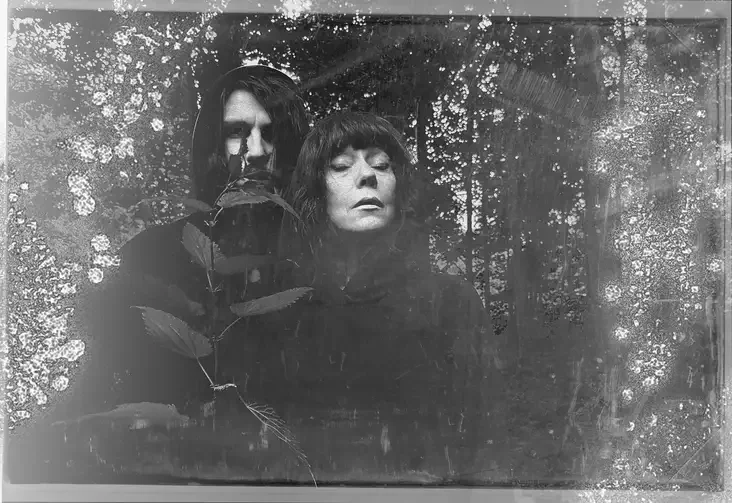
In August, artist, director, and poet Sviatlana Bien released her new album "Karova Bielaja" (White Cow) —a massive collaborative work with musician Yawhen Kuchmejnym (tochka K). It contains a great deal of existentialism, despair, and hope simultaneously. Music critics unanimously agree that this album has already inscribed itself in the history of Belarusian music.
During the album's support tour, Sviatlana Bien found time for a conversation with Nasha Niva. We touched upon the extreme conditions of recording "Karova," emigration, the challenges of life with her daughter in Berlin, the fear of dreaming, Belarusian PTSD, and new projects.

Sviatlana Bien — a Belarusian singer from Vitsebsk, theater director and actress, and poet. At one time, she was the leader of the musical group "Serebryanaya Svadba" (Silver Wedding). In 2020, after the presidential elections, she supported the protest, singing at courtyard solidarity concerts with other artists. February 2022 became a dark month for the artist in all senses: first, her husband, musician Artsiom Zaleski, died, then a full-scale war began in Ukraine, and Sviatlana was forced to leave the country due to the danger of detention. She now lives in Berlin, stages plays, writes poetry, and participates in another musical project, Wtbsk.
Yawhen Kuchmejnym — a multi-instrumentalist, a musical prodigy from Ivy. In 2016, his solo project tochka K won "Basowiszcza." Yawhen is the founder of the Neman9 recording studio. In 2026, he moved to the village of Malyja Azjarany in Polish Podlachia, on the border with Belarus, at the invitation of the local head (soltys), who wanted to "revive the dying village."
Nasha Niva: You and Zhenya Kuchmejnym recorded your new album under conditions that few would call comfortable — a tiny Polish village of Malyja Azjarany on the border with Belarus, which was snowed in during winter, a cottage where hands could freeze in the cold, and in the heat, you had to cool your feet in a basin. Of course, this somehow added uniqueness to the songs — like the live sounds of crackling fire in the stove — but was choosing to record the album this way intentional or forced?
Sviatlana Bien: Zhenya lives there now; he has his "Neman 9" studio organized there, and it was the most sensible decision to avoid renting a studio in Berlin or anywhere else. So, there was nothing romantic about it at the start. But in the end, it turned out to be a very romantic, beautiful, tragicomic, and a bit heroic recording story.
NN: Your album has already received high critical acclaim — as a work that will go down in history, as another powerful musical statement of the war era, as "the strongest album of the new 'relocant' scene." Your previous collaboration with Halya Chyikis was also warmly received. Do such weighty formulations burden or delight your soul?
SB: I try to give less weight to such formulations in my head.
For me, it's just an album, these are just songs that have accumulated over 10 years. There is nothing directly about emigration or war. It's entirely about the internal state, into which all events of the world flow very unexpectedly and organically at the same time.
Of course, I read what people write. And it's very pleasant and important that they took the time and paid attention to it. But I try to let it fly through my head without settling there. I just read and think, "Yes, thank you very much." Someone said something pleasant, someone will say something critical, and you have to somehow register that. But in a way that someone else's opinion doesn't affect my own feelings.
NN: Despite the fact that a considerable number of people took part in the album's preparation, the main work still fell on you and Yawhen. The same applies now to tours. This is a very extensive work; will it bring you commensurate financial gratitude?
SB: Music is the main and most important thing we live for and work with. But music is largely about service. Not about earning money.
Simply because there are always some concerts or other creative events happening, art somehow allows us to survive.
But a tour is not something that will significantly change our financial situation. It's more about meeting listeners and adventures in different cities.
NN: It's one thing to live in a village in Podlachia, as in Yawhen's case, and quite another to live in Berlin, a very expensive city. How did you manage to settle there?
SB: Berlin and I are in a great resonance. It behaves like an unreliable bipolar lover, sometimes throwing problems, and sometimes saving and amusing. There are many friends and events here. And beauty.
For some time, my daughter and I lived with friends in different apartments. For the past year, we have been living in an apartment, in such a beautiful house, with a courtyard that reminds me of my childhood in Vitsebsk. There's the same large dumpster for the whole yard, which used to be on Mir Street in Vitsebsk. Dirty papers fly around and antisocial elements hang out under the windows.
NN: And how are things with the German language?
SB: All my projects are connected with Belarusian and Russian, so I'm not making any progress in German. I attended courses, but they ended in nothing. Well, German words don't stick in my ear, they don't stick in my head.
My daughter goes to school.
NN: After the events of 2020, you ended up on the "blacklist of artists." But you remained in Belarus until 2022. Was there even an option not to leave?
SB: No, I didn't have much chance of staying. It was too dangerous. I had a great responsibility to my child. And so I couldn't hesitate there.
NN: We are speaking on the day when, as a result of Belarusian-American negotiations, another 25 political prisoners were released. Among them, for example, were musicians from Tor Band, who were severely punished for their creativity. Why did blacklists alone become insufficient punishment for the regime?
SB: The problem is not only in music and culture.
It's just an overall unjustified, terrible ruthlessness that applies to everything happening in Belarus right now. I would also call it blind, short-sighted, illogical. And since it's illogical, as a person with logical thinking, I cannot understand what drives these people. And these are very, very sad and irreversible destructions.
NN: In "Karova Bielaja," there are lines about you (and us) needing hope. What is it for you today? What helps you get through everything?
SB: I would like to find that point where it can be found. That's my hope: to find hope.
NN: In an interview with "Novaya Gazeta. Europa," you noted that the degree of this world's unbearability for you increased after the events of 2014. Since then, it has only increased. In such conditions, do you still retain any belief in justice?
SB: I think I generally didn't expect any logic or justice from the universe in the human sense. It seems to me that every person is a separate battlefield, where different forces fight: both good and evil, black and light. And everyone must be responsible for their own battlefield. And that's all.
And general universal justice (or injustice) seems to me a reflection of how much we lose our own battle. And first, you need to win it, and then try to influence what happens in the world.
NN: Turning again to the poetry in the new album, there is a line that a person is 60% tears. What else does Sviatlana Bien consist of today?
SB: I consist of cigarettes, coffee, deadlines, and a constant struggle between desperate cheerfulness and terrible despair.
NN: We saw a phrase in one of the reviews of the last album, saying that it cannot be called Russian, German, or Belarusian. But in our opinion, it is super-Belarusian in context, not only because the Belarusian language is used there. Tell me, living in emigration, is it difficult to write poetry and songs without your own land under your feet?
SB: By my nature, I'm not prone to attaching myself to any particular place. Everything most important happens within me, inside, in my heart. And it makes no difference to me where I live. None at all. I think I am a small fractal of Belarus. Wherever I live, I am its metaphysical representative, a tiny particle, a microscopic diplomatic mission.
I have a favorite phrase, by the priest and philosopher Pavel Florensky, who was killed in 1937 in Stalin's camps. It says that "man is a compressed synopsis of the universe." That is, every person is equal to the entire cosmos, only he is compressed into this small fractal, into a small unit.
Belarus for me is more than just land or a place. It reaches high into the sky and deep into the earth. And I am its molecule.
NN: And a person who doesn't attach to a place creates a band in honor of their native Vitsebsk? (This refers to another musical project involving Sviatlana — Wtbsk. — NN)
SB: Well, it's a sign of love. But I don't need to be directly in the place I love. My love doesn't depend on where I am.
NN: Here and there, one sometimes hears the question: is a revival of "Serebryanaya Svadba" possible in any format?
SB: To answer concisely, no, the band will not reunite, of course.
"Serebryanaya Svadba" very much corresponded to its time, a more carefree, safe time. And to my state at that time. And, of course, nothing in the world lasts forever, and everything crumbles and flies apart, and that's normal.
Simply, that time ended, and that me ended, then another me appeared, then yet another, and now another. And I never return to something that was long ago. I immediately fly forward.
It's so interesting to live, and so much is happening now, that thinking about what ended 10 years ago is too luxurious. It's just a foolish waste of time.
NN: Does your vision of yourself in the future align with how you formulated it in the past — by the sea, with your palace nearby?
SB: I absolutely must live by the sea, in a palace! And I invite all interesting men who own a palace by the sea to write me a love letter (smiles).
NN: What else do you dream about?
SB: I'm afraid to dream about anything. It's like with hope: my dream is to start dreaming again.
NN: In childhood, among other things, you dreamed of becoming a Sorceress or an Angel. For many, your music today is salvation and healing. Can it be considered that in some way, your childhood dream has come true?
SB: I've always wanted to help very much. And if someone says that my music, or plays, or books have helped them in some way, I feel great, great happiness. But I'm afraid to think about it too much, so that it doesn't influence me.
I would like to do much more. To this day, I deeply regret not becoming a doctor, like my parents. It seems to me I would have done much more useful things if I had treated people and brought concrete benefit.
Because for what I do now, I am not responsible; it sometimes happens unconsciously. And if it turns out that it worked and helped someone, it's not thanks to me at all, but rather through me.
NN: Tell us, where else can we see and hear you in the near future?
SB: With Lina Hesse, the same Berlin artist who did the book and play "The Unemployed Tree" with me, and our friend, actor and director Vanya Kilber, we recently staged a play called "10 Signs That You've Fallen Into a Black Hole."
It consists of astrophysical facts about black holes, which we reinterpreted in a more poetic, metaphysical vision. We really just wanted to put on a play about a black hole. We were very interested in it as a physical and astronomical phenomenon. Because we love space, physics, everything connected with science and miracles.
Having started working with this theme,
we saw that a black hole is such a powerful metaphor for post-traumatic stress disorder and severe depression. All those desperate states in which many people find themselves now. And we just started digging in that direction and comparing two stories: the astrophysical and the human.

For now, we plan to take this play to Munich for a festival and also have another showing in Berlin. And then we'll see: wherever we're invited, we'll go, we'll be happy.
I also strongly encourage you to listen to our audio play "Turning Instantly into a Spark..." (a new project by the "Pfljaumbaum" publishing house, dedicated to Zinaida Bandaryna — one of the most prominent Belarusian poetesses of the "Maladniak" era. — NN).
It's a very touching, beautiful play, in which many Belarusian actors put their efforts. Zhenya Kuchmejnym wrote music for it — there are very beautiful songs. It seems to me this is a very heartfelt project.
NN: What about your other musical project — Wtbsk?
SB: I play there with my best friend Syarozha Navitski (he is also from Vitsebsk). And Misha Radzionau helps us a lot, an excellent singer, known to many from the band The Retuses. Misha is also in emigration after the start of the full-scale war, in Berlin. We continue our joint project. We have performed a lot lately at various poetry events. And we are currently working on mixing the album we have already recorded; all that remains is to finalize it.
From the nearest events — we will take part in the Minsk x Minga festival (annual cultural festival in Munich. — NN), we will perform there on October 9.
NN: Many Belarusians today live in anxious disarray, some with PTSD, some with feelings of guilt and other complex emotions — what would you wish for them?
SB: I would like to say this to all people who are going through difficult times (and there are many such among Belarusians). And I, in turn, heard them from a specialist who works with people with PTSD, before we started making the play about the black hole.
She said that when a person has experienced some very difficult stressful experience, when they have faced something terrible, it is not so easy to erase it from the heart, and not so easy to find joy again and generally return to normal life. And it seems that this black hole will have no end. And there is one trick here: a person tries to fight it, goes to friends, goes to some event, tries to enjoy a beautiful sunrise, goes to the forest. They take steps, take steps, take steps to save themselves, to feel better, to be released, but they are not released. And this happens the first time, the tenth, the thirtieth, the hundredth.
And so the specialist said that the most important thing is to remember that this pit will, after all, one day fill up. It's just that everyone has their own. And it's unknown how many efforts you need for this: 100 or 200, or 215. And you shouldn't give up on the 200th, you still have 15 left.
She also said a phrase that later became our epigraph: that fear and catastrophe are not your whole life, they are only a part. It doesn't take up your entire volume. There will be other parts.
I don't know how important this is for someone to hear. But for me, these were very important words that supported me very much.
«Nasha Niva» — the bastion of Belarus
SUPPORT US-
Taylor Swift received an MTV award for Video of the Year
-
U2 celebrated their 50th anniversary in the Dublin school where they grew up
-
The bassist of "Pyatlya", his 18-year-old son and the star of "Razbitaha Serca Patsana" — we tell you about the Belarusian-speaking band Prypiać, which presented its original "Kalykhanka"
Now reading


"Didn't like the products on the shelf — and they write an SMS there." The Ministry of Internal Affairs called Threads a security threat and announced arrests

"Didn't like the products on the shelf — and they write an SMS there." The Ministry of Internal Affairs called Threads a security threat and announced arrests


"More than 10 people have left for Europe — and that's just from my department." A resuscitator from a district center frankly described the daily life of Belarusian medicine


Comments
Чорная дыра 2020-х - разрыў паміж сусветамі, эпохамі. Адсюль і адчай. Папярэдні для беларусаў адбываўся ў 1990-х.