


The Spanish slug devours everything in its path. Beer — any kind — can help stop it, and now is the perfect time for it.
The Spanish slug reproduces rapidly and has become a real catastrophe for vegetable gardens and flower beds: it gnaws at garden and ornamental plants. Autumn is a favorable time to reduce its numbers. We tell you how to deal with this dangerous pest.
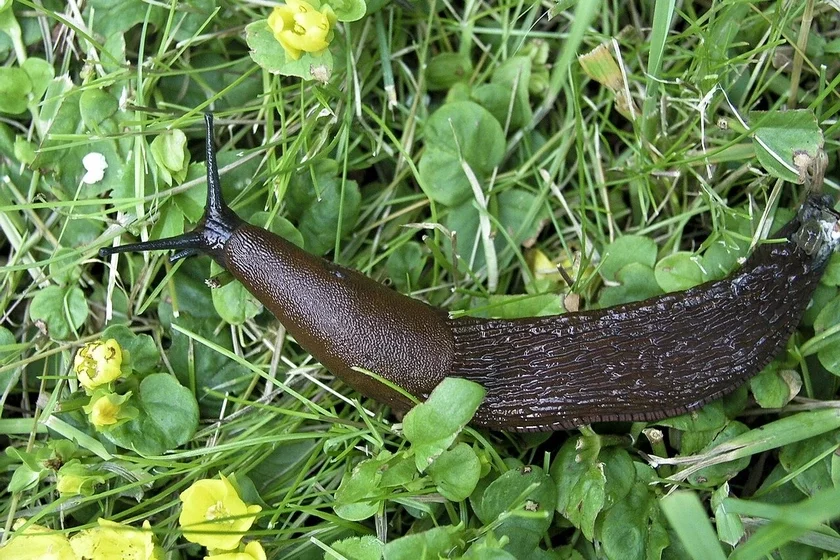
The Spanish slug (Arion vulgaris) has become a serious pest in many European countries over the past decades. In Belarus, it was first discovered in 2020 in Grodno and Borisov. Humans help it spread over long distances: slugs and their eggs are inadvertently transported along with fruits and vegetables, seedlings, soil, and other materials.
Despite its name, the "Spanish" origin of the species is not considered undisputed. Researchers name France and the western part of Central Europe among possible areas of origin. But the name "Spanish" has stuck to it.
An adult slug reaches approximately 7–15 cm. Its coloration is highly variable: from orange and reddish-brown to dark brown. Characteristic features are thick sticky mucus and a dark ventral surface, but it is difficult to reliably distinguish this species from some related ones based on appearance alone.
The danger lies in its appetite and numbers. The Spanish slug devours vegetables, garden and ornamental plants, fruits, as well as organic residues and carrion. Even chicks of ground-nesting songbirds can fall victim to Spanish slugs.
The Spanish slug can not only compete with local species but also hybridize with closely related slugs. Long-term observations in Germany have revealed such hybrid forms, and some local slugs have eventually disappeared from the studied area.
The life cycle of the Spanish slug typically takes about a year. Young individuals, which have overwintered in the soil and plant debris, begin to grow actively in spring and can develop into large adult slugs by summer. The breeding period begins in summer, with eggs most actively laid in late summer - early autumn, and egg-laying can continue later if the weather is favorable. One slug can lay several hundred eggs in its lifetime.
The Spanish slug does have natural enemies. These can include frogs, hedgehogs, thrushes, starlings, moles, and predatory beetles (for example, the ground beetle Carabus granulatus). However, one should not rely solely on natural helpers.
Chickens and ducks, which readily eat them, can help in the fight against slugs. However, it's probably not worth acquiring poultry solely for pest destruction. They require proper care and suitable conditions, and in the garden, they can damage young plants.
Physical barriers also help deter slugs. Around garden beds, you can create a protective strip of gravel or sand: it is more difficult for mollusks to move across such a dry surface. Raised beds, pots, and other containers can be lined with copper tape at least 5 centimeters wide — contact with copper causes an unpleasant reaction in the slug and forces it to retreat. It is important to remember: the barrier will not get rid of pests already inside the protected area, so they must be collected first.
Why does a slug need beer?
One of the most unusual ways to combat the Spanish slug is with beer traps. And this is not just folk advice: their effectiveness is confirmed by field research.
What attracts slugs is not the alcohol itself. Experiments have shown that an ethanol solution by itself hardly attracts them. Mollusks primarily react to the smell of beer — volatile substances formed during fermentation. Sensing this smell, the slug crawls towards its source, falls into the container with the liquid, and can no longer get out.
Making such a trap is not difficult. You will need a small plastic container, for example, from yogurt. It is buried in the ground so that the entrance is near the soil level, and a few centimeters of beer are poured in. It is advisable to make a small roof over it to protect the bait from rain and also to help prevent pets from accessing it.
Traps are best placed where slugs have already been observed: near damaged plants, in damp and shaded areas, near dense vegetation, and other shelters. The placement location itself can significantly affect the number of slugs caught.
Traps should be checked regularly, preferably in the morning. Captured slugs are removed, and the beer is periodically replaced. In a scientific experiment, where identical conditions needed to be maintained, fresh beer was poured every evening. For a regular garden, such frequency is not necessary, but if the smell weakens, the beer is diluted by rain, or many slugs have accumulated in the trap, the bait should be refreshed.
However, there's an important "but." The smell of beer not only catches slugs already near plants but also attracts them. Moreover, not every mollusk that crawls to the smell falls into the trap. As a result, you might get the opposite effect — attracting additional "guests" to your garden beds. In addition, other invertebrates may fall into the container. Therefore, for example, the German Federal Environment Agency does not recommend using beer traps to combat slugs.
If you still want to take advantage of slugs' ability to go for bait, a safer option is to create a place from which they can be collected manually. In a damp, shaded corner, place a board, a piece of cardboard, an overturned pot, or another opaque object, and underneath it, some bait, such as a lettuce leaf or a few oat flakes. Slugs will gather in such a shelter, after which they can be collected. It's not advisable to make such a "dining area" permanent – set it up a few days before collection.
However, a single beer trap will not solve the problem. The best results are achieved by combining different methods. If necessary, special anti-slug preparations – molluscicides – can be used.
The fewer pests that survive autumn, the smaller the "army" that will emerge in the new season.


"Didn't like the products on the shelf — and they write an SMS there." The Ministry of Internal Affairs called Threads a security threat and announced arrests


Comments