


Belarusian society is under strong pressure, but this does not mean that people have resigned themselves to the regime. This was stated by Nobel Peace Prize laureate Ales Bialiatski during a meeting with participants of Campus Polska Przyszłości in the Polish city of Olsztyn.
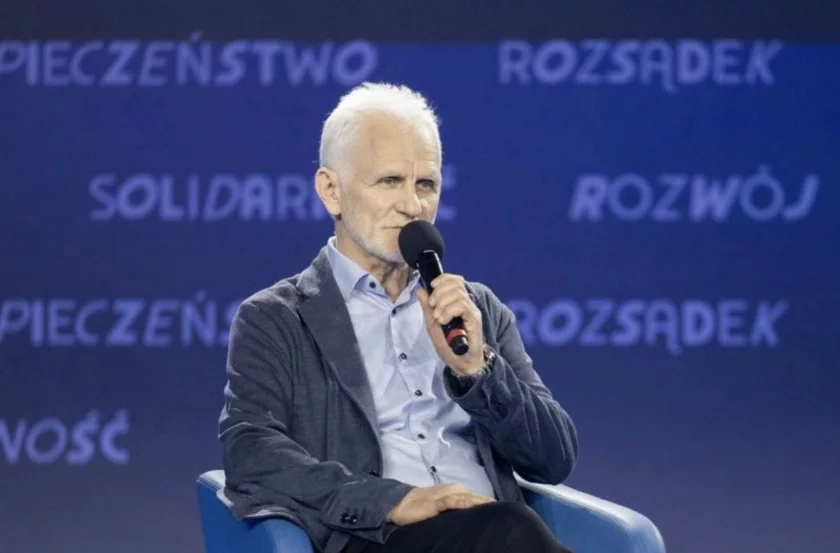
At the meeting, which was the first panel to kick off the Campus, there were more than a thousand youth activists from all over Poland. There were also Belarusian students currently studying in Poland, writes "Viasna".
The meeting took place on August 26 at Campus Arena, and the conversation with the Belarusian human rights defender was led by MEP Michał Szczerba. The organizers introduced Ales Bialiatski as one of the symbols of the Belarusian democratic movement, founder of the Viasna Human Rights Center, and Nobel Peace Prize laureate of 2022.
He dedicated a significant part of the conversation to what is happening in Belarusian society after years of repression, and noted that people in Belarus are under immense pressure, but this does not mean that society has reconciled itself with the existing system.
«People are fearful, but they are angry at this regime,» emphasized Ales Bialiatski.
The human rights defender also reported that a new criminal case was initiated against him in Belarus after his release. And there are many such cases of persecution.
The Nobel laureate placed special emphasis on the younger generation. According to his assessment, Belarusian youth have already proven that they want to live in a free and democratic society. He noted that this is particularly important to him, as, despite the repressions, a part of Belarusians continues to work for the future of the country.
«The youth have proven that they are ordinary European youth, who want to live in a normal country,» said Ales Bialiatski, emphasizing that the work for a free Belarus has not been in vain.
The head of the Viasna Human Rights Center spoke about his release in December 2025. After more than four years in the Belarusian prison system, he was released and immediately taken to Lithuania. Once free, according to his observations, there were significantly more initiatives by Belarusian youth in Lithuania, Poland, and other European countries than the human rights defender could have imagined while imprisoned.
He urged young Belarusians not to waste time and to use opportunities for education, civic work, and preparation for the future:
«We need to learn and prepare for changes.»
According to Ales Bialiatski, even under conditions of severe restrictions within Belarus, civic activism has not disappeared. He compared it to a river flowing underground: it is not visible on the surface, but it continues to exist and can resurface when the political situation changes. Because over years of work, the human rights defender had contacts with hundreds of Belarusians and saw how much a part of society wants nothing to do with the dictatorship; people are waiting for their time, and for now, they must learn, work, remain active, and maintain the ability to act.
Separately, the Nobel laureate spoke about political prisoners, emphasizing the importance of their resilience:
«I am proud of my people, my youth, because a thousand people are in prisons as political prisoners. And these people have decided not to give up.»
The Importance of the Meeting with Polish Youth
The Campus structure itself turned Ales Bialiatski's address into a direct conversation not only about Belarusian politics but also about how young people can influence the future of society. The official program emphasized that he came to Olsztyn specifically to meet with the event participants. The organizers called this conversation an opportunity to directly meet a person who spent more than four and a half years in imprisonment for his human rights activities.
During the conversation, the Nobel laureate also urged Polish youth to support human rights organizations and to pay attention to the situation of Belarusians who found themselves in Poland. In particular, one participant told him about a Belarusian student who could not obtain the necessary documents to continue his studies in Poland. Ales Bialiatski responded that such people need to be supported, although, in his estimation, such cases are still isolated.
Thus, the address by the founder of the Viasna Human Rights Center at the Campus was structured around three main themes: the state of Belarusian society under repression, the preservation of democratic sentiments among youth, and the necessity of preparing for future changes. Open activity in Belarus is currently significantly restricted, but civic work continues, and the readiness of a part of Belarusians for democratic changes persists.
On the first day of the Campus, alongside Ales Bialiatski, speakers at the official opening included Warsaw President Rafał Trzaskowski, Minister of Education Barbara Nowacka, Minister Sławomir Nitras, Marshal of the Warmian-Masurian Voivodeship Marcin Kuchciński, Olsztyn President Robert Szewczyk, and Polish parliamentarians, with whom the human rights defender also had time for conversation.


Comments