


There is a jellyfish in the world that can live forever
The small jellyfish Turritopsis dohrnii is capable of returning to "childhood" and restarting its life cycle in case of danger. The Guardian tells how it manages to cheat death.
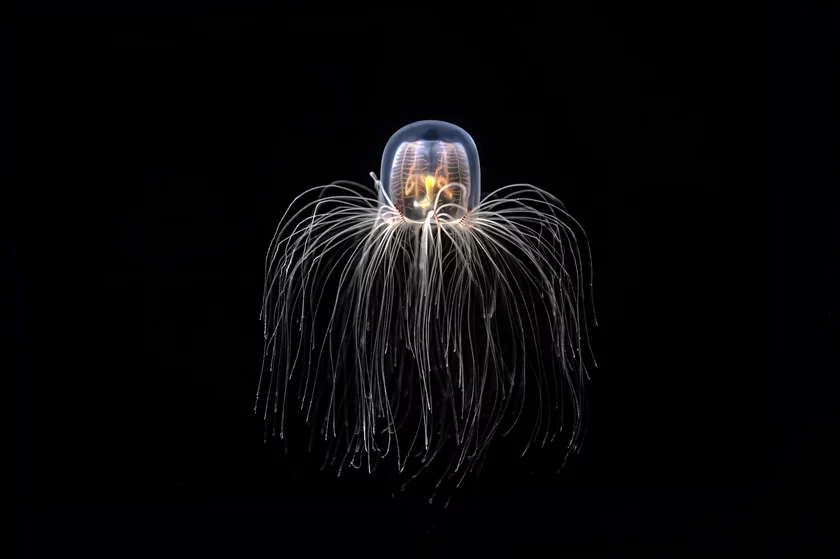
Humankind has long dreamed of eternal life, but today the search for immortality has gone far beyond myths and science fiction. Wealthy tech entrepreneurs fund experiments on organism rejuvenation, freezing bodies after death, and even hope to one day continue existence in digital form with the help of artificial intelligence.
However, what people are so far unsuccessfully trying to achieve with the help of technology already exists in nature. We are talking about the tiny jellyfish Turritopsis dohrnii, which has learned to "cheat" death in its own way.
Most jellyfish go through a normal life cycle. First, a polyp forms from a larva - a small, sessile form attached to a surface. From it, young jellyfish emerge, grow, reach adulthood, and reproduce. Eventually, the adult jellyfish ages and dies.
However, Turritopsis dohrnii is capable of avoiding such a fate. Under unfavorable conditions, this jellyfish activates an unusual survival mechanism. High temperature, hunger, physical damage, or chemical substances in the water can trigger it.
Instead of dying, the jellyfish returns to an early stage of its development. This process is called cellular transdifferentiation. At first, it might seem that the animal is dying: it sinks to the bottom and contracts into a small lump. However, after 24-48 hours, a new polyp with the same genome begins to form from it.
Researchers compare this process to a situation where a butterfly could turn back into a caterpillar. From the new polyp, an adult jellyfish develops again. If necessary, Turritopsis dohrnii is capable of repeating this cycle again and again. That is why it is often called the "immortal jellyfish".
It is very small itself – just a few millimeters. It can be found in various parts of the world: in the Mediterranean Sea and the Atlantic Ocean, as well as near the coasts of Japan, Panama, and Brazil.
In laboratory conditions, this small jellyfish is theoretically capable of living forever. However, this does not mean that it is completely immune to death. In the wild, the jellyfish's life can end much more prosaically – for example, if it is eaten by a predator.
Eight species of the genus Turritopsis are recognized worldwide, but so far, only Turritopsis dohrnii has been found to possess this unusual ability to return to a youthful stage of development.
-
2000-year-old mystery uncovered beneath the supposed burial site of Jesus, matching biblical description
-
NASA paid a startup $30 million to save the Swift telescope. Now the apparatus, which observed the death of stars for twenty years, will itself burn up in the atmosphere
-
Milk without a Cow: Israeli Scientists Taught Plants to Produce Milk Protein


The Return of Kaschei, the Abolition of Rusalkas, Navie from Polotsk, Kopsha and Vegelmof. What the First Belarusian Guide for Fantasy Translators Offers


Comments