


2000-year-old mystery uncovered beneath the supposed burial site of Jesus, matching biblical description
The Gospel of John describes Jesus' burial place as a new tomb, hewn out of rock and located in a garden near the place of crucifixion.

For almost seventeen centuries, the Church of the Holy Sepulchre in Jerusalem has been revered as the place of Jesus' crucifixion, burial, and resurrection. The first Christian church here was built as early as the 4th century, under Emperor Constantine, over a tomb that was already then considered to be the burial place of Christ.
But what was here before, in Jesus' time? Excavations beneath the church, which began in 2022 during a major restoration and concluded in 2025, helped answer this question. As Daily Mail writes, archaeologists were able to reconstruct what this part of ancient Jerusalem looked like and discovered several interesting coincidences with the Gospel narrative.
Garden among the rocks
The Gospel of John describes Jesus' burial place as a new tomb, hewn out of rock and located in a garden near the place of crucifixion.
New data confirms: an ancient quarry, which over time changed its purpose, is indeed hidden beneath the floor of the modern church.
Researchers found that after stone extraction in this quarry ceased, its deep sections (in places up to six meters below the modern level) were filled with soil. Small agricultural plots appeared there, divided by low stone walls.
Analysis of ancient pollen and botanical remains showed that grapes and olives were grown in this area, and it was also used for grazing livestock. This indicates that cultivated plots indeed existed at the site of the former quarry, which is consistent with the Gospel mention of a garden.
However, the discovered traces of vegetation have not yet been precisely dated by laboratory methods. Therefore, archaeologists cannot definitively prove that the garden was cultivated exactly at the same time as the crucifixion of Christ.
Tombs outside the city walls
In addition to gardens, archaeologists documented numerous burial chambers carved directly into the rocky slopes of the former quarry. This landscape created a unique combination: an open space for agriculture and pasturage, adjacent to a cemetery. This exactly matches the New Testament text, which describes a garden with tombs near the place of execution.
Other geographical details also coincide. The Epistle to the Hebrews states that Jesus suffered outside the city gate. Archaeological research has shown that in the 1st century, the area of the modern Church of the Holy Sepulchre was indeed located outside the then walls of Jerusalem, but close to the city.
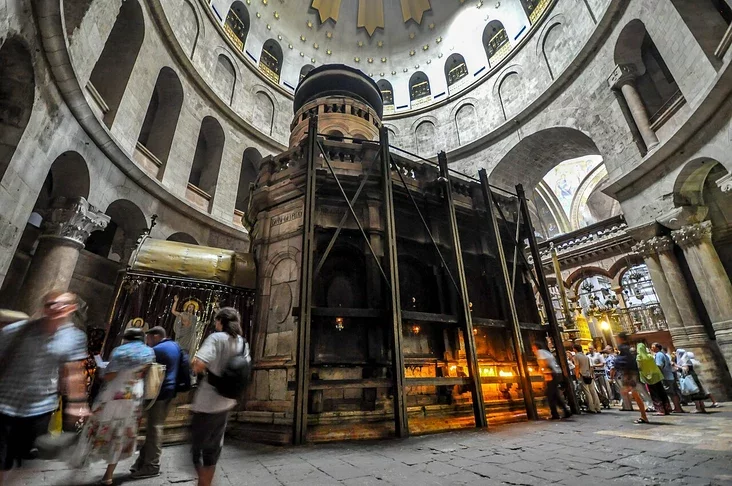
Another detail is found in the Gospel of John: the tomb was near the place of crucifixion, so Jesus could be buried quickly, before the start of the Jewish Sabbath. In the Church of the Holy Sepulchre, the chamber traditionally considered Jesus' tomb and the rock of Golgotha are also very close to each other.
None of these features alone was unusual for ancient Jerusalem: abandoned quarries were often used for both burials and economic purposes. Their combination in one place is what is important.
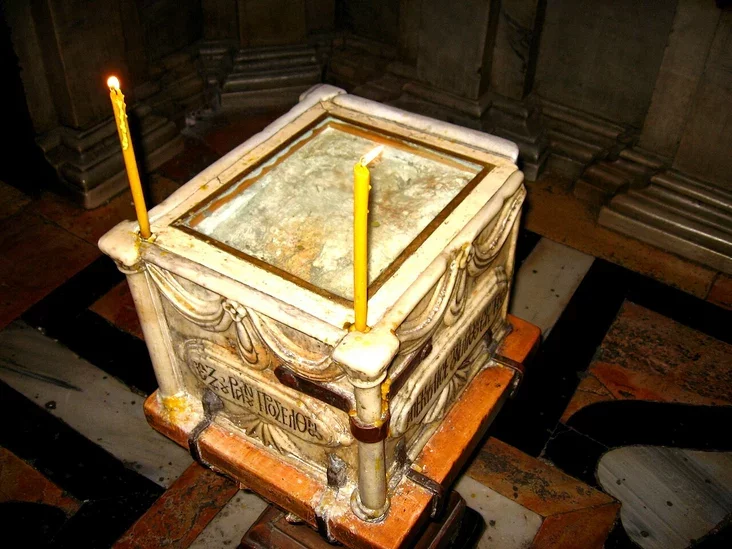
From Roman structures to a Christian sanctuary
In the 2nd century, under Emperor Hadrian, the area was rebuilt. According to later Christian tradition, a large pagan temple was erected over the sanctuary. However, new research suggests that the Roman cult complex might have been much smaller. One of its structures stood near the tomb, which later became revered as Jesus' tomb, and blocked access to it.
In the 4th century, under Constantine, the Roman structures were dismantled. Builders uncovered the burial chamber, which at that time was already considered Christ's tomb, removed part of the rock around it, and made it the center of a new Christian sanctuary.
The significance of this place was so great that when constructing the massive church complex, architects preserved the position of the tomb even at the cost of asymmetry in some parts of the building.
Is this proof?
Scientists remain cautious in their conclusions. Although the landscape matches that described in the Gospel, archaeology cannot provide a definitive answer as to whether Jesus' body lay in this tomb. No identifying inscriptions have been found on the walls, and precisely dating the time of the garden's cultivation with year-level accuracy is not yet possible.
However, excavations have shown that the traditional burial place of Jesus possesses the main geographical and physical features described in the primary sources.
-
NASA Successfully Launches Roman Space Telescope, Which Could Usher in a New Era in Universe Exploration
-
There is a jellyfish in the world that can live forever
-
NASA paid a startup $30 million to save the Swift telescope. Now the apparatus, which observed the death of stars for twenty years, will itself burn up in the atmosphere


"I am not a saint, but I didn't have a reliable shoulder next to me": Ksyusha's mother with SMA may be deprived of parental rights, but she argues that she is capable of improving


Comments