


NASA Successfully Launches Roman Space Telescope, Which Could Usher in a New Era in Universe Exploration
On August 30, NASA sent the Roman space telescope into space. The launch took place at the Kennedy Space Center in Florida with the help of SpaceX's Falcon Heavy rocket. The project cost is estimated at approximately $4.3 billion. The primary mission is planned for five years, but NASA expects the craft to be able to operate for the same duration afterward, Reuters reports .
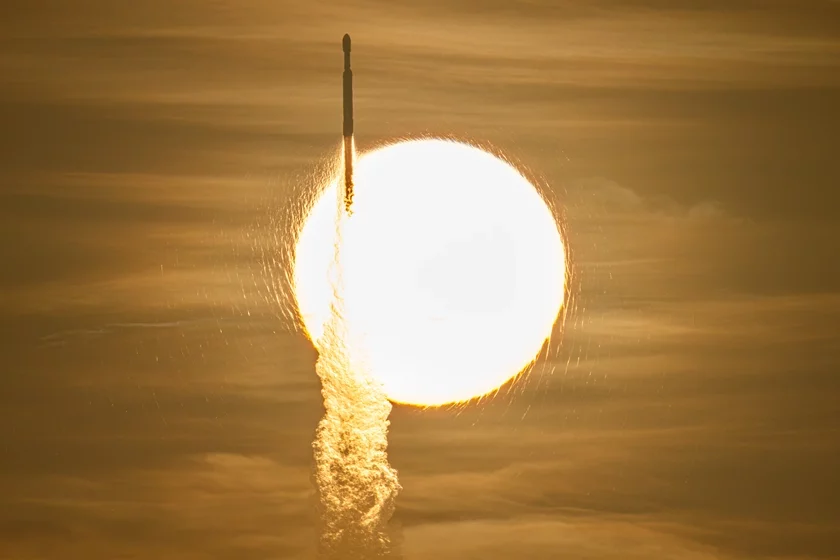
The telescope is named after Nancy Grace Roman — the first head of NASA's astronomy department. The craft is heading to the second Lagrange point, located approximately 1.5 million kilometers from Earth. This is almost four times further than the Moon. In this zone, the craft can remain relatively stable due to the equilibrium of Earth's and the Sun's gravitational forces.
Roman is already being compared to the legendary space telescopes "Hubble" and "James Webb", which have been operating since 1990 and 2021, respectively.
The new telescope will investigate black holes, dark matter, and dark energy, as well as exoplanets — planets outside the Solar System. NASA expects Roman to be able to find up to 100,000 new exoplanets in addition to the approximately 6,300 already known.
NASA's Deputy Associate Administrator for the Science Mission Directorate, Nicola Fox, compared previous telescopes to those observing the Universe through a keyhole. Roman, she said, will supposedly "break down the doors".
Roman is equipped with two important scientific instruments. The Wide Field Instrument (WFI) will be used, among other things, to study dark energy, and a special coronagraph will for the first time allow direct observation of some exoplanets.
While Roman's main mirror is approximately the same size as Hubble's, the new telescope will be able to cover a sky area approximately 200 times larger. Over its five-year primary mission, it is expected to survey an area of the Universe 50 times larger than what Hubble studied in its first 30 years of operation.
According to NASA's estimates, to fully display the panorama that Roman will be able to create, more than half a million high-definition televisions would be needed.
The significance of the launch was also acknowledged by US President Donald Trump, who called it a testament to "America's Golden Age". Earlier, his administration had attempted to cut funding for the project.
On August 30, Trump unexpectedly interrupted a NASA press conference to personally congratulate the agency on the successful launch, stating: "You're doing fantastic work, and I'm giving you all this money."
-
Back to pen and paper and smartphone ban: universities are forced to change the format of classes and tests, otherwise AI prevents both teaching and assessment
-
Google launched Gemini 3.5 Transcribe for speech transcription. Belarusian is on the list
-
Tim Cook steps down as Apple CEO after 15 years of leadership


Comments