


Belarusian volunteer Gerard told his version of the case opened against him in Ukraine
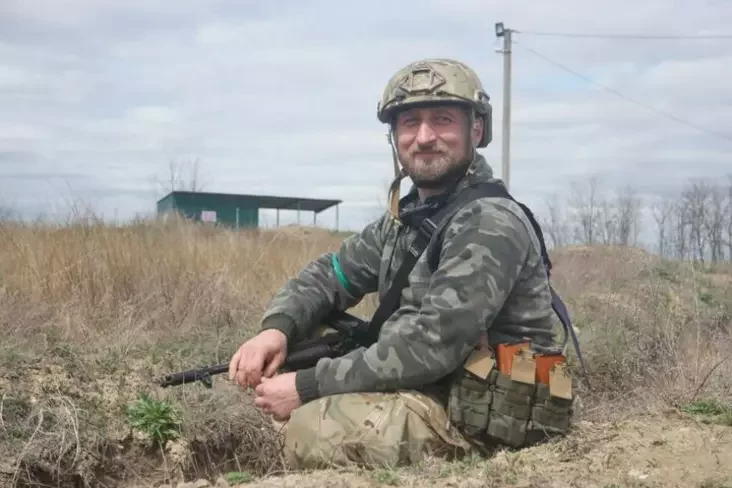
Belarusian volunteer Aliaksandr "Gerard" Krasouski was detained in March in Ukraine. After several months, he was released on bail. Now Gerard has given a detailed account of his version of how the criminal case arose.

Aliaksandr Krasouski is a Belarusian volunteer who joined Belarusian formations after the start of the full-scale war in Ukraine. He served in the Kastus Kalinouski Regiment, later transferred to the 225th Separate Assault Regiment of the Ukrainian Armed Forces, where he commanded the "Tur" unit. In 2024, fighters of this unit participated in battles during the Ukrainian operation in the Kursk region. Krasouski is a full Cavalier of the Order "For Courage".
On March 14, 2026, Gerard was detained in Irpin on suspicion of unauthorized abandonment of a military unit and illegal handling of weapons and ammunition. He himself denied guilt.
On July 31, he was released on bail. Recently, he gave a long interview to blogger Siarhei Biapalau, where he spoke about his detention.
Who owned the ammunition
Krasouski describes that on March 14, a special unit of the Rapid Operational Response Corps (KORD) of the National Police of Ukraine arrived from Kharkiv with investigators to detain him. During the search, 680 thousand euros and ammunition were found.
Krasouski insists that the ammunition found in the basement was not his. As he argues, they had been lying there since 2024 and belonged to another Belarusian volunteer who had lived in his house for some time.
Krasouski claims that the man lived with him for about three months and left not only ammunition in the basement, but also his belongings, clothes, a copy of his passport, a copy of his military ID, and invoices.
Gerard does not name this person. However, according to him, among the discovered items was an object by which it is possible to accurately determine in which military unit the person served and to whom such an item could have been issued.
Was there unauthorized abandonment of a unit?
The second part of the case is related to the suspicion of unauthorized abandonment of a military unit. Krasouski argues that there was no unauthorized departure.
Three days before the order for his dismissal was issued, Gerard was put on the list of servicemen who had unauthorizedly abandoned their unit.
Krasouski says that he was not dismissed through his military unit, as they refused to accept his report there. Therefore, he submitted a report directly to the command of the Ground Forces.
By that time, Gerard claims, he had already handed over his position, property, weapons, helmet, and body armor, and a temporary acting platoon commander had been officially appointed to his place.
After this, according to Krasouski, he officially went on annual leave, arrived in Kyiv, registered there, and due to health problems, underwent treatment at the Central Military Hospital. Gerard says he has documents confirming this.
Gerard's separate argument is the provision on military service in the Armed Forces of Ukraine by foreigners and stateless persons, approved by decree of the President of Ukraine. Krasouski refers to paragraph 111 of this document, which regulates the recall of servicemen from annual leave. Gerard argues that the command had no right to interrupt his leave.
Krasouski believes that the story of unauthorized abandonment of the unit was fabricated to force him to return to the 225th regiment, "and, possibly, to extort money."
Why he was held in the pre-trial detention center (SIZO)
Gerard insists that his detention in the pre-trial detention center (SIZO) was illegal. As he explains, Ukrainian legislation provided for detention as a measure of restraint for servicemen suspected of unauthorized abandonment of a unit. Krasouski, however, claims that at the time of his detention, he had already been dismissed from service for four or five months and had the status of a civilian.
Krasouski specifically focuses on the judge who heard his case. According to Gerard, she not only illegally held him in the pre-trial detention center (SIZO) but also exceeded her official powers and violated Ukrainian legislation. Now, according to him, these circumstances are being investigated. A corresponding statement has already been submitted to the High Council of Justice of Ukraine.
After the judge was changed, the situation changed. As Gerard recounts, the new judge reviewed the case materials and decided that he should be released. As a result, Krasouski was released from the pre-trial detention center (SIZO) on bail.
He himself believes that they did not want his release, because, at liberty, he would have more opportunities to act: to file applications and appeal to various authorities. The prosecutor appealed the decision to release him on bail and tried to have it overturned.
The prosecutor's appeal, according to Krasouski, was ultimately denied, and he remained free.
Gerard was not completely cut off from the outside world in the pre-trial detention center (SIZO). According to him, there was paid IP telephony there, and he could make a 15-minute call once a day. There was no internet or mobile phone, but there was a television on which inmates watched the news.
Where the money came from
Biapalau separately asked about the large sum of cash found during the search. In initial media publications, a sum of about a million euros was mentioned.
Gerard clarifies: "Not a million, but 680 thousand." According to him, his acquaintances, partners, and Belarusians from Europe gave money for the development of military units. He calls them "direct donations."
During the conversation, Biapalau mentioned posts by Dzyanis "Vaukalak" Urbanovich, which implied that Gerard allegedly sold machine guns to servicemen.
Krasouski says he doesn't know what machine guns are being referred to. However, he mentions one incident related to weapons. According to Gerard, a fighter with the call sign Yasen once approached him regarding a 120-millimeter mortar.
"I said that I don't have such a thing. There are groups of servicemen where someone exchanges trophies. So I sent him a link that someone has a 120-millimeter mortar and is exchanging it for this and that. Which machine gun Vaukalak is talking about — honestly, I don't know," Krasouski recounts.
Biapalau also mentioned other accusations by Vaukalak — including Krasouski's alleged use of prohibited substances. Gerard responds that he read these posts but does not take them seriously.
"Let him write what he wants. The man has his own fantasies. I perfectly remember all his amusing stories about Brest, and about how he fought with Brest. That's why I always said that this person might be a good warrior and so on, but somewhere in his head, reality gets mixed with fantasy. And, unfortunately, people who, let's say, truly know Vaukalak, understand what I'm talking about.
The man, indeed, perhaps due to a large number of concussions, injuries — he simply needs to undergo more rigorous rehabilitation to restore his health," Gerard says.
About the role of the former commander
Biapalau suggested that Krasouski's problems began after a conflict with the command. Gerard disagreed with this formulation.
He claims there was no personal conflict. Simply at some point, due to certain actions of the command, he decided to leave the 225th regiment. But, according to Krasouski, they did not want to let him go.
At that time, Oleg Shyraeu was the commander of military unit 7420. Biapalau asked Krasouski about their relationship and whether Shyraeu could be involved in the case for which Gerard was later detained.
As Gerard claims, he does not know where Shyraeu is now and does not follow him.
"What kind of person... I'll say this, before receiving the Hero of Ukraine award, he was one person; after receiving the Hero of Ukraine award, he became a different person. Before receiving the Hero of Ukraine award, he was a person with whom one could talk, work, and serve," Gerard says.
To a direct question about whether Shyraeu is connected to the criminal case against him, Krasouski answers affirmatively. According to him, he is now trying to get his former commander's orders declared illegal in administrative courts.
Gerard calls the criminal case itself fabricated "from start to finish." As one of his arguments, he cites the materials of an internal investigation. According to Krasouski, it was registered on 46 pages, but only 21 pages were found in the materials of his case.
At the same time, Gerard stipulates that he does not know if investigative actions are currently ongoing, and therefore he does not want to disclose all details. At the time of the conversation, he claims, he had still not been served with an indictment. Krasouski still remains in the status of a suspect.
What now?
After his release, Krasouski did not gain full freedom of movement. According to him, he cannot currently leave the Kyiv region, nor can he leave Ukraine. The latter, he says, was not part of his plans.
He expects that after September 14, he will be able to move freely around Ukraine again.
To Biapalau's question about whether there is now a real threat of re-arrest, he answers briefly: "No, there isn't."
Another detail Krasouski mentioned in the interview is Ukrainian citizenship. According to Gerard, the decision has already been signed, and he can obtain a Ukrainian passport, but he is not yet in a hurry to do so.
-
Lithuanian State Security: Karach's "Our Home" artificially creates conditions for Belarusians not meeting international protection criteria to obtain residence permits in Lithuania
-
"Georgia never became home." An IT specialist couldn't get used to the country, despite the 1% tax — now choosing between Spain and the USA
-
23-year-old special forces brigade officer sentenced to 19 years for "treason against the state"
Now reading


Putin Wants a New 'Yalta' — a Division of the World into Spheres of Influence Between Moscow, Washington, and Beijing. Over the Heads of Europe and Ukraine

Putin Wants a New 'Yalta' — a Division of the World into Spheres of Influence Between Moscow, Washington, and Beijing. Over the Heads of Europe and Ukraine


"People commented that salmonella entered the chat." A Belarusian went to work in Silicon Valley - and became a culinary blogger with 28 billion views

"People commented that salmonella entered the chat." A Belarusian went to work in Silicon Valley - and became a culinary blogger with 28 billion views


Belarusian warehouseman with a swastika on his shoulder was treated for alcoholism in Siberia and went to fight for Russia, but was left without payments or work


Comments