


This Belarusian woman parodies Belarusian propagandists and Russian liberals so successfully that her videos are taken at face value. VIDEO
Natalia Zhukouskaya is 27. She unhesitatingly parodied "Ninel from Moscow," then "Zhanna Amapawna," and didn't even notice how she amassed hundreds of thousands of views. A big interview and many videos.
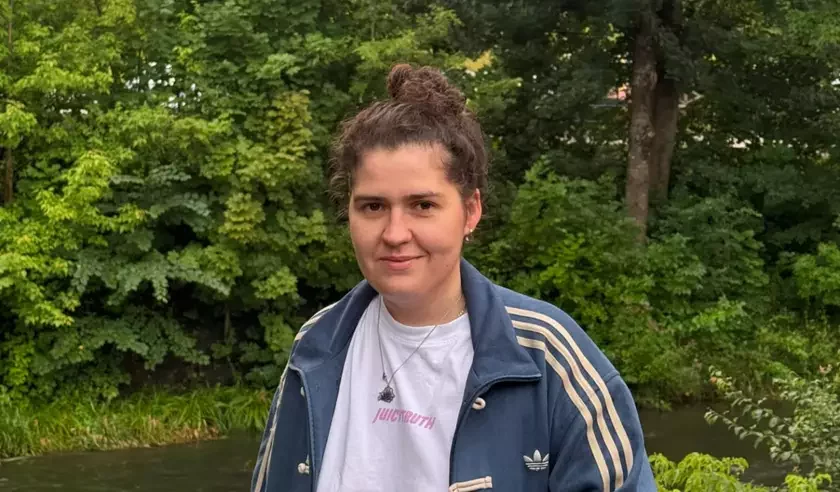
Out of her 27 years, Natalia Zhukouskaya has spent six in forced emigration, where, like many Belarusians, she was thrown by the events of 2020. At that time, the girl documented violations at polling stations, volunteered, was one of the faces of the Girls Power Belarus project, and helped political prisoners. Later, there was work for the International Committee for the Investigation of Torture, "Bysol," "White Coats," and much more that Lukashenka's regime calls "extremism."
"I thought I should cheer myself up somehow — that's how I recorded my first video," says Natalia.
And suddenly, these reels on Instagram started garnering hundreds of thousands of views.
Find out what started Natalia's fascination with parodies, how Svetlana Tikhanovskaya reacted to her infiltration of the "New Belarus" conference, and what new characters viewers will soon see performed by the girl.
"When I see a very funny person in front of me, I'm almost 100% sure they had a difficult childhood."
Natalia was born in Barysaw.
"My mother is Belarusian. And my father is from Sloviansk (Donetsk region). Part of our family is in Mariupol, but I don't have contact with them now."
In her childhood, the girl was forced to change four schools – two in Barysaw and two more in Minsk. In the first educational institution, Nata fell victim to ruthless bullying from classmates and the class teacher.
"I was always such a withdrawn child — maybe that's why. I literally became an outcast and grew up with this trauma of alienation. I think if I had told my mother about the bullying, she would have dealt with everyone there, but I kept quiet. Perhaps I didn't want to admit that 'something was wrong' with me. Perhaps it was a desire to protect my parents from worries.
It seems to me that I intuitively found a way to be funny, because I noticed that when you fool around, you immediately become the life of the party.
That's what happened in the new school. I clowned around, everyone laughed, everyone loves good emotions. That's how I created a safe environment for myself. Unfortunately, at the cost of worsened grades, because all my resources went into constantly being part of the class's social life. Of course, I think I also have something naturally humorous in me. But overall,
when I see a really, really funny person in front of me, I'm almost 100% sure they had a difficult childhood."
In emigration, Nata continued her studies at EHU in media communications. With the only difference being that after 2020, she could no longer come home every weekend. The tradition was gone, as was her entire Belarusian life:
"I never thought I wouldn't see Belarus again for so long."
When all the horror with violence and arrests began after the 2020 elections, Nata helped document cases of torture for transferring materials to The Hague.
"From that period, I still have a nervous tic," she admits.
"In a bad state, I thought I should cheer myself up somehow — that's how I recorded my first video."
In emigration, as a result of all the events and intense work, Nata was hit by severe depression.
"I was in a terrible state for almost two years, I couldn't cook for myself, I lived on delivery food — my small rented apartment was filled with packages from it, I could sleep 20 hours a day. At some point, I felt like I just couldn't live with myself, but I didn't want to die either. I gained 30 kilograms.
And the choice was whether to join the '27 club' or start recovering and getting out of it. Somehow I managed to pull myself together — I found a new psychiatrist instead of the psychologist who had only harmed me, I made an appointment with an endocrinologist. They prescribed me 'Ozempic.' And in this bad state, I thought I should cheer myself up somehow — that's how I recorded my first video."
"When Dubai started getting hit by Iran, the Emirates placed a large order with bloggers who made almost identical videos like 'I'm not afraid, I know who protects us,' referring to Arab sheikhs. I found this very funny, and I made a similar video, but with Lukashenka."
Then there was a video with a Russian tourist in Europe, who believed that Warsaw was an ancient Russian city and that beer was cheaper in Rostov. There was also a parody of a Belarusian activist in emigration, obsessed with digital security, and even of propagandist Ryhor Azarionak.
Today, Natalia already has a whole set of characters with their own biographies. For example, Zhanna Amapawna, who worries about the oppression of the Russian language and Soviet artists and strives to prevent color revolutions in Belarus. Or the Muscovite Ninel, outraged by the taste of potato pancakes and the lack of birch milk in cafes of "Belorussia."
Natalia initially perceived the first thousands of views as an accident, but now her videos easily gather hundreds of thousands and more. Videos about Russian tourists and liberals are particularly popular with the audience.
"Belarusians seem calm, but if you hit them with 'Belorussia,' they become the most aggressive."
After the videos started going viral, hate comments became their logical attribute — primarily from those who take Nata's characters at face value.
"The other day, a Russian-speaking public reposted me. As if a truly stupid Muscovite can't find lactose-free milk in Minsk. Well, comments keep pouring in, 'that I should go home to Moscow,' there are already six thousand of them.
Another interesting observation: Belarusians seem calm, but if you hit them with "Belorussia," they become the most aggressive. The arrogant behavior of Russians in Belarus irritates Belarusians greatly. And I can understand them. Belarusians who wrote some nonsense and insulted me under the video, I understand you all perfectly, I agree with you! Although there are also those who write that I am supposedly another Western project to divide Russians and Belarusians."
Nata emphasizes that she makes videos purely for fun. Although some organizations have already invited her to shoot parodies for money and on order.
"Of course, with such an arrangement, I would have more resources — for props, for example. But then I would no longer have creative independence. That would be a betrayal of my existing audience and a betrayal of myself. Of course, I thank them for the offers, but I politely decline.
My position is this: if you consider my content important, you can just give me money, without setting KPIs. Or you can support me practically — for example, I need a new phone for filming, leopard heels. And also a person who has a Soviet car and can let me film with it."
Most commentators, only realizing that these are humorous videos, immediately switch their hateful tone to respect. The only exceptions here are perhaps servicemen from Russia, who do not understand such humor.
"A Russian SVO fighter once wrote to me that he, allegedly, shows my videos to his daughter and scares her with me, like I'm a monster, and I replied that I felt sorry for his daughter, and blocked him. Honestly, hate hasn't affected me in a long time, school bullying hardened me after all."
"Petrukhin's team told me to f*** off and called me a bitch."
What the viewer sees in the videos is almost always 100% improvisation.
"I just have a fairly extensive observation skill. My psychiatrist says I'm a hypersensitive person. And on the one hand, I suffer a lot because of it, but on the other hand, I can notice things, subtexts that someone else wouldn't pay attention to."
On her own initiative, Nata, in the image of Zhanna Amapawna, visited the last conference of "New Belarus," where her observational skills precisely told her how to successfully mock Svetlana Tikhanovskaya, the representative of "BelPol," ex-political prisoner Mikola Dziadok, and blogger Siarhei Petrukhin.
Svetlana Tikhanovskaya has already given her respect to this report.
"True, his team ended up telling me to f*** off and called me a bitch. They were standing on the street and specifically filming everyone who came to the conference. So I decided I would film Petrukhin in return, in the image of Zhanna Amapawna. Like, he's my little man, poor guy, not allowed into the conference, but I bribed someone who needed it and would get in... But one of his team members grabbed my arm and wanted to take me to the police."
Nata says that the video with Petrukhin and Zhanna Amapawna will still appear on her page.
In the future, the girl would like to bring many characters to life — for example, a Belarusian judge, and also diversify her portfolio with other propagandists.
Azarionak, however, is on hold for now.
"He's just disgusting to me. Only sometimes is he funny. I'm interested in conflictual characters. With Azarionak, everything is clear."
Nata believes that the secret to her videos going viral is their authenticity. Because she observes all situations in life, making a note of her next "victim" in her notebook.
"These videos are my way of coping with our terrible reality. With the nightmare that surrounds me. Yes, the context and bubble may change, but overall, our reality is truly terrible," admits the interviewee.
Natalia is pleased that a large portion of her audience watches her from inside Belarus.
"For example, in the video about the pride parade in Vilnius, which I reviewed in the image of a propagandist, most of the audience is Belarusian."


Comments