


Residents of an agro-town near Gomel groan from the invasion of the "mad cucumber"
Residents of the Krasnoye agro-town in the Gomel district have been trying to combat the lobed echinocystis, popularly known as the "mad cucumber", for about ten years. Independent attempts to deal with it have yielded no results, so local residents have turned to the authorities for help, writes Tochka.by.
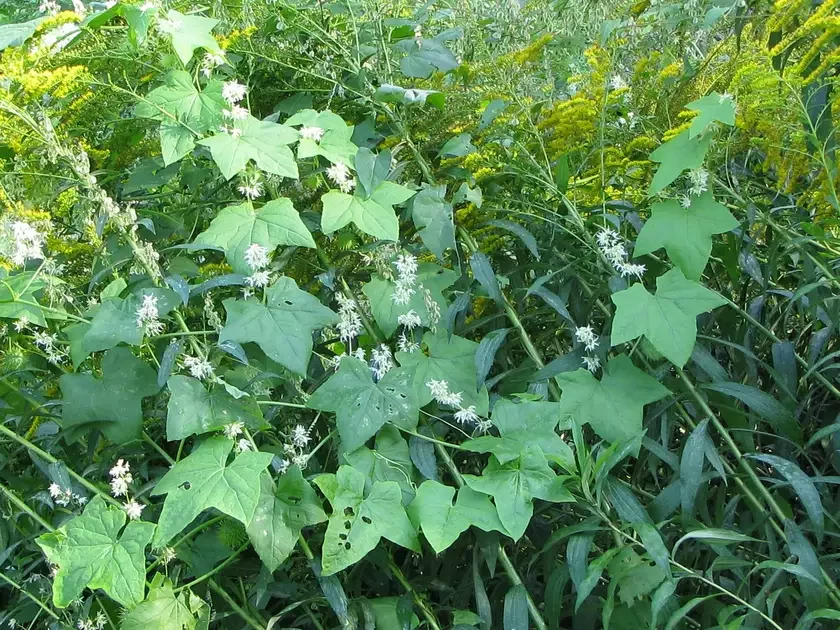
Visually, this plant is quite attractive and has a pleasant honey scent. However, it spreads very quickly. In one season, its shoots can grow 5-10 meters long and twine around trees and bushes, depriving them of sunlight.
The plant got the name "mad cucumber" due to the peculiarities of its fruits. When ripe, high pressure builds up inside them, and even a light touch can be enough for the fruit to burst open and eject seeds up to 10 meters away.
The homeland of echinocystis is North America. It was brought to Europe as an ornamental plant, and the first cases of its growth in Belarus were recorded in 1963 in the Brest region. Initially, it was used for landscaping arbors, but later the plant became invasive and began to displace local vegetation.
In Krasnoye, the main problem is related to an abandoned neighboring plot, which is almost completely overgrown with echinocystis. Local residents claim that the plot has an owner, but it is not properly maintained. As a result, the plant spreads to neighboring territories, and in some places, its thickets are already taller than a person.
Fighting echinocystis is difficult. Using chemicals is risky because the plant twines around other trees and bushes, which could also die. Therefore, the main method is to remove the weed along with its root. However, with the problem on such a scale, the residents of Krasnoye can no longer cope on their own and hope for help from the authorities.
-
Belarus and Russia agreed on 107 out of 110 points of the rapprochement plan for the next three years. But the most important one is pending.
-
"Didn't want to risk the plane." Why Belarusians pay almost 200 euros to choose a border crossing date
-
Natallia Kaliehava spoke about helping Belarusian refugees, her family, her attitude towards Tsikhanouskaya. And she explained who "beavers" and "hares" are
Now reading


Natallia Kaliehava told about helping Belarusian refugees, her family, her attitude towards Tsikhanouskaya. And explained who "beavers" and "hares" are


Comments