


A Belarusian Launched a Resource for Monitoring Residence Permit Issuance in Various Polish Cities
Vladislav himself is also waiting for his residence card in Białystok. Thirteen months have already passed since he submitted his documents.
“Poznań: September 2025 – application for a residence permit (Blue Card), December – fingerprint submission, June 2026 – positive decision.” This is the kind of information about legalization in various Polish cities that Vladislav, a Belarusian, collects daily. In June, he launched a Telegram channel with a calendar for obtaining residence permits and told Most why this is needed.
Vladislav himself is also waiting for his residence card in Białystok. Thirteen months have already passed since he submitted his documents.
The basis for obtaining the permit is running an individual entrepreneurial activity. The man has already submitted his fingerprints — this is a mandatory procedure for legalization. He expects to receive a decision in approximately three months. The interlocutor makes this prediction by analyzing the experiences of other foreigners (primarily Belarusians and Ukrainians) who went through this process a little earlier.
Vladislav started this project to better understand his own prospects for obtaining documents. Initially, he collected statistics only for the Podlaskie Voivodeship, where he lives. But later, Belarusians from other regions started writing to him, asking about the situation there. This led to the creation of separate sections for each voivodeship.
Every evening, the channel's creator gathers information from open sources: Belarusians and Ukrainians often share their experiences in thematic groups. However, their messages are scattered and often get lost. Vladislav, however, maintains only a calendar. According to him, this allows users to track the situation in their region, by their type of residence permit (temporary stay, permanent stay, or resident card), and by their basis (work, family reunification, business activity, and others).
“This gives a sense of calm,” he explains his idea. “For example, a month ago I submitted my fingerprints. Is it normal that my case hasn't started being reviewed yet, that the police haven't come for a check? You look at others' experiences and understand when it's worth worrying, and when it's not.”
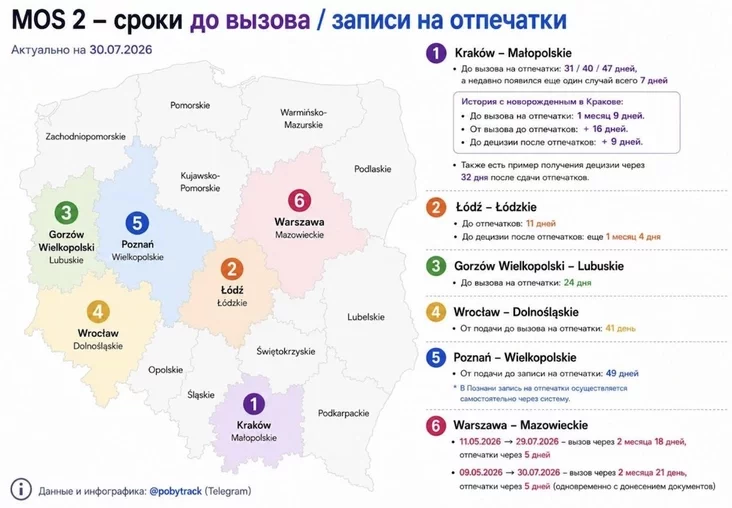
Overall, Vladislav believes, the collected experiences confirm the data from official statistics, which are published with a slight delay. However, while state bodies provide information in a generalized form, real stories allow a specific user to track cases that are maximally similar to their own. This is especially important in regions where specific categories of cases are assigned to inspectors. For example, this is the case in Warsaw.
Vladislav's work has already allowed for initial conclusions about the operation of the new MOS-2 module, launched at the end of April. Currently, applications for residence permits in Poland are submitted electronically through this module. According to his observations, in five cities – Krakow, Wrocław, Łódź, Poznań, and Warsaw – applications submitted via MOS-2 have already started being processed (applicants are called for fingerprint submission). And in Krakow and Łódź, there have already been first cases where positive decisions were issued for such applications.
For now, the Belarusian is developing the project on a voluntary basis. However, he does not rule out that if the service becomes in demand, he will try to monetize it in the future.


Comments