


How a serious fruit fly brain study turned into an internet meme — its brain model was taught to play Doom and trade cryptocurrency
Scientists have for the first time published a complete map of the adult fruit fly's central nervous system, hoping to take a step towards understanding the nature of human neurological diseases. However, open access to the data led to an unexpected result: the digital model began to be used for unusual tasks.
In October 2024, researchers from Princeton University, together with the FlyWire consortium, presented in the journal Nature a diagram of the female Drosophila melanogaster brain, which included almost 140,000 neurons and over 50 million synapses.
In September 2026, a team from HHMI Janelia Research Campus, Cambridge University, and Google Research published in Cell a complete connectome of a male specimen. This model, called MaleCNS, covered not only the central brain but also the ventral nerve cord — the equivalent of the spinal cord in vertebrates. The database contains information on 166,700 neurons and about 125 million synaptic connections.
The fruit fly brain measures approximately 750 by 350 by 250 microns, smaller than a poppy seed, yet it contains about 150 meters of neural connections ranging from 50 to 100 nanometers thick. To create its precise digital map, scientists used serial electron microscopy. The biological sample was solidified and cut with diamond knives into more than 7,000 ultrathin layers, each about 40 nanometers thick. Each slice was scanned, resulting in 21 million images with a total volume exceeding 40 trillion pixels.
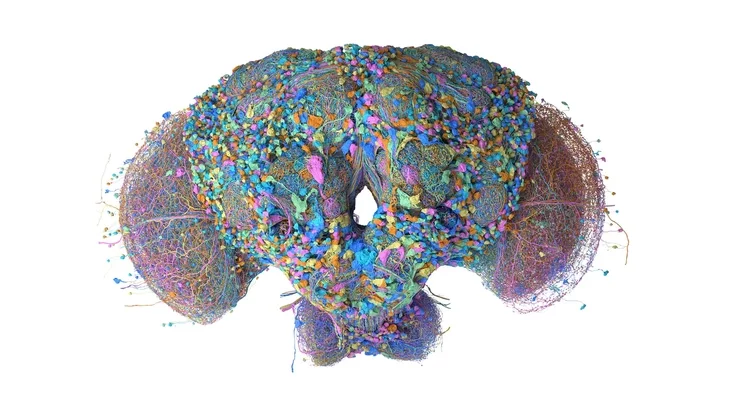
To combine two-dimensional images into a three-dimensional model, artificial intelligence algorithms were used, specifically Google's Flood-Filling Networks neural network technology.
The program automatically identified cell boundaries, but human involvement was required to verify and correct computer recognition errors. The collective efforts of thousands of volunteers and scientists amounted to approximately 33 person-years of manual verification. According to researchers' estimates, without the use of artificial intelligence, such a modeling process would have taken about 50,000 person-years.
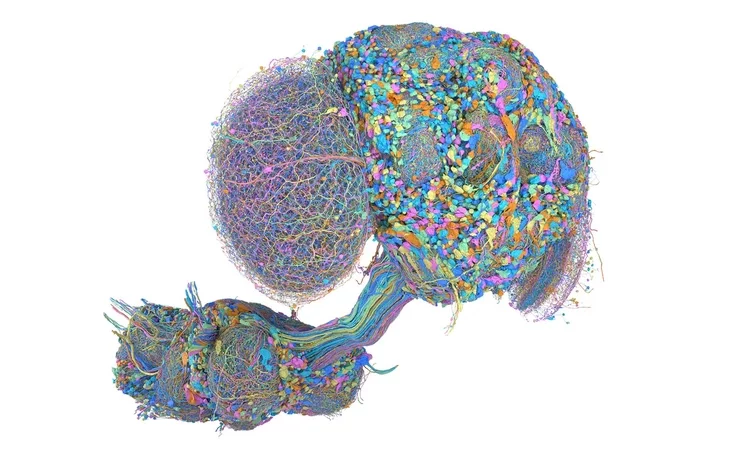
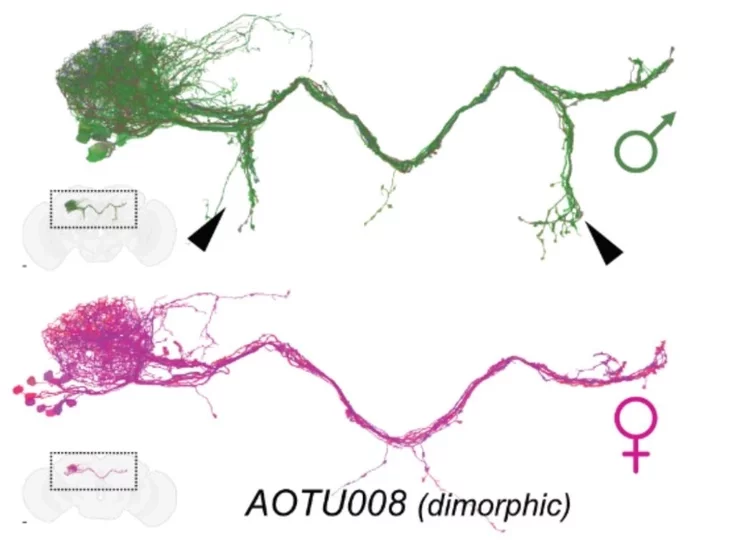
A distinctive feature of the MaleCNS model was precisely the integration of the ventral nerve cord, which for the first time allowed researchers to trace pathways from sensory receptors to motor neurons that directly control the insect's movement. Researchers also identified and mapped specific sexually dimorphic neurons. These cells differ in males and females, being responsible for different behavioral patterns during mating and processing sensory signals.
How to run the nervous system in a software environment
A connectome is not a full-fledged simulation of a living mind. It is a static database, an accurate "wiring diagram" that only shows which neurons are connected to each other and how many synapses form these connections.
The digital map lacks information about the current electrical activity of cells, concentrations of chemicals, presence of neuromodulators (such as dopamine or serotonin), glial state, and overall hormonal background.
For this static circuit to function in a software environment, each neuron is converted into a simplified mathematical model. Most often, the leaky integrate-and-fire model is used for this. A virtual neuron accumulates input signals from neighboring cells, and upon reaching a certain threshold, generates its own pulse, transmitting it further along the chain, after which it returns to its initial state.
To interact with the outside world—a video game, a trading terminal, or a text editor—developers create special software interfaces. External data (e.g., pixels on a screen) are converted into artificial signals and fed to the virtual sensory neurons of the fly (usually to visual or olfactory receptors).
Next, impulses propagate through the network strictly according to the biological map of synaptic connections. In the final stage, another program code records the activity of the output (motor) neurons, which in a real fly are responsible for the movement of wings, legs, or proboscis, and translates this activity into program commands: pressing a key on the keyboard, movement in a game, or selecting a trading operation.
The model itself does not understand the context and, unlike a living brain, does not possess the capacity for natural neuroplasticity and learning.
From Minecraft to cryptocurrency trading
The availability of an open interactive dataset allowed programmers to start their own experiments. Already on September 7, YouTuber Ro0oney published a video where the simulated network controlled a character in the game Minecraft.
The next day, another blogger released a video showing the model playing the rhythm game Beat Saber. It garnered 22 million views and spawned an internet meme in which the virtual fly was entrusted with a wide variety of human tasks.
the fly brain can play beat saber pic.twitter.com/AqKMqD6gzP
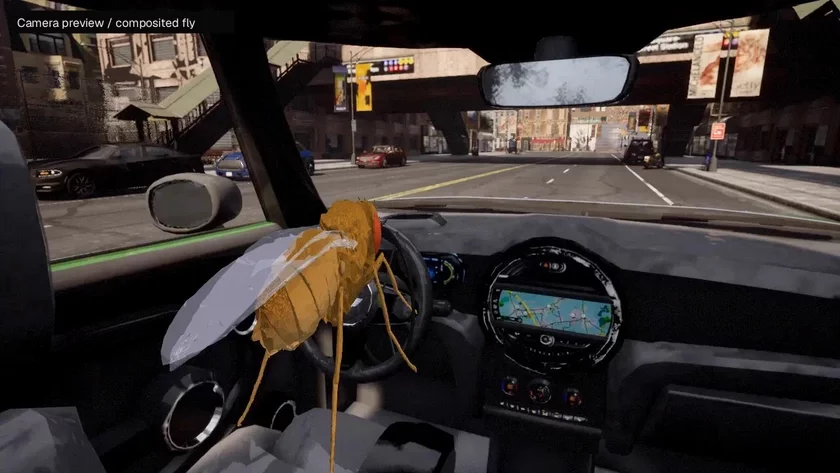
Dozens of new projects emerged in the following days. One demonstrated how the simulation simultaneously parks a car in a driving simulator. In a project called DOOM-x-Fly, visual data from the cult shooter was streamed to the insect's vision model, and the output layer of the program analyzed the activity of thousands of neurons to press game keys.
the fly has completed* the ultimate test: parallel parking pic.twitter.com/KqdDg8dvo6
An engineer under the nickname SpikeCalls went further and connected the simulation to the physical world: he connected the digital brain to a camera and four motors of a real drone, where visual signals directly controlled the thrust of the propellers.
Coinbase crypto exchange engineer Alex Wormuth developed the Stonkfly project: he turned a digital copy of the fly into a day trader for trading the BTC-USDC currency pair.
I gave the fly brain $100 to trade bitcoin.
Dopamine neurons are stimulated when the fly makes profit. Neuron activity controls buy/sell decisions and makes trades on coinbase.
Will the fly get rich? pic.twitter.com/XVWSFattGu
The program converts a standard candlestick chart of historical quotes into a 320x180 pixel color image and transmits these RGB values directly to the virtual brain's photoreceptors, distributing the image between the model's left and right "eyes."
Within the simulation, the fly has three actions available: buy, sell, or hold the asset. The basic decision-making ("thinking") interval is 500 milliseconds, and market data is updated every 60 seconds. For one operation, the algorithm can stake up to 10 dollars, but no more than 24 times a day.
The author implemented a biological reinforcement system: portfolio value growth simulates a dopamine release, activating 15 specific cells. Conversely, financial losses or deduction of trading commissions activate two aversion cells.
However, the algorithm is deprived of the ability to use leverage or short sell.
The Stonkfly project code is available for open access on GitHub for macOS and Linux operating systems. To run your own "neuro-trader," you need 16 GB of RAM, Python 3.11 installed, and a C++ 17 compatible compiler. By default, the simulation runs in test mode with a starting virtual balance of 100 dollars, but the developer has provided instructions for connecting the algorithm to a real account.
Ethical questions
The widespread use of the digital model for entertainment purposes sparked ethical discussions on platforms like Reddit. Users began expressing concerns about the potential digital suffering of the simulated creature.
Questions arose about whether the virtual fly experiences stress or pain when forced to continuously process data from video games or financial markets. The situation is even compared to dystopias like the "Black Mirror" series and the concept of "The Matrix."
Neurobiologists refute the possibility of consciousness or the ability to feel within the current technology.
A connectome is exclusively a static map of synaptic connections. Digital simulations created based on it use simplified mathematical models of neurons that do not reflect the full complexity of a biological organism.

The software environment lacks physiological processes that ensure vital activity and perception: metabolism, glial cells, hormonal background, and the capacity for neuroplasticity.
Although living fruit flies have pain receptors and respond to negative stimuli, the virtual model is deprived of the ability to feel pain or fatigue.
The "dopamine release" in projects like Stonkfly is merely a mathematical variable in the program code, not a real chemical substance.
The real scientific value of the FlyWire and MaleCNS projects is not related to internet trends. Since fruit flies share about 75% of genes associated with human diseases, a precise map of their brain will allow researchers to study the mechanisms of diseases such as Parkinson's or Alzheimer's at the level of individual neural circuits.
The connectome structure will also aid in the development of more efficient architectures for artificial intelligence. As for digital modeling of the human brain, due to its scale (about 86 billion neurons compared to 166 thousand in a fly), this task remains technologically unreachable for now.
«Nasha Niva» — the bastion of Belarus
SUPPORT USNow reading


"Didn't like the products on the shelf — and they write an SMS there." The Ministry of Internal Affairs called Threads a security threat and announced arrests


Comments
так называемой эволюции, а не сверхразума ?