


In Grodno, archaeologists found fragments of a church from the late 16th — mid-17th century
Specialists from the Institute of History of the National Academy of Sciences of Belarus presented new archaeological finds in the Grodno region at a special press conference, reports BelTA.
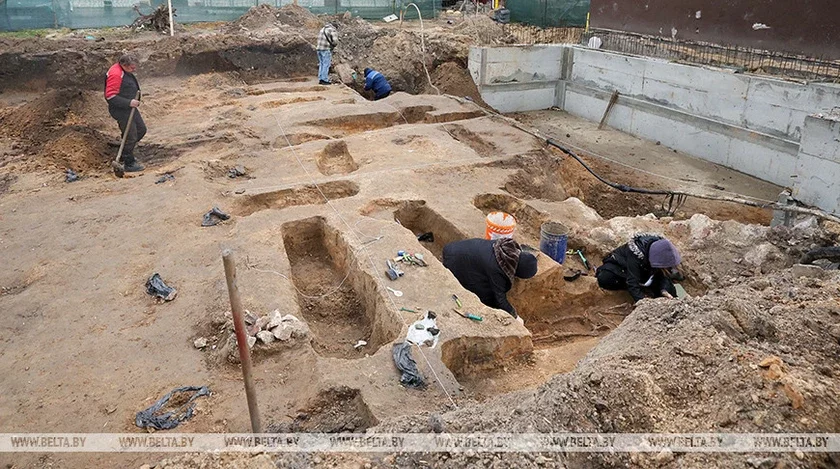
As the scientists noted, excavations were carried out in Grodno and Lida this archaeological season. These works are related to the study of burial complexes from the 16th-19th centuries.
In Grodno, research was conducted on Malaya Traetskaya Street. During construction work there, burials dating back to the early to mid-16th century were found. In addition, fragments of a religious building were discovered, which are associated with the Church of the Holy Trinity that existed in Grodno from the late 16th to the mid-17th century.
Burials were found near this object.
"They have an unusual layout and differ from graveyards of that period: the buried were arranged in a specific structure. The study of the finds continues in laboratory conditions. A rather rare fact for Belarusian territories was recorded at this site — a healed trepanation," the Institute of History of the National Academy of Sciences of Belarus reported.
In addition, materials related to individual cults were found. In particular, medallions are mentioned. Artifacts from the 17th-19th centuries were also found there. It is assumed that this cemetery functioned for a short period and was associated with the activities of the church. The graveyard was likely abandoned after the church ceased to exist.
In Lida, archaeologists investigated crypts with lead sarcophagi, dating back to the late 19th century. Three burials were found. Notably, scientists managed to restore the names of some of the buried. One of them is Yulian Zdanovich, a lieutenant colonel of the Lida regiment. He participated in the Russian-Turkish War, was awarded, and spent the last years of his life in Lida, where he was subsequently buried. On another sarcophagus, a plaque with the name of the buried and individual letters of his surname was preserved. As a result of the study, it was revealed that he headed the Lida prison castle for 14 years. A decision was made to rebury the remains of these people in the territory of Lida.
Also, this year, the study of the oldest archaeological monument in Belarus — the Agava site, located in the Ivanava district of the Brest region — will continue. According to the latest data, its age exceeds 400,000 years, which is confirmed by the results of analytical studies. Research stopped at a depth of 7.5 meters.


Comments
Турэмшчыкі расейскія вартыя ушанавання нават праз стагоддзі!...
Як яны у́жо дасталі!....