


A new system for protecting roads from wild animals has been tested for about two years on the Belarusian M10 highway, which connects the border with Russia, Gomel, and Kobryn. If the project proves effective, such equipment is planned to be extended throughout Belarus, writes BelTA.
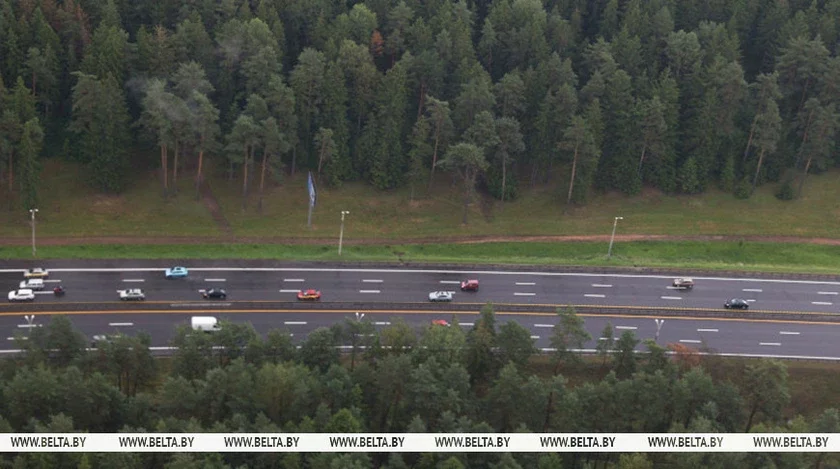
The pilot project is being implemented jointly with the National Academy of Sciences. An overpass for animals has been created on one section of the highway, but the main task of the system is to prevent them from directly entering the roadway.
For this purpose, motion sensors were installed at breaks in the fence. When an animal passes near the road, the sensor detects it and transmits a signal to a road sign with variable information. The sign lights up and warns drivers that a wild animal is near the road. The animal may not yet be on the roadway itself but is nearby.
Approaches to the crossing were also equipped with special noise strips made of coarse gravel. Such a surface creates discomfort for animal hooves, making them less willing to try to jump over it and enter the road.
Another element of the system is lighting. It not only helps to better see the section of the road but also should deter animals from entering the illuminated area.
The design is constantly being improved based on the results of its operation. Specialists believe that the experience gained on the M10 will soon be applicable to other Belarusian highways.
A similar system is now being created on the M6 Minsk — Grodno highway in the Valozhyn district. They plan to use additional means of protection there, including the so-called "Texas gates," or Canadian cattle guards. These are used in places where ordinary mesh fencing cannot completely block the path for animals, for example, at intersections and junctions.
The special design of such gates creates discomfort for the animal, so it does not proceed further and turns back. In addition, special one-way flaps will be installed at the ends of the fence. They will operate on the principle of exit in only one direction: if an animal has already reached the end of the fence, the flap will allow it to go into the forest but will not allow other animals to exit the forest onto the highway.
Not only specialists from "BeldarNDI" are involved in the project's implementation. "Beldarsuviaz" is responsible for the sensors, and road owners are responsible for installing the corresponding constructions.


Comments
Няўжо так складана проста насыпаць над дарогай насып, як гэта робяць у Польшчы? Зверху жывёлы, а у створаным тунэлі машыны.