


On Veachka Stankevich's grave, the monument has not a single word in Belarusian. This is what it says about emigrants, emigration, and the "Belarusianness of grandchildren"
Whoever can, hold on to Belarus, even if it means staying silent, making peace, and making bitter compromises, writes Mikola Buhai.
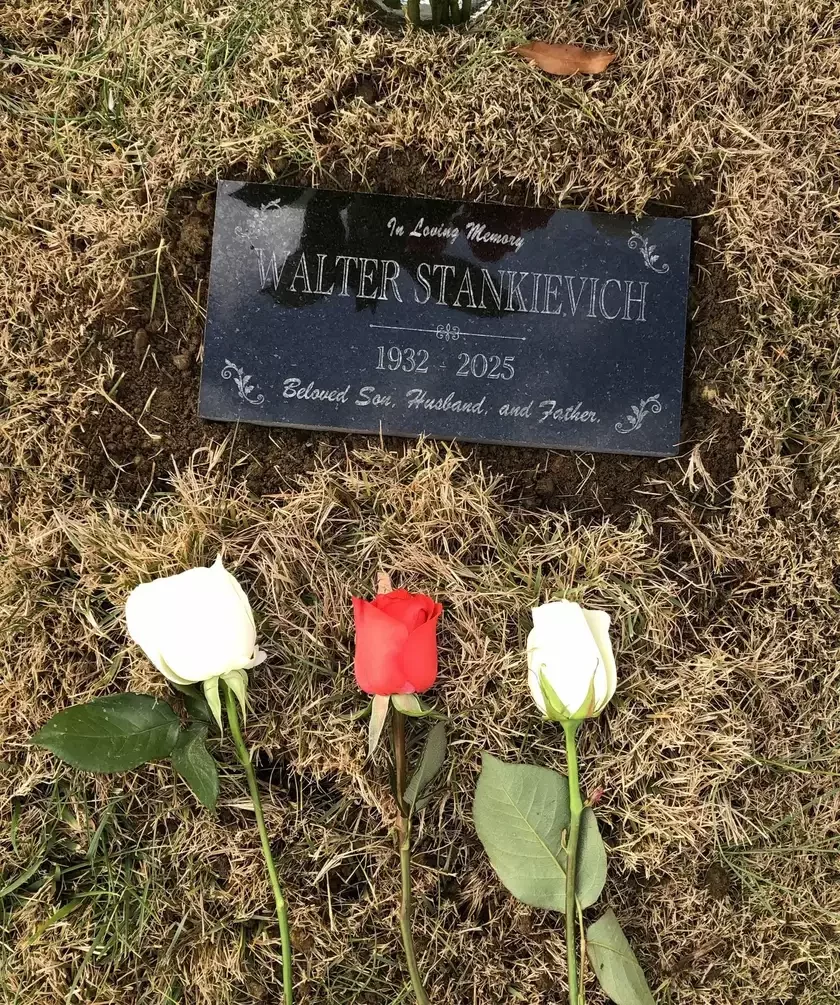
Veachka Stankevich lived a long 92 years. He was the son of a Nasha Niva contributor, a scientist, and a senator in interwar Poland, Jan Stankevich. His mother was Czech: his father married her while studying in Prague. Veachka was born in Vilnius in 1932, and lived in the USA from 1949. The child of a top intellectual, he was also a top intellectual himself. He worked as an engineer at corporations "ITT" and "Western Union," until he moved to work for Radio Free Europe/Radio Liberty — where he was himself.
Belarusianness, loyalty to his father's path, was the foundation of his life, even during his service in the American army (he served from 1951-1954, during the Korean War).
He played for the New York football team "Belarus". He was an active member of the Association of Belarusian Youth in America, chairman of its New York chapter, and later chairman of the Main Board. Several times he was chairman of the Main Board of the association of Belarusians in America, which is called the "Belarusian-American Association". And this loyalty to the country of his origin was with him until the end of his life. He was deputy chairman of the BNR Rada, chairman of the Piotr Kracheuski Belarusian Foundation. He published the quarterly "Belarusian Review"; he was already 81 when he and his wife established the Monroe-Vilnia Foundation to support various Belarusian projects. His whole life was dedicated to the Belarusian cause.
He rests in a Belarusian cemetery, but there is not a single Belarusian word on his monument: "beloved son, husband, and father" in English. This means only one thing: for his children and grandchildren, Belarusianness no longer means what it meant to him.
I say this for a reason. Have no illusions that "we will move to Poland, the USA, Spain, or Ireland, but I will raise my children as Belarusians there, because we will speak Belarusian in the family." Family speaking and Belarusian-centric life are not enough to avoid assimilation in foreign lands. Only a few children of emigrants feel "more Belarusian than American," "more Belarusian than Polish." In the third generation, these are no longer just isolated cases, but isolated cases of isolated cases (though then, they are often golden, outstanding individuals in every sense).
Belarusians should not expect that Belarusianness will be preserved in your descendants in exile and dispersion.
A terrible dilemma faces many: to remain in a virtually occupied country where it is sometimes hard to breathe, or to leave — and there, life starts from scratch. But it's not just life from scratch — if what matters to you is not only your personal life but also the life of the nation, then Belarusianness in the longer term can only be preserved within Belarus, where there exists, albeit unfree, a state acquired through the heavy sacrifices of many generations of our people.
It's not linear, however: the preservation of Belarusianness inside Belarus now depends on the activities of exiles: without media, cultural initiatives, without politicians who raise money for culture and civic structures, Belarusian culture would devolve into a pathetic state — we see what happens to the unfortunate peoples of the Russian autonomies (and they would be sent to war, to slaughter, in the same way).
It's such a complex process: Belarusians "there" are the guarantee and condition for the preservation of Belarusianness here.
But at the same time, your grandchildren "there" will not remain Belarusians. No way.
It's easier to preserve Belarusianness in places of compact Belarusian residence — in Vilnius and Podlachia, but even there it is problematic and conditioned by the favor or disfavor of the authorities, and this is situational; in these border regions, the "Belarusianness of grandchildren" is a rarity. Assimilation of minorities is relentless.
Those for whom it is important that their children and grandchildren remain Belarusians, that our lineage does not die out, must not forget this.
The monument on Veachka Stankevich's grave painfully reminds us of this. In everyday terms, we live in a fortunate time when there is neither hunger nor poverty — as long as you work. But in national terms, we must sail between the Scylla of the pro-Russian dictatorship and the Charybdis of dissolution in the global world. Unless you are threatened with trials you cannot endure, whoever can, hold on to Belarus, even if it means staying silent, making peace, and making bitter compromises.
-
Palchys urged not to rewrite the history of 2020: Do not look for false versions of the past
-
Bialiatski: Joining the European Union — it's not a question of "I want it or not", it's a matter of the survival of Belarusians as a nation
-
Turarbekava: The main question now is what part of sovereignty Lukashenka will agree to




Comments