


How a Belarusian Woman with Four Children Became a Professor in Florida
Palina Prysmakova is an associate professor at the School of Public Administration at Florida Atlantic University, a researcher, and the Secretary of the Rada of the Belarusian Democratic Republic (BNR). She was born in Minsk, studied at Kolas Lyceum, and later her fate took her to Bialystok, Potsdam, Warsaw, New York, and Florida. She speaks seven languages, raises four children, and admits that instead of cleaning, she'd rather cook something delicious for her family.
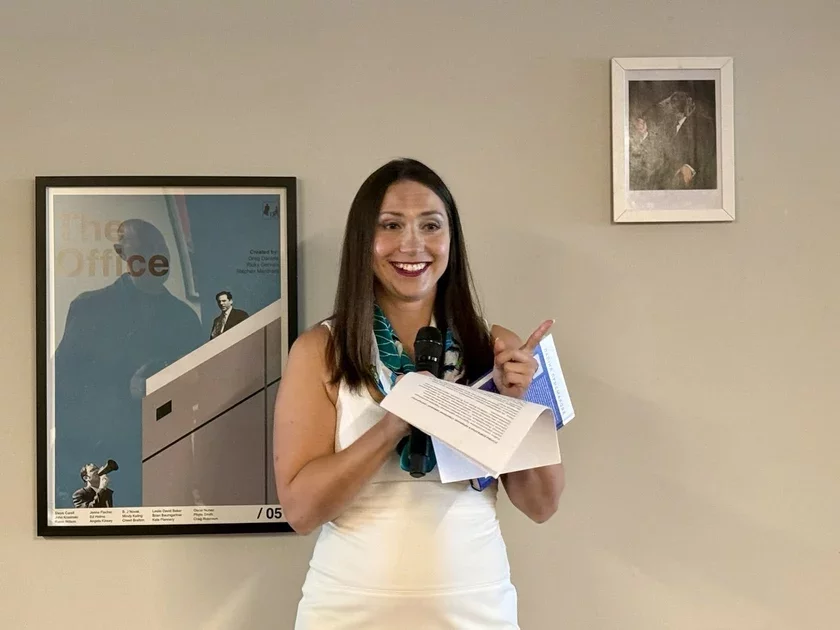
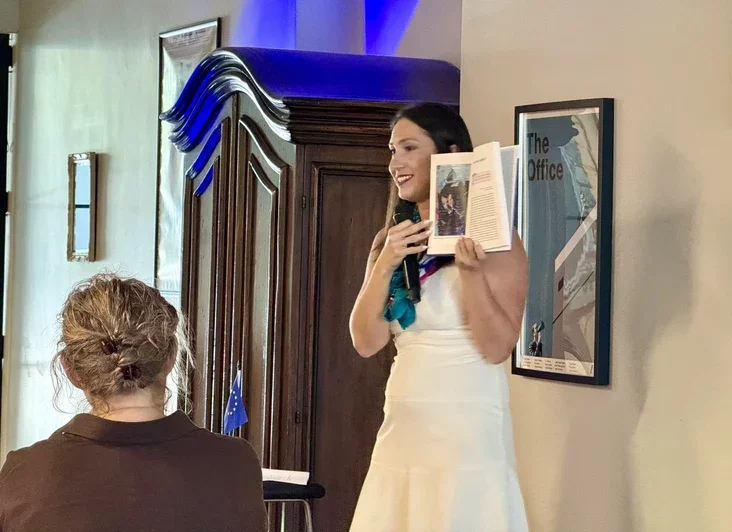
«Money fell out of the book!» — exclaims Palina Prysmakova, picking up a banknote from the floor. And she immediately finds in this coincidence a perfect illustration of what she came to talk about with Belarusians in Vilnius:
— This is the foundation of public administration.
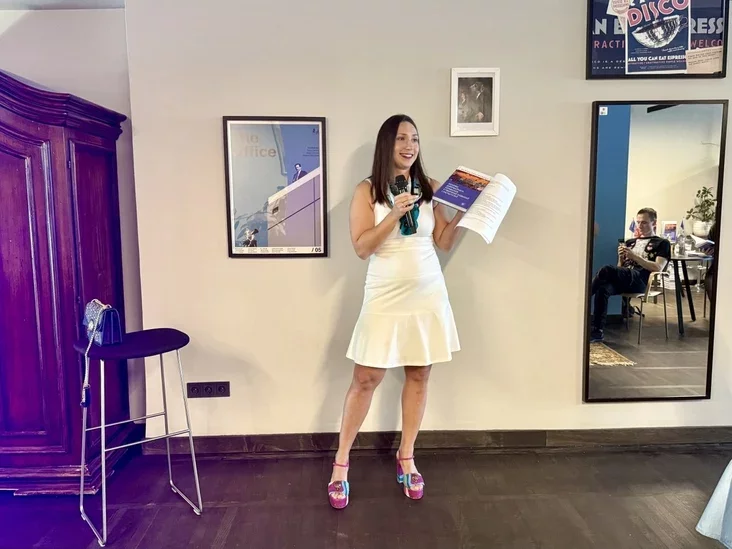
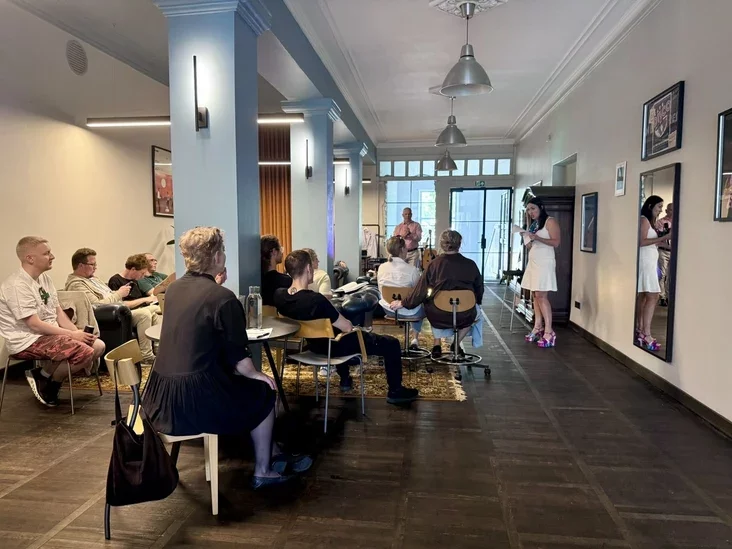
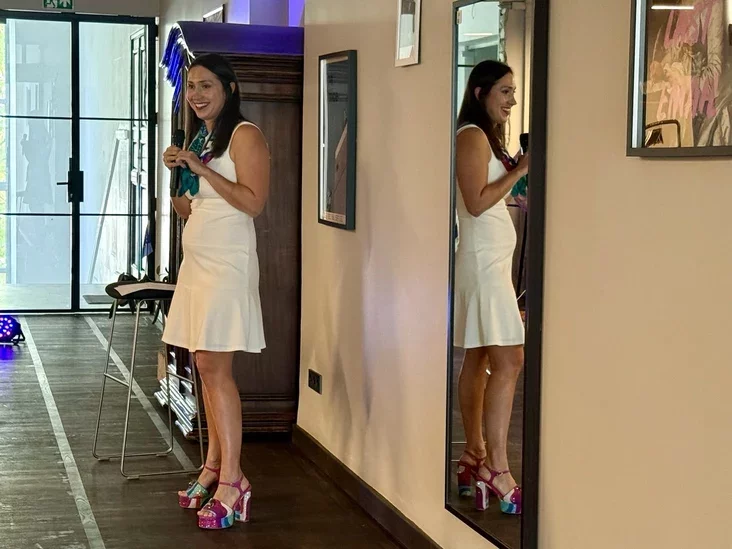
At the presentation, Palina stands before the audience in a white dress and pink high-platform sandals. Instead of an academic lecture, it turns into almost a game: she asks the audience questions, jokes, and invites them to guess who her main character is.
Not Lukashenka, not a minister, and not an abstract official. Palina's favorite character is a Belarusian who uses public services, is confident that everything in the country is free and everyone owes him something, yet «doesn't understand a damn thing about finances» and loves to criticize the entire bureaucratic apparatus.
Palina describes her book «Fundamentals of Public Administration: Building Skills and Institutions» much simpler than one might expect from a professor:
— It's about people, about money, and about how these people make decisions regarding that money.
We talked with Palina about her childhood in a Belarusian environment, emigration which she doesn't consider emigration, the life of an American professor, the diaspora, and the people who might have to build the state institutions of a new Belarus.
«In childhood, I played radio shows and taught my great-grandmother»
«Nasha Niva»: Palina, you were born in Minsk, studied at Kolas Lyceum, then lived in Bialystok, Potsdam, New York, Florida, the Netherlands, and worked in Warsaw. Which of these places changed you the most?
Palina Prysmakova: The Netherlands impressed me the most. It's a place where I would like to live, besides Belarus, of course. I spent a relatively short time there, about half a year, but after that, I had the opportunity to visit for longer periods.
I was struck by how similar the history and fate of the Dutch are to Belarusians. They have many rules, just like us, but, unlike Germans, they know how to let go of these rules and relax when necessary. There is also a parallel history with a large empire nearby. When they are called Germans, they reply: «No, we are Dutch.» Just like us: «No, we are Belarusians, not Russians.»
They are very creative. Every time I visit, after a day or two, I want to write something, draw, learn to play something. Inspiration comes from all sides. At the same time, there is cleanliness and order, like with us: everything must be tidy, no trash lying around.
And they are very family-oriented. I myself am for a large family; I have four children. In the Netherlands, three children are almost the norm. Not all European countries, and not even Belarus, have such an approach to family.
«NN»: How do you remember yourself as a child? Could you imagine that you would become a professor?
PP: In my 1990s childhood, there weren't many toys. But there was a tape recorder on which one could record something, and a few old cassettes. I constantly played radio shows. And as a result, my first career was connected with «Radio Racyja» and «Belsat». It turns out I got enough of playing radio shows in my childhood.
My great-grandmother, born in 1911, also looked after me a lot. She walked ten or fifteen kilometers to school and managed to learn to read and write a little. My favorite game was to sit and teach my great-grandmother spelling or math from my school notebooks. Since she didn't have much else to do, she agreed to play such games with me. So, I also practiced teaching from childhood.
«NN»: What kind of family did you grow up in?
PP: My father was Belarusian-speaking, actively participated in the Belarusian movement, and was interested in Belarusian culture. My mother supported all of this but remained more in a passive role. My father, however, was always engaged. At one time, he greatly supported the band «Stary Olsa», was a patron, and helped organize tours and concerts. Belarusian artists in our home or we in theirs — this was part of family life.
On the other hand, I am a professor already in the third generation. My paternal grandfather was a professor at the Technological University, my father studied for his postgraduate degree, although he didn't complete it, and my aunt is a professor at BSU.
Thanks to my grandfather, my grandmother had a dacha in a university village. There were, of course, potatoes, cucumbers, and flowers. But in between gardening, people would ask each other when someone would finish their dissertation, complaining that students didn't want to study. Academic conversations were around me from childhood.
«Our family learned the word «Akrestsina» back in 2006»
«NN»: What did Kolas Lyceum give you besides education?
PP: I already had a sense of Belarusian identity. Kolas Lyceum, naturally, multiplied it. But the main thing it gave was an understanding of social sciences. No other secondary education institution in Belarus could provide this. No matter how much they taught a subject like «Man and the World,» it was all not quite on topic.
At the lyceum, there were personalities, teachers, who shared not only knowledge but also their life experience. For example, Belarusian language was taught by a person who wrote textbooks used by the whole country. You understand the scale of responsibility of such a person — and that is impressive.
«NN»: You left Belarus long before 2020. You even said you had a «nomadic» lifestyle. What prompted you to do this?
PP: I consider my emigration a choice made in 2006. Since I studied at the lyceum, we all supported the democratic movement. We were detained as schoolchildren and released because we were minors. But it was clear: as soon as we turned 18, everything would shift to a different format and there would be different responsibilities.
I responsibly enrolled in RTI (now BSUIR. — NN), but at the same time, just as responsibly, I found an opportunity to study at a private educational institution in Poland. I was offered a good scholarship and studies at a prestigious economic university in Estonia. But back then, I couldn't imagine how I would spend a year learning Estonian and be alone, when everyone else was going to Poland. So, I went to Bialystok.
As expected, there were crackdowns in 2006. I wasn't arrested, but my father was. Our family learned the word «Akrestsina» back then.
I simply skipped the university enrollment stage, from which I could have been expelled later, and continued my studies elsewhere.
«NN»: How did you end up in Florida after Bialystok?
PP: In Bialystok, I studied at the Higher School of Public Administration, founded by Barbara Kudrycka. She was a member of the Polish Parliament and the European Parliament, actively supporting Belarusian causes. She was already denied entry to Belarus, so she traveled to our protests and marches with a diplomatic passport.
It was a private non-profit school. People paid for tuition, but there was a flexible system of discounts and scholarships. The school found funding for Belarusians, and the tuition money was invested in its development.
Professors from Australia, America, and Western European countries visited us. During one such visit, American professors, having met me, invited me to continue my studies in Florida.
Initially, I didn't agree. To me, it sounded strange: I was planning to go to some «normal» university in France, for example, in Strasbourg, and here was some Florida. I even wondered: do people even study there?
But then I came, met the faculty and graduate students, and realized that I would hardly find a better place with such prospects and so many people to work with and learn what's happening in the world.
Four Children, Late-Night Lectures, and No Perfect Order
«NN»: What does a typical day for a lecturer in Florida look like?
PP: I'm a morning person. If I had my way, I'd wake up at five in the morning, watch the sunrise, drink tea or coffee, write or read something.
But for twelve years now, I've been teaching master's students who work. This is a program for managers of non-profit organizations. Students are busy during the day, so they come to class after work. Lectures start at seven in the evening and sometimes end at ten or eleven. And then people suddenly have a million questions that, for some reason, weren't asked before the lecture.
I get home around one or two in the morning and therefore wake up late. I'm not proud of this — I'd rather it be the opposite. If I manage to get up at nine or ten and the children allow it, I try not to turn on the internet and write something. Because as soon as you open social networks or news, your head no longer works that day.
«NN»: Did you create your family already in the USA?
PP: I would say I created it in the same suitcase with which I travel all over the world. By the age of three, my eldest daughter had visited twelve countries. With the second child, we also traveled a lot. When the third appeared, it became technically difficult to pack and unpack things.
Now the children have grown up, so we can move around in separate groups, rather than one big crowd.
«NN»: You professionally study how institutions and organizations work. How systematic are you yourself? Does the public administration professor remain in your personal life?
PP: I am not a perfectionist and not an A-student. I'm a solid B-student. If I see that something is already done well enough, I won't continue to fine-tune and polish it to perfection.
I really love to rest. I don't understand people who never rest. I can't do that and allow myself to relax. Although, some close ones say I still rest too little.
I don't have order at home, I apologize. I have many children. If, by some magic, I am left alone for a week, then, of course, everything is great. But I don't worry about it too much.
I love to cook. They say there are women who love cleanliness, and there are women who cook. There are ideal ones who do both, but that's not me. If I have free time, I'd rather cook something delicious for my family than scrub something clean.
«NN»: How many languages do you know?
PP: Belarusian, Russian, Polish, German, French, English. I understand Serbian and can somehow converse in Serbia. That makes about seven.
«NN»: How much does a professor earn in Florida?
PP: At our university, a professor who does not hold an administrative position earns from 45 to 90 thousand dollars per year before taxes.
In Florida, there is no state income tax; we only pay federal tax. But life is very expensive. The tax on my house is approximately one-third of my annual salary. Kindergarten in Florida currently costs about two thousand dollars a month. So, for now, we don't go there or use a kindergarten in Vilnius, if that option is available.
In America, professors and people working in higher education are middle class. If one were to live in Vilnius with such an income, one could feel very wealthy.
«Now, the life of a migrant in the USA resembles some «Belarus 2.0»
«NN»: In a 2015 interview, you said: «There is no poverty anywhere in Belarus like what I saw in America.» Has your perception of America and its social system changed over the subsequent eleven years?
PP: I do not retract my words about American poverty. The USA has a very polarized and very unstable society. You can be a prince, an emperor, a billionaire, and a day later find yourself literally on the streets, with nothing to eat or nowhere to live. And vice versa. Social mobility there is very high.
But people who fall into poverty, especially if they were born into it, sometimes cannot escape it with any effort.
If something didn't work out for a person in Belarus, they might think: I'll go somewhere to work — to Moscow, to the West, or to America. At least, the idea of another place where it might be better remains. But if you were born and live in the USA and nothing works out for you, where do you go to seek happiness? Psychologically, this is very difficult. People cannot break out of this cycle.
«NN»: And what do you like about America?
PP: Higher education. From my experience with German, French, Dutch, Belgian, Polish, and Lithuanian educational institutions — nowhere is there such higher education as in the USA.
Its main advantage is the academic freedom of the lecturer. When I am given a subject, I am told its code and title. That's all. Of course, I am responsible for what I do, but I am trusted to perform my work.
If the head of the department wants to come to my lecture and see what I'm doing there, she must request my permission in writing two weeks in advance and justify why she needs to be present at the class.
«NN»: You have built a professional life in the USA, lived abroad for many years. Why, after so many years, has Belarus not simply become a country you once left?
PP: Because I didn't leave to go forever. I went to study in Poland. I wanted to go on Erasmus, go on a Work and Travel program — by the way, I used this opportunity several times during my student years.
I didn't think I was emigrating. I just stayed and traveled a bit, saw what was happening. Until 2020, I regularly came home two or three times a year. I didn't feel like I had left. Only after 2020 did returning become impossible.
Truth be told, I missed Belarusian-speaking people in Florida. We have a large Belarusian community; the Belarusian-American Association section has existed for over ten years, and the organization itself since the 1950s. Belarusian life there always thrived.
But when I spoke to people in Belarusian, they replied in Russian. I tried to switch to Russian too, and they said: «Palina, no! Not you.» I replied: «Then at least sometimes answer me in Belarusian.» They said they couldn't yet, but also didn't allow me to switch to Russian.
This tired me: I wanted a lively conversation, not a one-sided talk. After 2020, Belarusian-speaking people came to Florida. For me, this is a joy, although for them, the reason for moving is, of course, tragic. Now, in this sense, everything is good.
«NN»: How has the life of Belarusian migrants in the USA changed after Donald Trump's return?
PP: Now many people are being detained, and all of this already resembles some «Belarus 2.0». We are afraid to organize open events because immigration police read the news feed well and can come to take people away. Belarusians can only be gathered in a private apartment, although even then you understand: if the police really need to, that won't stop them.
This policy exists not just in words. You're driving in a car, music is playing, everything looks like a normal day in America. And then the music stops, and a message from immigration services plays: «You have a unique opportunity to return home. We will buy you a ticket, there will be no punishment — just come and surrender.»
To hear such a thing in the USA — a country built on immigration, including people from Eastern Europe and Belarus — is very harsh.
«NN»: Are you aware of Belarusians who have ended up in immigration detention centers?
PP: Yes. There are public campaigns in their support, raising money for medicine, trying to release people on bail. This is a serious problem, and we maintain contact with those who reach out. But some do not want to make their story public: they hope it will be easier and quicker to get out that way.
«Belarusians have created over 40 institutions. We underestimate what we have done»
«NN»: You have been observing the Belarusian diaspora from within for many years. How has it changed since 2020, and what about today's Belarusians abroad inspires you, and what concerns you?
PP: I am inspired by the creativity and the number of organizations and institutions created by Belarusians abroad after 2020. I tried to count them — it comes out to more than forty.
Yes, someone didn't share something with someone else, one is dissatisfied with another. That's normal. I look at all this and think: «Well done, great, cool.»
What concerns me is that many people who left after 2020 are convinced that they are the first Belarusians to find themselves abroad. They know almost nothing about Belarusian life that has existed for decades and even centuries in the USA, Australia, the Caribbean, or even in Poland.
It comes as a discovery to them that there were already Belarusian churches, educational institutions, wellness centers, a whole network of organizations and partners there. This is not disdain — rather, ignorance, because it wasn't taught in school. If not for Kolas Lyceum, I might not have known anything about it either.
«NN»: In recent years, Belarusians abroad have been creating their own political and public institutions. Can they then be transferred to Belarus?
PP: We do not overestimate, but rather underestimate what has been created. When I tell foreigners at international public administration conferences what Belarusians have done, they react: «Wow, is that possible?» And I reply: «Imagine, we managed.»
But what does «transfer an institution» mean? You cannot transfer the registration of an organization to Belarus. You can transfer people, their knowledge, experience, and desire to do the work. If they have learned to operate according to a certain scheme, which they developed themselves or borrowed from someone, naturally, they will be able to use this in Belarus.
The main question is not how transferable the structure is, but whether these people will still have the strength and opportunity to dedicate another segment of their lives to this.
They have already put family, personal comfort, and rest aside and spent five to six years creating institutions abroad. Will they be able to dedicate another five to six years to replicating all of this in Belarus? That is the question. But the knowledge and skills they have gained are unique.
«NN»: Are there enough people capable of building a new public administration system in Belarus?
PP: Thanks to 2020, there are not just enough such people — there are very many. Ours is not such a large country. We don't need tens of thousands of specialists: if there is at least one capable person at each local level, everything will already be fine.
The Rada of the BNR, which dreams of self-dissolution
«NN»: You are the Secretary of the Rada of the BNR — an institution that embodies the historical continuity of Belarusian statehood. What does being part of the Rada personally mean to you?
PP: It is a great honor. I am glad that I joined the Rada even before 2020. Thanks to this, I had the opportunity to get to know the «dinosaurs,» the gurus of the Belarusian movement — people who never lived under Soviet rule.
Very few such people remain; they are already very elderly. Some left Belarus as children, others later. But the very opportunity to talk and argue with people who never lived a single day under the Soviets — is perhaps one of the greatest joys I have had in my life.
«NN»: As a professor of public administration, how do you evaluate the Rada of the BNR as an institution?
PP: The Rada of the BNR is a government in exile. It fully corresponds to the functions of such a government: it sits, waits, observes current political processes, and hopes to dissolve itself as soon as possible.
Sometimes the Rada is criticized by people who do not understand its functions. Our task is not to interfere in current political processes, not to support individual projects, actions, or political movements. Our function, so to speak, is similar to that of the British Queen: to sit and watch what happens.
If a democratic, independent, and Belarusian in spirit state appears on the territory of Belarus, we will very willingly dissolve ourselves, transfer the mandate to the person or structure that will lead the country, and conclude this marathon.
«I'm interested in trolleybuses running on schedule»
«NN»: You wrote a Belarusian-language work on the fundamentals of public administration. Why was it important for you to write it specifically in Belarusian?
PP: Fate threw me where it threw me, and I try to talk about Belarus as much as possible. But I am paid not for that. I am paid for my knowledge in public administration and public services.
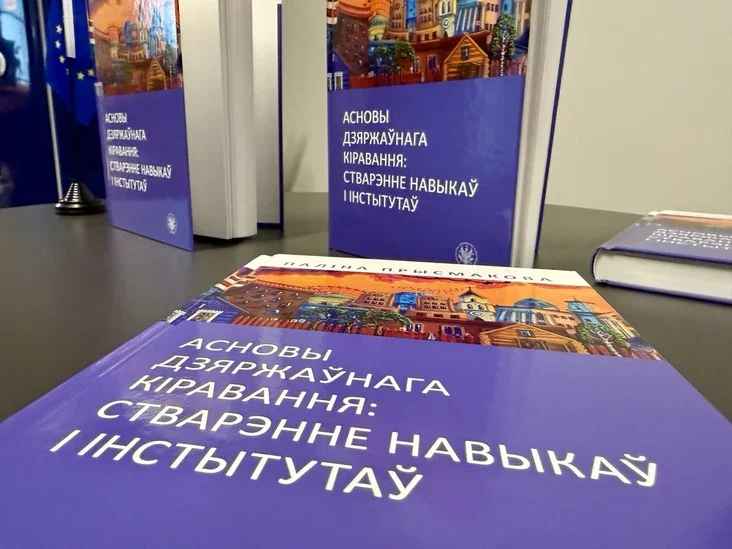
This knowledge is universal; it can be used in different countries and systems. The book is about people, money, and how people make decisions regarding that money.
This is not political science. Political scientists love to ask: «What about power?» But public administration scholars are not interested in that. Just as a biologist deals with biology and a chemist with chemistry, I deal with management. I can discuss the regime and express my own opinion, but I am not a political scientist.
I don't say which political system will be best for Belarus. I'm interested in people and structures. I'm interested in how to get a certificate at the Civil Registry Office, how to get a discount for kindergarten, and how to make sure trolleybuses run on schedule.
In Belarus, there is a lot of good and many responsible people. But sometimes they lack basic knowledge. I'm not saying they do everything badly. On the contrary, sometimes they do very well, but they don't realize how well.
The book does not dictate: do this or that. It shows how else one can organize the work of a state or public structure, how to agree, allocate money, and human resources.
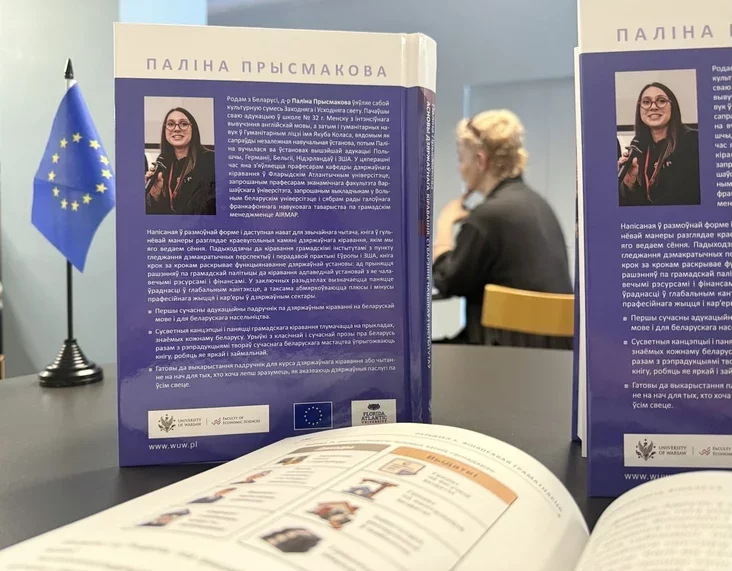
Thanks to the Free Belarusian University, I conducted two courses on this topic and was finally able to discuss my profession in Belarusian with Belarusians, including those who worked in state and public institutions. The result of these conversations was the book — for those who did not attend the course but want to join the discussion.
This is a scientific work, but not a scientific treatise. It is written in conversational language — practically my own dialect. It contains neologisms, as the Belarusian language lacks some professional terminology in this field. To all linguists and philologists: don't throw tomatoes at me. This is a very interesting Belarusian language. If you want to say that something is not written in Taraskievica or is bad Narkamauka — that's right, because it's «Tara-sama-Narkamauka».
I wrote the first chapter in a Parisian cafe. My Belarusian passport had expired, and I had registered to renew it at the Belarusian embassy in Paris, with an appointment scheduled nine or ten months later. I had already bought tickets and booked a hotel, but literally two days before the trip, news broke that Belarusian embassies abroad would no longer renew passports.
I flew anyway. I sat in Paris and wrote the chapter on decision-making. In a way, a very fitting situation for such a topic.
«NN»: Do you see yourself in a government position in future Belarus?
PP: This is a completely natural thought. But I would like to do what I am truly good at. And I am good at education in the field of public administration. Most of all, I would like to work at the Academy of Public Administration, just dropping the second half of its current name. It could be the Academy of Public Administration of Free Belarus, New Belarus, or simply normal Belarus.
I would like to create courses, trainings, and prepare publications for officials and managers of public institutions. That would be a joy for me. I would have enough strength and energy for it, and I know exactly what needs to be done.
But to go into some structure simply for a position and learn something completely new on the fly — why? I would like to implement in Belarus what I already know how to do.
Now reading


Unique photos of the construction of the Old Bridge in Grodno. Who photographed the dangerous caissons in which people risked their lives at the bottom of the Neman to place the supports? MANY PHOTOS


Comments
Она нигде не упомянула, где получила ученую степень и какую
В американских университетах в прикладных областях (как и ее область) можно быть "профессором" без PhD , имея более низкие степени MD, JD, MBA.
Наверное, это как раз ее случай
У нас в Австрии профессорами называют даже учителей гимназий и некоторых других старших школ. Поэтому австрийцы обычно уточняют университетскую должность как Universitätsprofessor