


For 100,000 years, the fate of one of the early Homo sapiens individuals remained a mystery. Now, an international group of scientists has concluded that the man was a victim of a deliberate attack. If this interpretation is correct, this is the oldest known case of violent human-on-human assault.
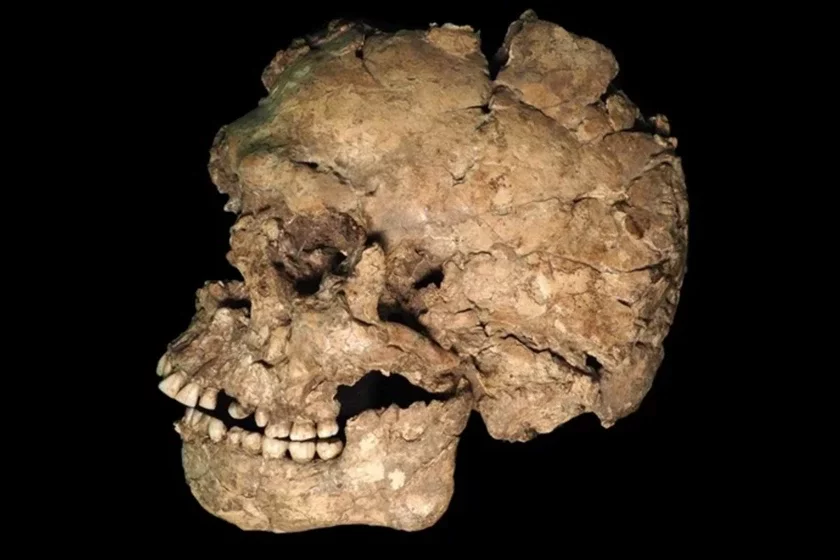
Live Science draws attention to the results of a study of the skull of a Homo sapiens individual, known in scientific circles as Qafzeh 25. He was buried in the Middle Paleolithic in Qafzeh Cave, located in modern-day Israel.
This cave has long been considered one of the most important archaeological sites. Between approximately 145,000 and 92,000 years ago, at least 27 individuals were buried here — among the earliest known Homo sapiens to live outside Africa. These burials were studied by archaeologists back in the mid-20th century, and traces of head injuries caused by a blunt object had previously been found on two skeletons.
Now, scientists have re-examined the skull and mandible of one of the buried individuals using microscopy and computed microtomography. They discovered a cut that runs through the left side of the mandible, affecting one of the premolars and part of the maxilla.
The bone had healed, leading researchers to conclude that the man lived for a considerable time after the injury.
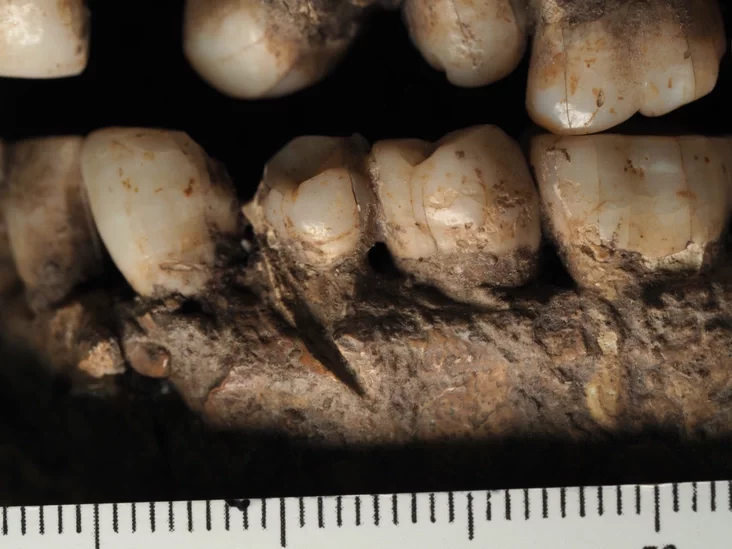
It is currently impossible to say precisely what tool caused the injury. However, during excavations in Qafzeh, flint scrapers and sharp points, which could have been used as spearheads, were found.
The study's authors note that traces of injuries inflicted by sharp weapons are very rarely found in the skeletons of Middle Paleolithic people. Some of these could be explained by hunting accidents. However, the location of this injury rather suggests a deliberate attack.
The cut is on the left side of the face. According to modern forensic studies, such injuries are most often sustained by victims of face-to-face attacks, as most people are right-handed.
If this interpretation is correct, then, as the authors note, the discovery would be the earliest archaeologically recorded case of an injury inflicted by a sharp weapon.
Qafzeh Cave has long been considered one of the key archaeological sites, as it is where some of the earliest evidence of intentional human burial has been found. The new study complements this picture.
«These results provide new arguments in the discussion about the origin of complex forms of behavior such as interpersonal violence, care for the injured or sick, and burial rituals,» the publication quotes paleoanthropologist Ana Pantoja Pérez, head of the study from the National Center for Research on Human Evolution in Spain.


Comments