


How Norway almost completely abandoned gasoline cars and what problems it faced afterwards
In Norway, 98.6% of new cars are already electric vehicles. For most European countries, this figure still seems an unattainable goal. However, the country's experience shows not only the advantages of almost completely abandoning gasoline and diesel cars, but also new problems. Die Welt introduces the details.

Electric cars in Oslo. November 2016. Photo: Fredrik Bjerknes / Bloomberg via Getty Images
The process of phasing out internal combustion engines in Norway was not accidental — it is the result of a consistent state policy that began as early as 2001. At a time when electric cars were not yet mass-produced, the country's government exempted their buyers from 25% VAT and a high registration tax, which traditionally makes new cars very expensive.
Owners of electric cars also received a number of other benefits: preferential conditions for paying toll roads and free parking, as well as the ability to use public transport lanes.
However, in the early years, this did not bring much effect. The market offered very few models, and the network of charging stations remained insufficient. The situation only began to change in the 2010s, when the state and private companies began to invest heavily in infrastructure. The result was an extensive network of 10,000 fast-charging stations.
In addition, in 2017, the right of residents of apartment buildings to install charging points was enshrined at the legislative level. This helped eliminate one of the main obstacles to the transition to electric transport.
But the key factor in the transition was the 'taxation by harm' system. In parallel with benefits for electric cars, the government sharply increased taxes on internal combustion engine vehicles, based on their CO₂ emissions. As a result, buying a traditional car became economically unprofitable, especially given the cheap electricity that Norway obtains from its own hydroelectric power plants.
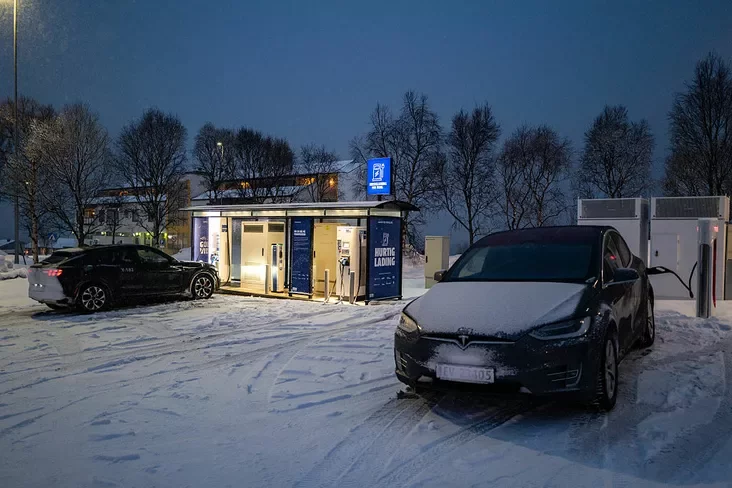
Charging station in Alta (Norway). March 2025. Photo: Salwan Georges / The Washington Post via Getty Images
Norway maintained a consistent course regardless of changes in government. This was facilitated by the absence of its own automotive industry that would need to be protected, and the availability of financial reserves from the state oil fund.
True, now that the share of electric vehicles in the new car market has approached one hundred percent, the authorities have begun to gradually roll back some of the benefits. Since 2023, a registration tax has been reintroduced for electric vehicles, albeit significantly lower than for traditional cars.
The VAT exemption only applies to amounts up to 25,500 euros (equivalent) and is expected to completely disappear by 2028. Other privileges have also been abolished or restricted – for example, the use of bus lanes, as this began to create problems for public transport movement.
The transition of Norwegians to electric vehicles has had a positive impact on the environment. Compared to the 2010s, carbon dioxide emissions from road transport in the country decreased by approximately one third. At the same time, air quality in cities improved: nitrogen oxide emissions and the number of fine particulate matter decreased.
Problems of the Transition
Nevertheless, the mass transition to electricity has created new problems. The first of these was the load on power grids during peak hours, which forced operators to introduce flexible night tariffs. The second factor is climatic: in the harsh conditions of the north, electric vehicles lose part of their range, which requires an even denser network of charging stations.
In addition, the total electricity consumption in the country could increase by 60% by 2040. At the same time, opportunities for further development of hydropower are almost exhausted, and the construction of onshore wind farms faces resistance from parts of society. As a result, discussions have already begun in the country about a possible entry into nuclear energy.

Electric vehicle charging station in Eidfjord — a small village among the Norwegian fjords. Photo: Martin Berry / UCG / Universal Images Group via Getty Images
Some experts also draw attention to security issues. Complete dependence of transport on the electricity grid can become a problem in the event of crises or military threats. Therefore, even proponents of electrification admit that certain sectors, such as the army or police, may retain other types of engines.
A separate challenge remains the production of batteries. European countries have not yet created a sufficiently powerful and independent supply chain. Therefore, dependence on Asian manufacturers, primarily China, remains very high. Simultaneously, the presence of Chinese automotive brands in the Norwegian market is also growing.
Discussions also raise cybersecurity issues. Some studies have shown that certain Chinese-made vehicles may have vulnerabilities that allow remote interference with their operation. No less relevant remains the problem of recycling used batteries, for which there is currently no ideal solution.
Despite these difficulties, Norway is not going back to gasoline and diesel cars. On the contrary, the country is preparing to extend electrification to other types of transport. In the coming years, authorities plan to actively convert freight transport to electric motors and biofuels. A specialized network of charging stations is already being built for trucks. A significant portion of ferries have also switched to electric propulsion. For now, the situation with large container ships looks more complicated. Other types of engines will have to be sought for them.
Now reading


"Arms Dealer Serykh Could Have Kidnapped Kotov to Hand Him Over to Belarusian Special Services and Gain Lukashenka's Attention" — Stanislau Ivashkevich

"Arms Dealer Serykh Could Have Kidnapped Kotov to Hand Him Over to Belarusian Special Services and Gain Lukashenka's Attention" — Stanislau Ivashkevich


«Out of desperation, he went to Belarus, where he had an operation.» A comrade-in-arms told what is known about the arrested Kalinouski fighter Andrei Siarheyeu

«Out of desperation, he went to Belarus, where he had an operation.» A comrade-in-arms told what is known about the arrested Kalinouski fighter Andrei Siarheyeu
A Minsk resident returns to her homeland after 23 years of living in the USA. Because she wants to give birth to children only here — so that they are Russian-speaking


Comments
Шмат коней - шмат метану, парніковы эфект і пацяпленне клімату.
Шмат аўса - шмат трактароў у полі і далей ланцужок пацяплення клімату .
Шмат агародаў - шмат датацый і насення, шмат датацый і насення - шмат дадатковага энергаспажывання і далей ланцужок пацяплення клімату.
))