


Erdogan called for stripping permanent members of the UN Security Council of their veto power. And to abolish permanent membership altogether
Turkish President Recep Tayyip Erdoğan, on the eve of the annual session of the UN General Assembly in New York, in an op-ed for Bloomberg called for a radical reform of the organization's governing bodies. According to him, the UN Security Council still reflects the structure that emerged after World War II, thus requiring a more effective, fair, and accountable approach to state representation.
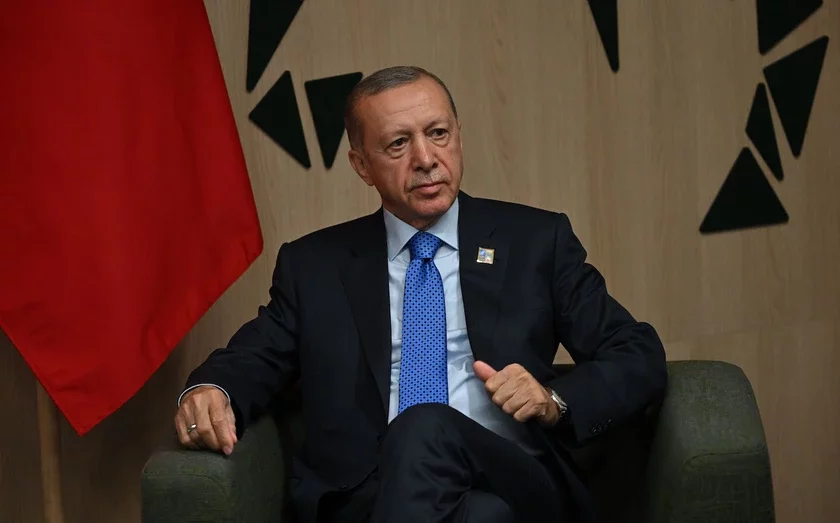
Erdogan proposes to strip countries — permanent members of the Security Council — of their veto power. In his opinion, individual states should not be able to block decisions supported by the majority of the world's countries.
The Turkish president also advocates for the complete abolition of permanent membership in the Security Council. He believes that all Council members should be elected by the General Assembly for a specific term and on a rotational basis. If a state wishes to regain a seat on the Council, it must once again secure the support of the majority in elections. At the same time, Erdogan proposes strengthening the powers of the General Assembly and making the Security Council more representative and accountable to it.
The permanent members of the Security Council with veto power are currently the United Kingdom, the USA, China, Russia, and France. Previously, these countries were the only states possessing nuclear weapons, but now there are nine nuclear powers in the world. Erdogan believes that when addressing global and regional problems, it is necessary to more actively utilize the capabilities and experience of various regions of the world. In this context, he reiterated the Turkish call "The world is bigger than five," referring to the five permanent members of the Security Council.
Two years ago, the UN General Assembly, despite Russia's resistance, approved a plan to reform the organization. It envisioned the reorganization of the Security Council and the possibility of limiting the veto power of permanent members, as well as strengthening the role of international law in matters of peacekeeping, preventing wars, and accountability for their initiation. However, since then, no significant changes have occurred in the UN governance system.
Erdogan links the necessity of reforms to the events of recent years — the pandemic, energy crises, supply chain disruptions, and regional conflicts. In his opinion, these events have shown that a system where the resolution of global crises depends on a few capitals no longer corresponds to the modern world.
He stated that it is impossible to create an international order for the future while preserving the hierarchy of the past. According to the Turkish president, the events of the last quarter-century have shown that the balance of power and the international order are not immutable. The system that was supposed to provide humanity with peace, stability, and universal well-being has failed to prevent new wars, reduce inequality, and adequately respond to changes in the global balance of power.
Permanent members of the Security Council have used their veto power to block resolutions that did not align with their interests. For example, in April, Russia and China blocked Bahrain's resolution on ensuring navigation through the Strait of Hormuz. Out of 15 Council members, only Russia and China voted against, while Pakistan and Colombia abstained.
In March 2024, Russia also blocked the continuation of the work of the UN commission that monitored North Korea's nuclear and missile programs. Most Council members supported the continuation of its work, and China abstained, but the Russian veto was sufficient to prevent the procedure from taking place. As a result, the group, which had been operating for 15 years, ceased its work.
Finnish President Alexander Stubb also previously advocated for changing the Security Council system. Two years ago, he called for stripping individual states of the ability to block Council decisions, expanding the Council's composition, and considering the possibility of suspending the membership of a country that is waging, in his words, an "illegal war". As an example, Stubb cited the Russian invasion of Ukraine.
Now reading


"As long as we remember our own, no one will steal them from us." Hurnievič explained why Parfyonov's opinion on Chagall means "to the 'lilac moon'" for us


Comments