


Blueberry Freedom. How Americans started growing berries in China, but didn't rejoice for long
Fifteen years ago, a major American berry producer began operations in China, hoping to make blueberries a new food trend in the country. Today, the Celestial Empire grows more blueberries than any other country in the world, prices have plummeted, and an American company is suing local producers over the illegal propagation of protected varieties. The Wall Street Journal details this story.
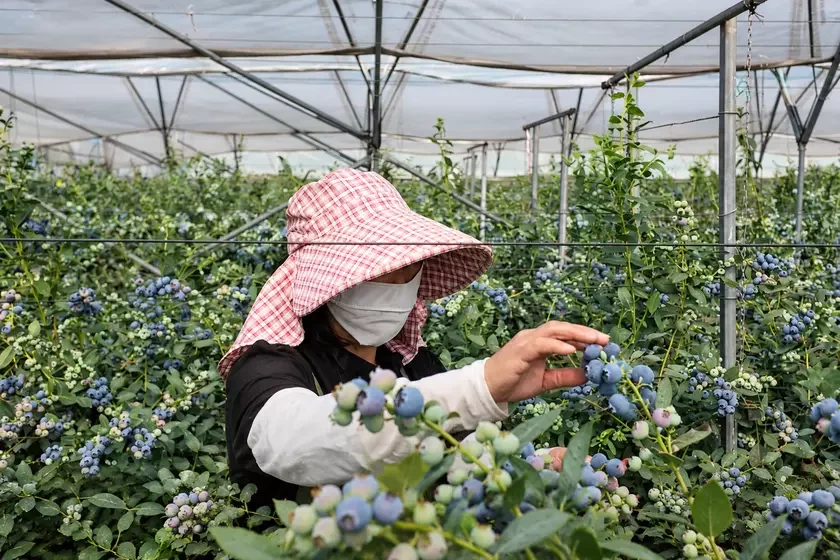
When the American berry company Driscoll's was looking for expansion opportunities outside the US in the early 2010s, its executives traveled to various countries in Latin America and Asia. As a result, they focused on China. The country's economy was growing rapidly, the middle class was getting richer, and with that, interest in healthy eating was increasing. Driscoll's decided that this trend could be used to build a new large market for berries.
It remained to choose which ones. Raspberries and blackberries were considered too unusual for Chinese tastes by the company. Strawberries also didn't seem like the best option: Japanese producers were already involved with them. As a result, they opted for blueberries, which were hardly grown in China at the time. Driscoll's wanted to turn them into a new popular product and seize this niche before competitors.
Planted not in soil, but in substrate
Yunnan province in the southwest of the country was chosen for production. The climate was suitable: plenty of sun during the day and cool nights. But there were problems with the land and water. Dumps were found near potential plantations, wastewater could be discharged into rivers, and the soil itself did not always meet the company's requirements.
To solve the problems with the quality of local soil and water, the company implemented high-tech greenhouses where bushes were planted not in soil, but in a coconut substrate. This allowed precise control over nutrient intake and avoidance of plant diseases. For Driscoll's, this was the most expensive production per hectare in the company's history.
At the same time, an exclusive license was acquired for growing varieties with special taste characteristics. Among them was the Eureka Sunrise variety. The products were positioned as a premium commodity: the berries were expensive and often purchased as a gift. The profitability of the business was so high that infrastructure costs were recouped in one season.

Illegally propagated by cuttings
Soon, local producers began to copy the technology. Growing similar berries turned out to be technically simple, as it was enough to cut cuttings from the bushes and propagate them to obtain patented varieties.
Initially, Driscoll's avoided lawsuits against local farmers, fearing reputational losses. However, European genetic companies, which owned the rights to the varieties, began conducting investigations. They hired private detectives who, posing as buyers, obtained samples of seedlings from local farms and sent them for genetic analysis.
In one such case, a Spanish company proved in a Chinese court that a local producer illegally used varieties, including Eureka Sunrise. The infringer admitted that he had acquired the plants through acquaintances at Driscoll's plantations. The court ordered the destruction of the seedlings and the payment of about 23 thousand dollars in compensation and fines. Later, Driscoll's itself also filed more than 20 lawsuits in China to protect intellectual property.
Legal disputes over individual varieties could no longer stop the growth of the industry. In 2021, China surpassed the US to become the world's largest producer of blueberries, and by 2025, its annual production was already twice that of America's.
Along with production, competition also grew. More and more companies entered the profitable niche, supply increased, and prices went down. In China, such cycles of fierce competition are called "involution": a successful market attracts new players, they quickly ramp up production, and as a result, the fight for the customer eats into profits.
For buyers, however, this process had a pleasant outcome. Blueberries, which were still recently an expensive exotic, became a mass and affordable product. Chinese state media even spoke of "blueberry freedom" — their availability to everyone.

Conclusions for foreign business
As WSJ notes, the blueberry case highlights a characteristic feature of doing business in China. In this market, high profits can be quickly obtained, but the period of exclusivity is usually very short. If a product proves successful, local companies, with the support of state funding, quickly copy technologies, scale up production, and collapse the profitability of the entire sector.
Driscoll's itself, despite fierce competition and reduced profits for its producers, remains in China and expects further growth. Blueberry consumption per capita in the country is still lower than in the US and Europe. At the same time, the company is increasing the export of berries grown in Yunnan to other Asian countries.


Comments