


"A Matter of Justice." Widow of Belarusian Warrior Fights in Ukraine for Payments and Fair Treatment
Veranika Yanovich, a former fighter of the Kastus Kalinouski Regiment, was denied her husband's last salary — Belarusian volunteer Aliaksei Lazarau, who died in January 2026. The grounds for the negative decision was the woman's Belarusian citizenship. She emotionally shared this on social media. A "Euroradio" journalist spoke with Veranika about the bureaucratic trap for Belarusian volunteers in Ukraine and why the situation has remained unresolved for four years since the start of the full-scale war.
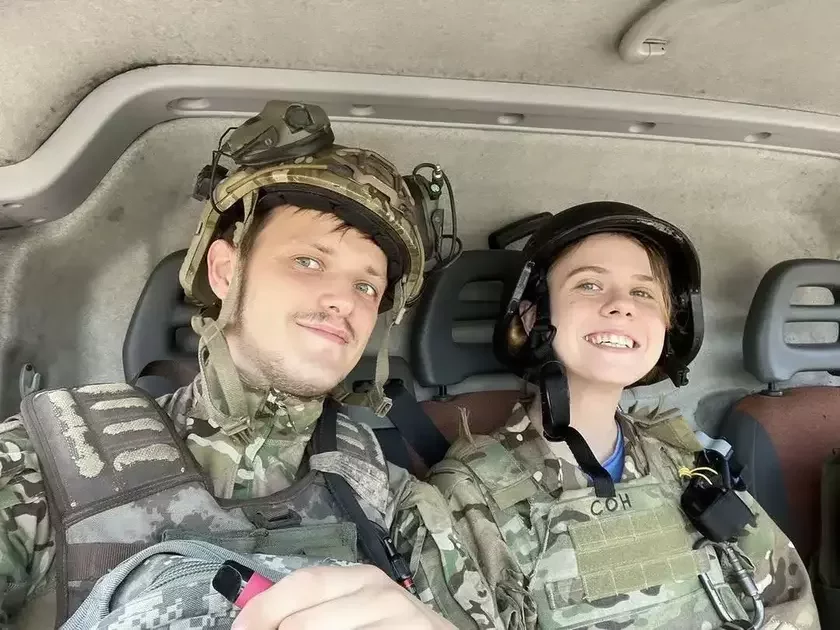
— Based on your post, Lazarau's commander effectively denied you payments because you have Belarusian citizenship. Is that correct?
— Actually, it's not entirely correct to say that the commander himself refused. I don't really want to say anything about the military unit, especially its commander. I mean not the one who is in charge of the 225th separate assault regiment, but specifically the one to whom Lyosha reported. He is a very good person. He helped me with the petition [for awarding the title of Hero of Ukraine to foreign fighters] and also wants justice — for me and for my family.
The problem lies in Ukrainian legislation, in new resolutions adopted in 2024.
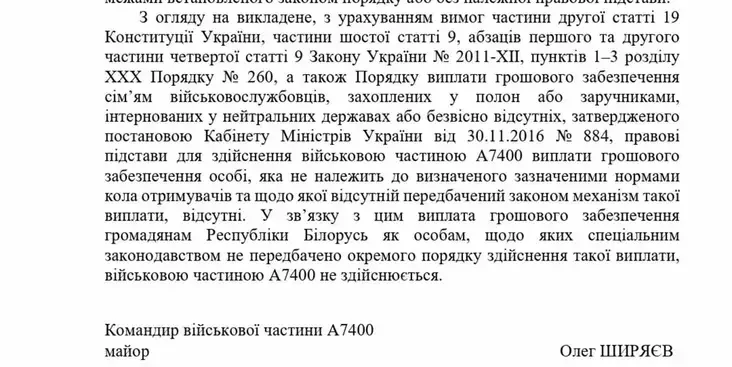
When we submitted applications and waited for answers, we simply couldn't find these new resolutions. And when I received a response from the military unit, the specific reasons for my refusal were indicated there. I attached them to my post.
Knowing all my background, Lyosha's background, everything we had to go through, it's very unpleasant. For us, the money issue was never the main thing. Why did we join the army? Our family, on the contrary, sacrificed financial stability throughout the war.
Lyosha earned well. Before I joined, I was also working quite successfully, planning to move to another job; I had my own career plans. But we sacrificed all this because for us it was a matter of justice and our values.
And I'll say this — the refusal itself is quite classic. We just weren't very knowledgeable about this issue, because families with similar problems don't talk about it publicly.
This is a very painful topic. When so much effort is put into a righteous cause, justice, values, and it all comes down to money, it's very difficult.
For eight months [after Aliaksei's death], I waited for a normal, clear answer as to why I was being refused. I am being denied the return of money that belonged to my husband.
<…> I have not yet received an answer from the Ministry of Defense of Ukraine regarding payments [due to death]. But here we are talking about my husband's money [last salary]. What right does the Ukrainian state have to decide what happens to my husband's money? It is not his mother or wife. I am his wife.
In the first screenshot I attached to the post, there is a paragraph of the law they refer to in the refusal. And when I, with my history, with everything we had to go through and how much I am going through now, read a sentence where I am listed next to collaborators and traitors after a comma — forgive me, but this crosses every line.

— You say you waited eight months for a decision. Why did the case take so long to consider?
— Here, the procedure itself is such — by the time your turn comes for consideration by the commission, it all takes time. When they encountered my case, I understand that, most likely, this was the first such instance.
I am sure they didn't know for a long time what to answer me and what to do. I really didn't like this silence. It stressed me out.
My lawyer and I submitted requests, and they would answer us: "The commission is considering it, the commission is considering it."
In fact, I had known about the refusal for several months, but I didn't know what they were citing. No one could clearly and plainly say: "Here is such a law, such a resolution, therefore we are refusing you."
We looked ourselves, searched, but couldn't find these documents.
I especially didn't want this topic to become public. Because even now people are starting to write to me: "Why did he go to die?", "He died for nothing," and so on.
And I want to tell these people: when you write such things, do you understand that these are completely different things? Why he was there — and what is happening now.
<…> How can one even compare a person's feat with their citizenship? And this doesn't make those who attacked Ukraine good. They attacked, they kill peaceful people, civilians.
That's why I decided to talk about it publicly. I understand that there are families who fear persecution. They live in Poland, they have relatives left in Belarus, and they cannot speak publicly.
There are people who were not public at all in the military. And their loved ones also fear political persecution.
It turns out that there is no adequately drawn line: who is an enemy, who is a collaborator, who is a traitor, and who is a person who sacrificed their life, health, and time, came here to help and fight.
There is no such understanding from the Ukrainian state. Does it even differentiate these people? Or are we all the same to it?
— Considering that several hundred, or perhaps more, foreign volunteers have already died in Ukraine, I understand that the problem primarily concerns citizens of Belarus and Russia?
— Yes.
— When you yourself were in the army, you were paid a stable salary. When you served, everything was normal. And now, after you were discharged and your husband was also connected with the Armed Forces of Ukraine, this problem with payments arose. How do lawyers explain why such a legal conflict occurred?
— I think such a situation occurred because the law they formulated was approached irresponsibly. They didn't think through all the points, all the nuances — or didn't want to calculate and take them into account.
Unfortunately, besides speaking out publicly and trying to somehow influence this, I don't see any other way.
Legally, in fact, this law exists. I will most likely lose the first court case. People who also deal with similar issues told me this. They say that the Constitutional Court of Ukraine can help here, but that's already a higher level.
And again, this requires time, effort, money.
I am a person experiencing loss. No one knows what my life looks like now. No one knows what my loved ones are going through.
And now, instead of trying to move on, to cling to this life, to find some meaning, I am forced to deal with such things.
— Do you know any other stories of people who have found themselves in the same situation?
— My story is unique only in that I have full legalization here, I am under additional protection; Lyosha and I got married in Ukraine. That is, I have a full package of documents. It seems that you are under the protection of the Ukrainian state, but it does not protect you in any way.
I also know about other cases. There's a different situation with documents there.
After yesterday's post, many people wrote to me. They told their stories. And this is not an isolated case.
This is not a story about the military unit itself deciding to do this and refusing. This is a legislative story. Someone made such a decision and decided that we are all the same, that there is no difference between us.
In fact, much is said about the problems of Belarusians in Ukraine. There are problems that are being solved, and in most cases, we solve them with our own efforts.
This is another problem that can be solved. But again, it's time, resources, a lot of work, money.
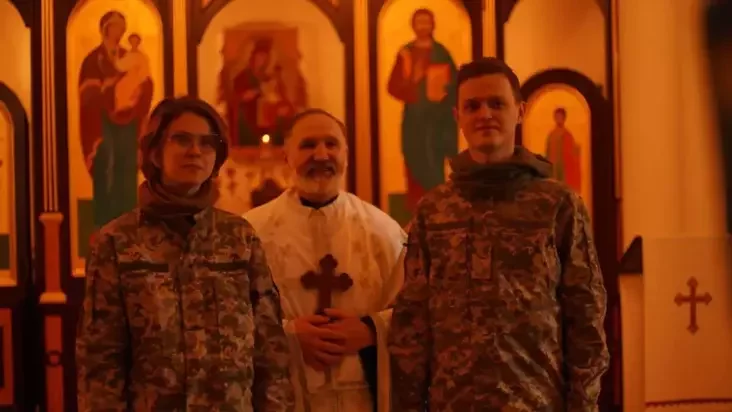
I am no longer afraid. I have lost a lot, and I am not afraid to talk about such things.
I even had thoughts of just stopping doing this. But I understand that I have been public in this story from the very beginning and can try to achieve justice.
And it's not for me. It's for other families, other volunteers.
There must be justice. There must be respect for military personnel and their families, regardless of whether they are citizens of Belarus or Russia.
It is clear that there should be certain restrictions related to security issues. But there must also be justice.
They must deal with each specific case. A person sitting in a bureaucratic office, earning a salary and dealing with bureaucracy, must also take into account that there are people like us and think about what to do with us.
— And what do your acquaintances tell you? How do they react to your situation — both Ukrainians and Belarusians? Do they still have the desire to stay in Ukraine, given such an attitude from the state?
— I always separate the bureaucratic system from society. For me, these are different things.
All my [acquaintances] Ukrainians — public figures, journalists, and just ordinary people — are all in shock. They are ashamed.
They say: "Forgive our state."
Most of the people I talk to are ordinary people. And for them, everything is clear. For the state, for some reason, it's a big question.
As for whether I will stay in Ukraine — I have a grave here. I won't go anywhere.
Sometimes I joke darkly: I wanted to put down roots somewhere — and here I have.
— This year, there was a meeting between Zelenskyy and Tsikhanouskaya in Kyiv. Have representatives of the Office or other Belarusian democratic forces already contacted you regarding the resolution of this problem? And how do you see it: can Belarusian democratic forces help you with this?
— I have not cooperated with them, and they have not contacted me.
But, in fact, let's be honest — the problems of Belarusians in Ukraine that existed, we solved ourselves. And those that exist now, too.
Everyone knows everything perfectly.
I understand that individual situations can help solve the problem globally for everyone. But some actions are needed.
How many years has this situation been dragging on? It turns out, four years. And if they want to deal with these problems, let them deal with them.
But everyone needs help. So that it's not a story about us helping a person because they are a public figure, and forgetting about others.
This should be systemic work. So far, there is no systemic work here. There are only discussions about problems.
— Let me also ask you about your petition for awarding the title of Hero of Ukraine to foreign fighters, under which you collected 25,000 signatures. Has it started to be considered?
— Currently, the situation is that the petition is under consideration. So far, there has been no movement on it on the website.
Currently, on the website, we see that petitions submitted two years ago are being considered and responded to. The situation with our petition, of course, is somewhat different from most petitions.
But I think we need to start solving this. Because waiting two years is again a loss of history, a loss of memory of heroes.
I know that our petition and our initiative are known at very high levels. We not only collected signatures but also did other work. But will there be any movement? Will we have to try to push this issue ourselves again? Only time will tell.
We are trying. I am striving to carry Lyosha's spirit. Despite all the injustice and negativity, to hold onto optimism, faith in truth, and faith in justice in my soul.
Lyosha was always like that. And for me, this is also about the memory of Lyosha — to carry this justice and achieve it.
— What is your current physical condition? What do you do every day? What does your daily life look like? And do you have any problems besides this situation with payments?
— No, there are no such problems. I have bank accounts. I weave [jewelry] to order and do all this officially. In most instances where I apply, I have no problems.
I just try to work more. But it's all very difficult.
For a while after Lyosha passed away, it was very difficult for us to simply pull ourselves together and do ordinary household things.
I forgot to feed the cats. <…> My loved ones helped me a lot. Relatives — people whom I already consider family here. They were by my side, stood watch, looked after me, helped with household matters.
After that, I had heart problems. I learned to walk again, you could say, because my heart simply couldn't withstand the stress. I would walk a hundred meters and start experiencing tachycardia, my blood pressure would rise. I had to take a pill, rest, and then start walking again.
In all this — loss, pain, suffering.
When we talk about loss, we often talk about emotional, meaningful things. But what does the body, the organism, experience? It also dies in a certain sense. And I had to learn to do many things anew after all this.
I am very grateful to the people who were by my side during this time. I will never forget it.
This was the scariest thing I have experienced in my life.
— What do you plan to do about the refusal? How, in your opinion, can this problem be solved?
— This problem can be solved. Moreover, this problem must be solved.
Lawyers are currently working on it. We ourselves are also trying to approach it comprehensively.
If we have access to people who have certain political weight, we use it. We highlight the problem.
Some people in the Verkhovna Rada already know about it and want to take it under their control, under their patronage. Journalists are getting involved, Ukrainian human rights activists want to help.
This is all because this law was adopted. And here, comprehensive work is needed to change it, to make it humane, to make it just.
I understand that restrictions are needed on security issues and so on. But still, one cannot forget about humanity and justice.
Because if we are fighting for justice against evil, then there must also be justice towards those who are doing it, by whose hands this justice is achieved.
-
"It's important for Europe to remain consistent." Tsikhanouskaya and Borrell discussed Belarusian resistance at an international forum in Spain
-
Czech citizen came to Belarus to visit his sick mother, and he was arrested
-
Former teacher disgracefully expelled from a concert in Minsk Gymnasium No. 4. It was dedicated to Teacher's Day


Comments
Нават не ўяюляю, што гэтыя сваякі адчуваюць, калі чытаюць пра Міндзіча, кааператыў дынасція і полк Скеля
Кіраўніцтва Украіны да свайго насельніцтва не на шмат лепей ставіцца, чым да беларусаў
што пра гэтую сітуацыю кажуць іншыя прадстаўнікі беларусаў ва Ўкраіне? Францкевіч быццам вырашае ўсе праблемы
гена там быццам прасоўвае усе паляпшэнні для ваяроў
Ганчарэнка нават заканапраекты ініцыюе
ПС. Сілаў Вераніке! І спачуванні.