


From "Three Turtles" before OMON to Guitar Lessons. Pit Pavlov Teaches Belarusians to Play
The charismatic NRM guitarist in emigration did not dissolve into nostalgia for the old Belarusian rock scene: he created the "HrajEm" school, shows how to play Belarusian songs, collects Belarusian musical terminology, and convinces that music is not a gift for the chosen few.
"All people must play and sing. At least, Belarusians," says Pavlov. "Shtodzen" spoke with the musician about why Belarusians need their own songs, their own guitarists, and their own musical language.
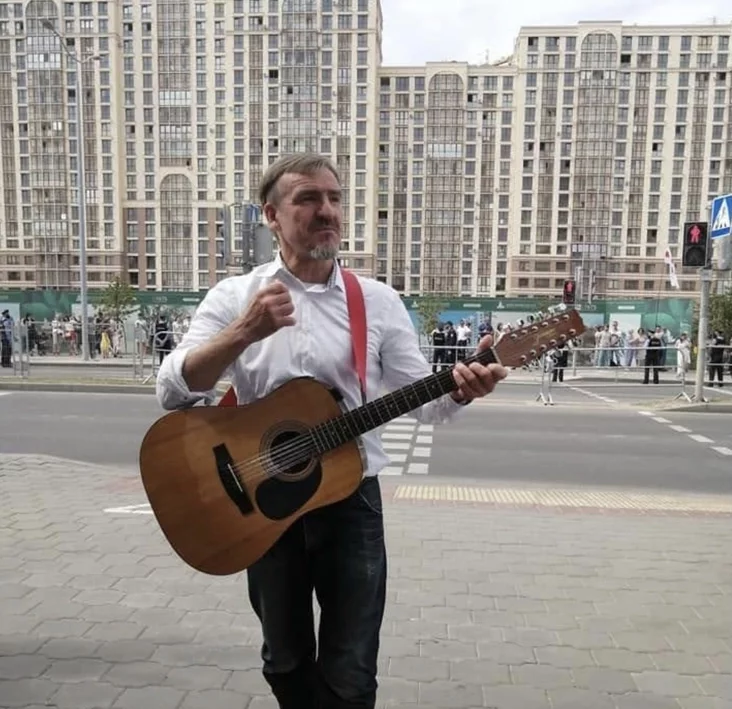
— Tell us, please, about the project "How to play this song"? When did the idea appear?
— It all started in 2020, when people began to be arrested for music. I started creating such an initiative "How to play this song". I made several video instructions and uploaded them online. First, I made an instruction for "Three Turtles", then for "Walls", then for "Changes" in Russian, because these were, I believe, the main protest songs.
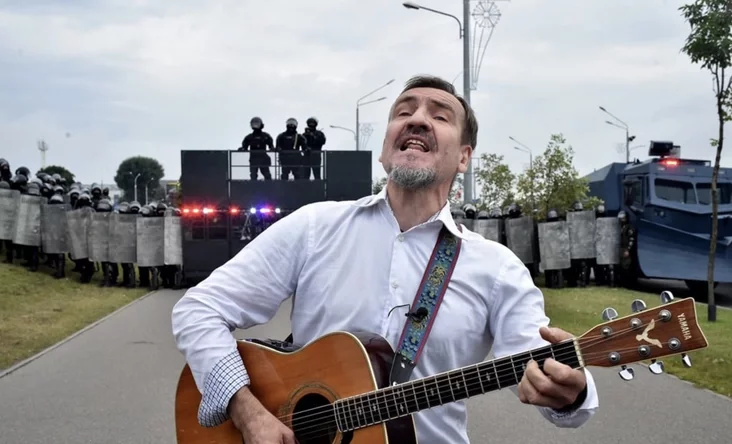
Then, on the wave of protests, I started shooting many videos. I managed to do some things, some not. I tried to invite our most famous Belarusian musicians to show how to play their well-known songs in a simplified version, so that everyone could pick it up. At that time, it caused an incredible resonance, incredible support; people asked questions, watched, and contacted me.
"After Two-Three Lessons, a Person Could Play Two-Three Songs"
— And when did you get students? And how is the learning process structured?
— I've had students all my life. People just contacted me, came to me. They fall into three categories. The first category – children: "Teach a child to play from scratch." The second category: "Show me how to play this song, specifically this N.R.M. song, this solo, how you play some virtuoso complicated piece." And the third category – these are masterclasses. That is, there are people who already play well, know a lot, but I see that some narrow areas can be expanded, that a person can easily be brought to another level in a few lessons.
I developed my own methodology, not copied from anywhere. I start with children so that after two or three lessons, a person can play two or three songs, have a repertoire, and a desire to continue playing even without me. We start directly from singing and playing songs.
"HrajEm" School: Warsaw, Online, and Patreon
I now live in Warsaw, giving offline lessons: people simply sign up and come to me. It's not very cheap for our people, who are in a "transitional" position, perhaps not cheap. But it's not expensive by Warsaw standards.
There are also online lessons. I have a fairly well-organized sound, good audibility, a very good camera. That means, on the other end, I can explain and show everything perfectly; everything is audible, everything is visible.
And there's a third form, which I'm currently actively filling. I have a Patreon. I upload methodological materials there in the form of electronic tablatures, PDFs. This is what I once used to learn myself, to learn songs, my own author's descriptions, which sometimes even look like literature.
My school is called "HrajEm". Now everyone tries to use this word, but I've been using the word "HrajEm" for, probably, 15 years, since I named it. In Belarusian, it's "Граем" (Hraem), and in Latin script, it's written with an H: "H" capitalized, "raj" lowercase, and then "Em", "E" as in a chord, "Em" – E minor. So, it becomes "HrajEm" in Latin script.
"It is Very Important to Play That Cherished Thing"
When I work with a student individually, I tailor it each time for them. I don't just say, "Do this, this, this, I'll check." No, each time we choose something specific that, firstly, suits this person and this student, and secondly, something they really like themselves. It is very important that there is motivation to play precisely that, that cherished thing, what sits inside as a desire, and not what the teacher deems appropriate.
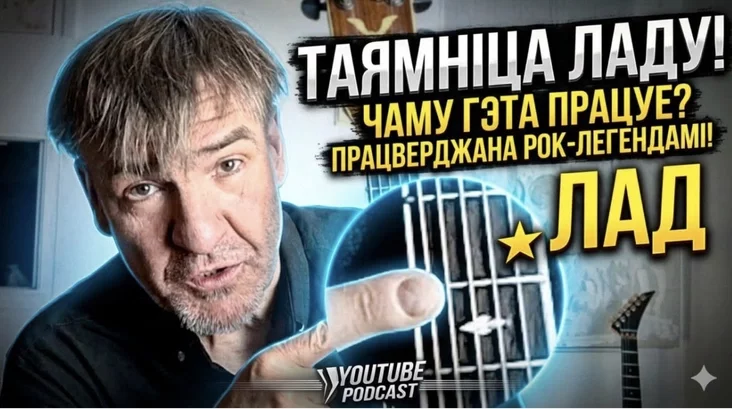
Collection of Belarusian Musical Terms
And another project that I've started now, I started it myself, but I want it to be an open project. I'm compiling a collection of Belarusian musical terms, because over the years, we've developed a certain amount of musical terminology that is different from Russian, as we have our own names for everything.
For example: verse, chorus, additional vocal, drums — these are drums, cymbals. For everything, there are our own words or common words with Europe.
"The Entire Former USSR Combined Did Not Produce as Many Guitarists as Belarus Alone"
It's important that the Belarusian guitar school is at an incredibly high level in the former Soviet Union. That is, the entire former USSR combined did not produce as many top-level guitarists as Belarus alone.
Perhaps the most famous Belarusian guitarists are, maybe, Uladzimir Tkachenka from "Pesniary" and Pit Pavlov. That's my impression. Maybe also Siarhei Trukhanovich from "Krama". But other names are very significant to me, yet no one knows them. Lionia Viarenich, Arkadz Yushyn, Siarhei Antsishyn — these are guitar geniuses. No one knows these people, and I would like to give them a voice.
These are people who, one could say, created the Soviet guitar school, influenced it greatly, because they started practically from scratch.
The numerical advantage of Russian culture can be combated in one way: by trying to attract the attention of our own people, because the quality of the materials is sometimes very high.
"People Don't Believe It Can Be So Simple"
— And how do people generally react to these initiatives, is there interest?
— There's not just interest. There's no stopping it! The only thing is, there's this complex: "Oh, that's Pit Pavlov, he's probably out of our reach, he's unattainable because he's such a star." This is what people don't believe, and it gets in the way.
And there's another layer: people don't believe it can be so simple, because this Soviet musical education put all its effort into convincing the average person that it's not given to everyone, that it's given to some celestial beings. That playing, singing, writing music is not for everyone.
"20-30 Belarusian Songs Must Be Learned to Play and Sing for It to Be a Code"
"No, you need to have talent..." I also believe in talent, but I call a completely different level "talent". But the basic level, the first level, the entry — you don't need talent for that. It's like learning to drive a car.
Music and drawing lessons existed, but they were formal. The most insignificant subjects were drawing and music, but I believe that this is fundamental. 20-30 Belarusian songs must be learned to play and sing for it to be a code.
I believe that all people must sing. And that this should be made a part of basic school education, any education, artistic education. At the most basic level, coverage should be 100%.
All people must play and sing, everyone, as many as there are. At least, Belarusians.


In New York, the Twin Towers were recreated in natural size using 2977 drones — corresponding to the number of victims of the September 11 terrorist attack


Comments