


A sterile environment really causes allergies in children. Now scientists have found out what protects children from allergies
Scientists have long suspected that a sterile environment disorients the immune system, and children growing up in the countryside suffer less from allergies. Now, German researchers have identified specific types of bacteria that may explain this effect.
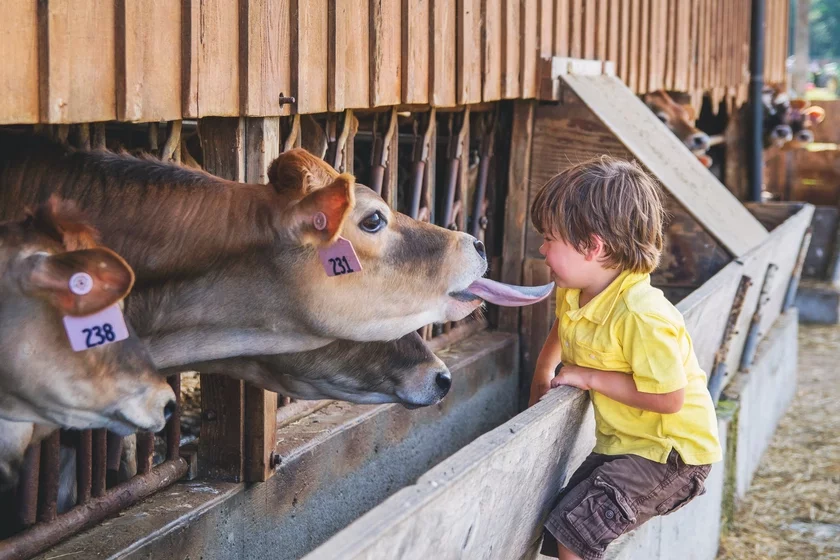
Allergies, asthma, and atopic dermatitis are becoming increasingly common in children in industrially developed countries. One hypothesis explains this by arguing that an excessively sterile environment in early childhood prevents the immune system from having sufficient contact with microorganisms. As a result, it may overreact to harmless substances — for example, plant pollen or animal hair.
It has long been observed that children growing up in rural areas and having daily contact with farm animals have a lower risk of such diseases. This phenomenon is called the "farm effect." But until now, it remained unclear which specific microorganisms might be responsible for it.
Researchers from the Ludwig Maximilian University of Munich and the Helmholtz Center for Asthma and Allergy Prevention tried to find this out. National Geographic draws attention to the results of their research.
Scientists investigated the microbiome of the environment in which the children lived. They analyzed dust from the mattresses of over a thousand schoolchildren from rural areas in Germany and Japan, as well as air samples from several dozen cow sheds.
As a result, they were able to isolate nine types of Gram-positive bacteria whose presence was associated with a protective effect. According to the researchers, cows may be the source of these microorganisms. The bacteria live in their digestive system, get into manure, and from there — into the air of the cow shed. Children can inhale microscopic particles, as well as bring them home on their clothes.
In the air of cow sheds, the identified nine types constituted about a quarter of all detected microorganisms. In dust from children's mattresses, their proportion was significantly smaller — about 6%.
How this affects immunity
Researchers tried to determine not only the link between bacteria and a lower incidence of allergic diseases but also their possible mechanism of action.
It turned out that substances produced by these bacteria can act on the AhR receptor — a special protein in cells that reacts to certain chemical substances and helps regulate the immune system's function.
With moderate exposure to bacterial metabolites, mechanisms capable of suppressing inflammatory reactions are activated. This can help the immune system not overreact to common substances from the environment.
However, the researchers emphasize moderate exposure. The findings of the work do not mean that the more a person interacts with bacteria, the better. Excessive activation of the same AhR receptor can have adverse consequences.
Will "farm bacteria" appear in city apartments?
According to the researchers' calculations, the identified bacteria can explain a significant part of the protective effect of the farm environment — approximately two-thirds in the case of asthma and about half in the case of pollen allergy and atopic dermatitis.
But this does not mean that, for allergy prevention, children should be taken to cow sheds or that hygiene should be abandoned. Rather, the work opens up the possibility for developing new methods of prevention. In the future, research could lead, for example, to the creation of products that safely enrich the home microbiome, or inhalers based on substances produced by the necessary bacteria.
But before such products can appear, scientists need to conduct a series of further experiments and thoroughly study each stage of interaction between these bacteria and the human body.


Comments
В сша - это общеизвестный факт. Есть даже статистика по штатам. И даже статистика по симбионтным бактериям.
И корреляция между здоровьем и сельхозштатами давно известна.
Но напоминать любителям влажных салфеток и страшных бактерий надо, хоть и бесполезно.
Пры гэтым, яшчэ і польскі арыгінал недакладна перадае вынікі дасьледаваньня (яно толькі пра дзіцячую астму, а не пра алергіі ўвогуле), бо праўдападобна таксама зроблены штучняком з выкарыстаньнем няякаснага запыту.
Потым будзеце ўсім журналісцкім прафсаюзам абмяркоўваць, чаму прэстыж прафэсіі ўпаў