


Far-right in Germany achieve a major victory for the first time since the fall of the Third Reich. What this means for Europe
The victory of the "Alternative for Germany" in the elections in Saxony-Anhalt was historic. For the first time since the fall of the Third Reich in 1945, a far-right nationalist party has achieved such significant electoral success in Germany. The result could have consequences far beyond one federal state, writes the BBC.
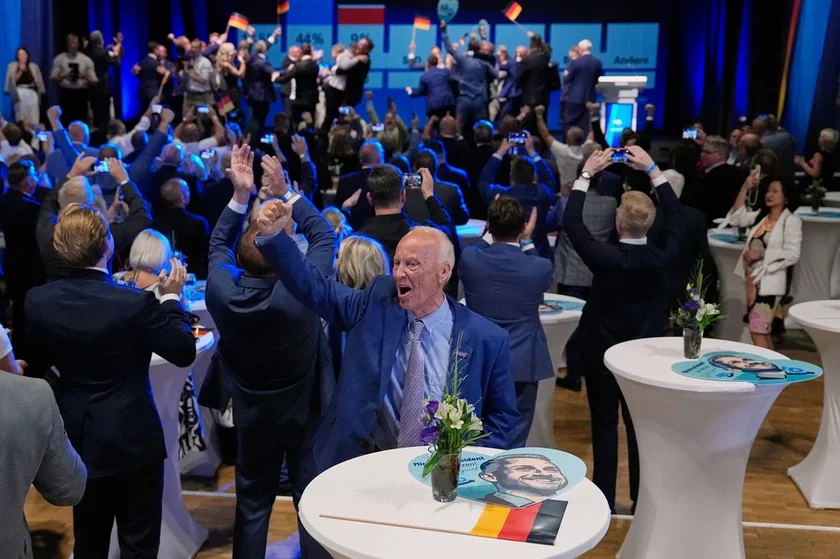
"A seismic event," "a socio-political earthquake," "a turning point for Germany." This is how political analysts and many media outlets characterized the victory of the anti-immigration party "Alternative for Germany" (AfD) in the local elections in Germany on Sunday.
Is this an exaggeration?
Saxony-Anhalt is one of the smallest of Germany's 16 federal states. It accounts for only 1.7 million of the 59 million voters nationwide.
How significant can political sentiments in this region be, especially given that the AfD narrowly missed an absolute majority?
The answer: very significant.
First and foremost, within Germany itself.
Although the vote was regional in nature, its consequences are felt at a national level. The AfD's convincing lead intensifies pressure on the already difficult position of the centrist coalition government in Berlin. This could be the final nail in the political coffin of Germany's highly unpopular conservative Chancellor Friedrich Merz, who had promised to curb the AfD's popularity.
These political problems will further weaken and distract Germany — the most influential player in the EU — during a period of continental crisis, as Europe struggles to contain Russian aggression, Donald Trump's tariff whims, and the economic threat from China.
The Saxony-Anhalt election results also force a reassessment of the situation across Germany, where the Nazi past is still perceived very acutely. This is the first significant electoral victory for a far-right nationalist party since the fall of the Third Reich in 1945.
German authorities have partially recognized the AfD as anti-democratic, and a number of the party's regional branches, including in Saxony-Anhalt, as far-right and extremist.
As is known, the AfD is particularly popular in eastern Germany, but now, according to polls, it is becoming the largest political party nationwide.
It seems Germany's political mainstream has failed voters. What should Europe's largest economy and the continent's most populous country (excluding Russia) do now?
Small Saxony-Anhalt resonates beyond Germany.
The US President himself published the Saxony-Anhalt exit poll results on his Truth Social platform on Sunday.
The AfD's anti-immigration slogan "Germany for Germans" largely echoes Donald Trump's slogan — MAGA, "Make America Great Again." Along with other nationalist parties in Europe, the AfD largely borrows Trump's strategy — undermining the authority of mainstream media, questioning the impartiality of judges, and promising to "make Germany great again."
However, it is worth noting that the name of the US President is rarely mentioned during election campaigns in Europe. Politicians are well aware of his unpopularity among voters.
On Sunday evening, following Trump, Kirill Dmitriev, CEO of the Russian Direct Investment Fund, posted on social media. He called the AfD's result "historic," stating that the German federal government was "discredited," and Chancellor Friedrich Merz was "humiliated" and "turned into Starmer."
You might ask: what interest could regional elections in Germany hold for Russia, and what did Dmitriev mean by making that caustic remark about the former UK Prime Minister?
The German government is the largest donor to Ukraine, and the UK, as is known, supplied Kyiv with missiles used to strike Russian territory. This caused deep outrage in Moscow.
The AfD, on the contrary, holds a rather pro-Russian stance. It advocates for an end to military aid to Ukraine, the lifting of sanctions against Moscow, and the resumption of purchases of Russian energy resources. German industry suffered huge losses after the country stopped importing cheap Russian energy resources following the full-scale invasion of Ukraine in 2022.
The AfD's lenient attitude towards Russia has another attractive side for residents of eastern Germany, which remains significantly poorer than the western part of the country. This is despite Germany having spent between 2.3 and 3 trillion euros (depending on sources and inflation accounting) on integrating the former communist part of the country after the fall of the Berlin Wall in 1989.
Saxony-Anhalt is Germany's poorest region, and there, as in many other parts of the former GDR, voters often experience so-called "Ostalgie" — "nostalgia for the East" and for more stable times under the communist regime.
The European Union also closely watched the elections in Saxony-Anhalt. The next 12 months will be a busy election season across the EU. Elections are expected in key countries — France, Italy, Spain, and Poland.
In Brussels, there are fears that more "extremist" parties — both left-wing, but especially right-wing — could strengthen their positions everywhere.
The leader of the Spanish nationalist party Vox, Santiago Abascal, wrote on X on Sunday that the AfD's victory in Saxony-Anhalt was "a great hope for Germany and for Europe."
In turn, France's Minister Delegate for European Affairs, Benjamin Haddad, considered an ally of centrist President Emmanuel Macron, warned: "The victory of the far-right in regional elections in Germany is a serious challenge for Europe."
Neither the AfD nor other European parties described as "far-right" or "ultra-right" accept this definition. They also differ from each other in tone and party program. The French "National Rally" party, led by Marine Le Pen, expelled the AfD from its faction in the European Parliament two years ago for being excessively "radical." However, these parties typically share an anti-immigration platform and pronounced nationalist rhetoric. And this causes concern in the EU.
Slogans like "Germany First," "Italy First," or "France for the French!" worry Brussels. They believe that the rising popularity of nationalist parties undermines European cohesion when it is needed more than ever.
Nationalist parties, such as the "Alternative for Germany" or Italy's "Lega," tend to be deeply Eurosceptic, although Brussels states that Europe needs to unite to counter, for example, pressure from Donald Trump or effectively protect European business from dumping by China.
European defense agencies also warn that divisions on anti-Russian sanctions or a restrained approach to NATO membership (as, for example, in the case of Marine Le Pen's "National Rally" or the German AfD) play into Moscow's hands.
Heads of intelligence agencies state that countries must act together to stop Russia's war against Ukraine, otherwise the Kremlin might be tempted to strike NATO territory, such as the Baltic states.
The fact is that European voters are well aware of these external threats and their consequences for their country. They are concerned about the consequences of the wars in Ukraine and the Middle East, the deteriorating state of healthcare systems, and the decline in economic security for themselves and their families. Uncontrolled immigration and street safety also cause great concern.
And this is where the importance of the Saxony-Anhalt election results lies. It is a clear alarm signal not only for traditional political parties, but also for institutions such as the judiciary and intelligence services — those whom the AfD calls the "corrupt establishment."
Voters in Europe feel lost and betrayed by the parties they have supported for decades. The fact that they are now, on the eve of elections, looking to the right or to the left, does not mean that all of them have suddenly become extremists.
The AfD's election slogan in Saxony-Anhalt sounded optimistic: "Everything is possible!" Plus a promise to restore Germans' sense of pride in their country.
Despite the fact that this party has not yet proven itself in practice in government, people seem increasingly willing to give it a chance.


«If you work at home, you have nothing to live for, and if you work in a truck, you have no time to live». Belarusian long-haul drivers spoke about their lifestyle

«If you work at home, you have nothing to live for, and if you work in a truck, you have no time to live». Belarusian long-haul drivers spoke about their lifestyle


A young Belarusian didn't want to serve time in Russia for drugs, so he figured out how to quickly get out of the colony — and ended up on Ukrainian positions near Pokrovsk


Comments